
Category: WINE
The Guys with the Ties a Visit to Ruinart and Moët & Chandon
A visit to Champagne with Yair – Day 2 morning
The breakfast at L’hôtel restaurant Les Avisés, Chez famille Selosse was so neatly laid out, the coffee and pastries were perfect, (not easy)! the breads divine, accompanied with local cheeses and cured meats and a fried egg made to perfection what else would you ask for first thing in the morning after a perfectly good night sleep.
We parted with Thanks fairly early cause we have a full day schedule Starting at Ruinart – the most ancient champagne house 1729, a meeting with Ruinart Chef de Cave, Frederic Panaiotis
But first….
A visit to Rheims Cathedral,
We drove up north from Avize to Reims pass Epernay (we will return there soon enough, it is a very busy day…) we enter Avenue de Chamapgne and the Names of the BIG Houses of Champagne at the entrances to each of the Polished “suit wearing” champagne house appear on every corner , Here’s Veuve Clicquot. Than Pommery on the corner of Bd. Henry Vasnier , from there up Rue Libergier.
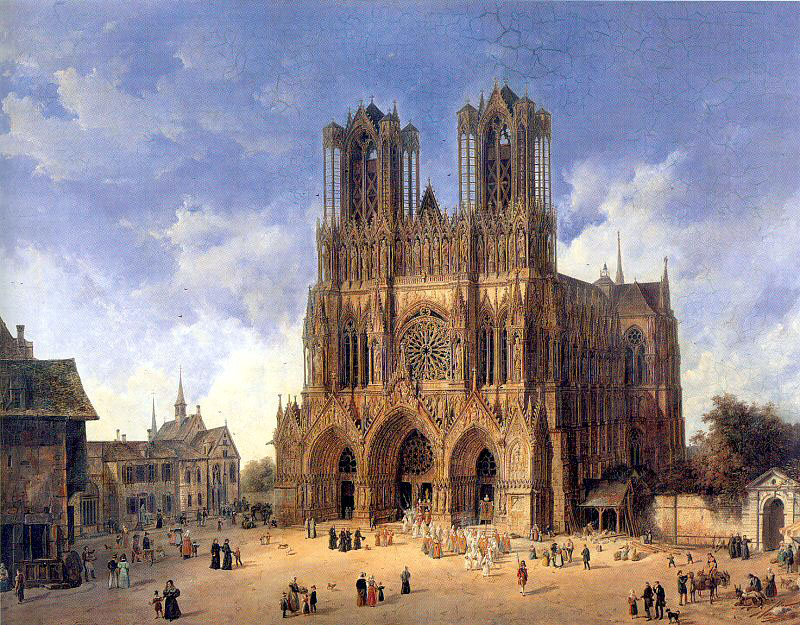

The glory size and beauty of Rheims Cathedral “hits” you in the face. This cathedral is counted amongst the top 7 Gothic Cathedrals of Europe, proudly stands with Milan and Seville Cathedral, York minster, Notre Dame de Paris, Santa Maria del Fiore in Florence and Chartres Cathedral near Paris.
All the kings of France were once crowned in Rheims Cathedral. Along with the cathedrals of Chartres and Amiens, Rheims is a member of the illustrious triad of “High Gothic” or “Classical” French cathedrals built in the 13th century.

Yair gives me 20 minute to wonder around this wonder of medieval architecture where In 498-499, Clovis the first King of the Franks who united all the Frankish Tribes in Gaul was baptized by Saint Remi. However, the first king to be crowned was Pepin the Short at Soissons in 751, then again at Saint Denis in 754 by Pope Stephen II. From then on, all the Kings of France were crowned in Rheims by their archbishops.

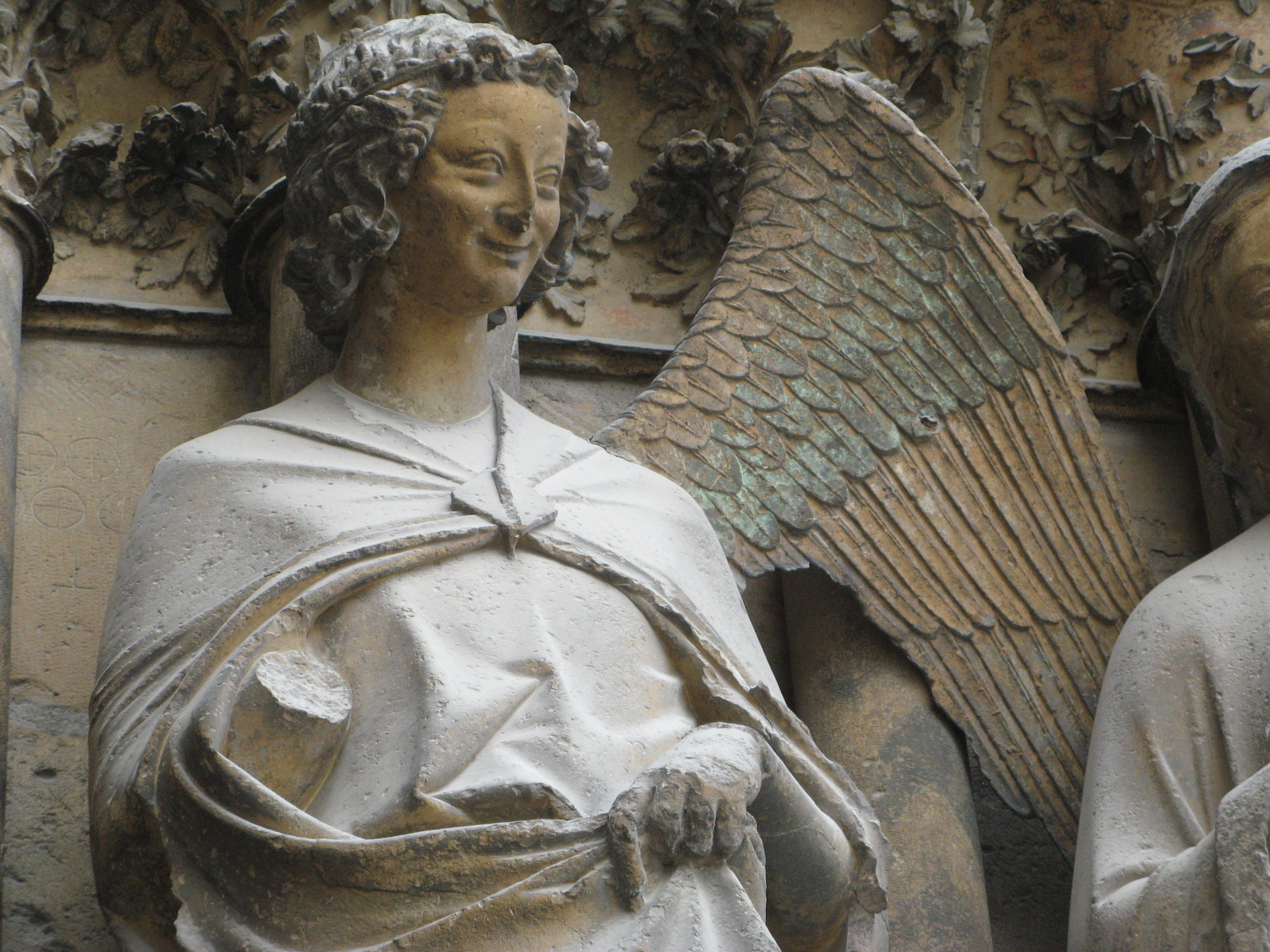
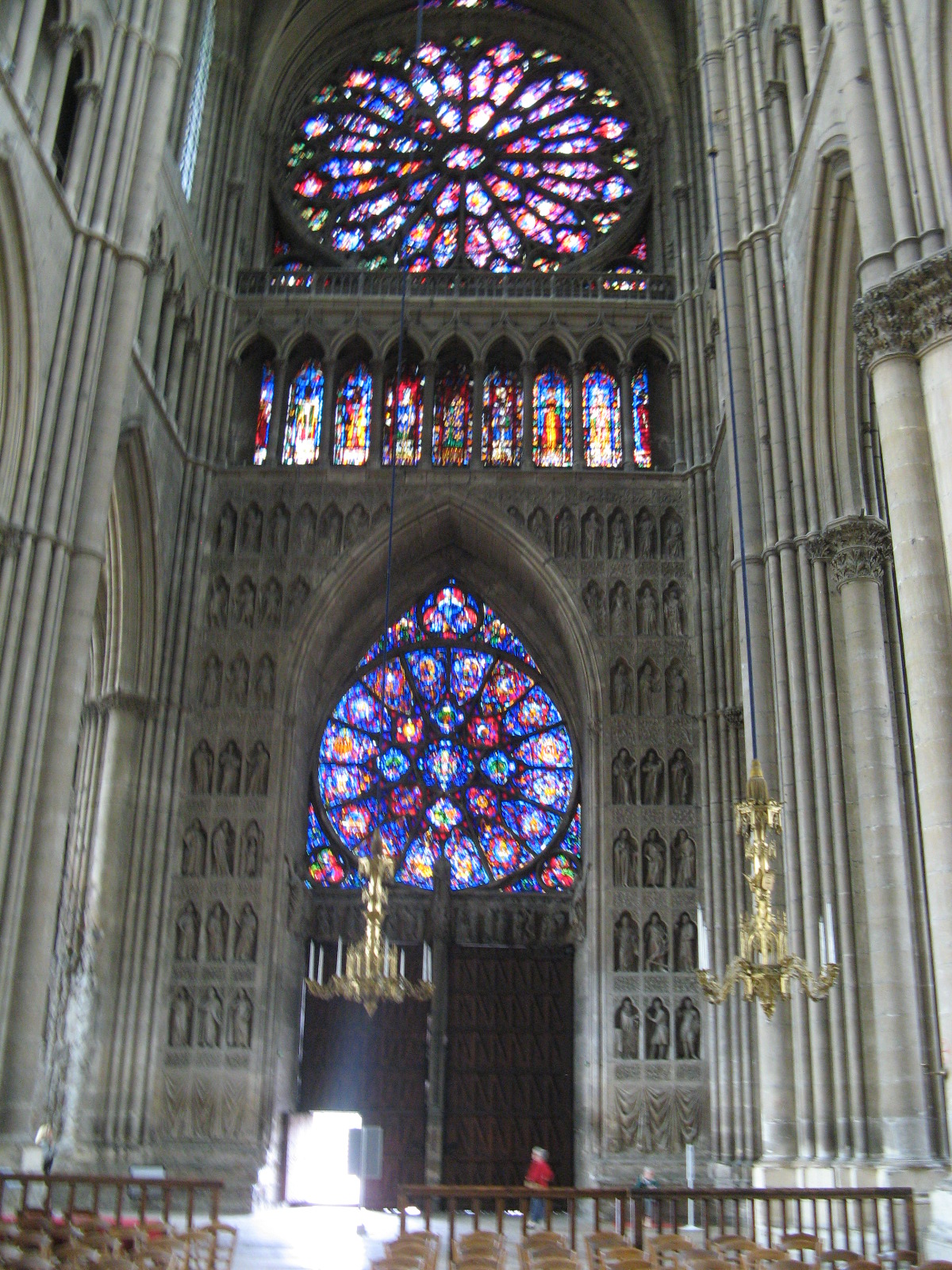
But the symbol of the Cathedral and indeed the City of Rheims is without a doubt a statue of a smiling Angel at the North façade of the North Portal (the main entrance). It has a story that goes like this: At the outbreak of the First World War, the 13th-century Rheims Cathedral was seriously damaged by German shelling. The serene heavenly smiling statue of Angel on the north portal was decapitated by a burning scaffolding beam, during the fire of September 19, 1914. In the newspapers, this statue became the “Smile of Rheims” or “Smiling Angel”, a symbol of French engineering and heritage destroyed by German brutality and bombs. The monument quickly became an emotional picture of the tragic and destructive consequences of war. From original fragments and a casting preserved in Paris, this famous figure was reconstructed after the war with American donations and was returned to its place on February 13, 1926. The Smile of Rheims was restored and the “Smiling Angel” welcomes you as you enter the huge Cathedral. This is the kind of building the gives you a sense of humility (although the aim is impress you with grandeur…) The interior of the cathedral is 138.75 m long, 30 m wide in the nave, and 38 m high in the centre.
And so are the so called Great Houses of champagne they have separated themselves from the “agriculture, farm look” side of champagne and reside in Grand houses meticulously kept, with driveways and gardens and proper “dress code” for all employees, after all, Noblesse oblige…
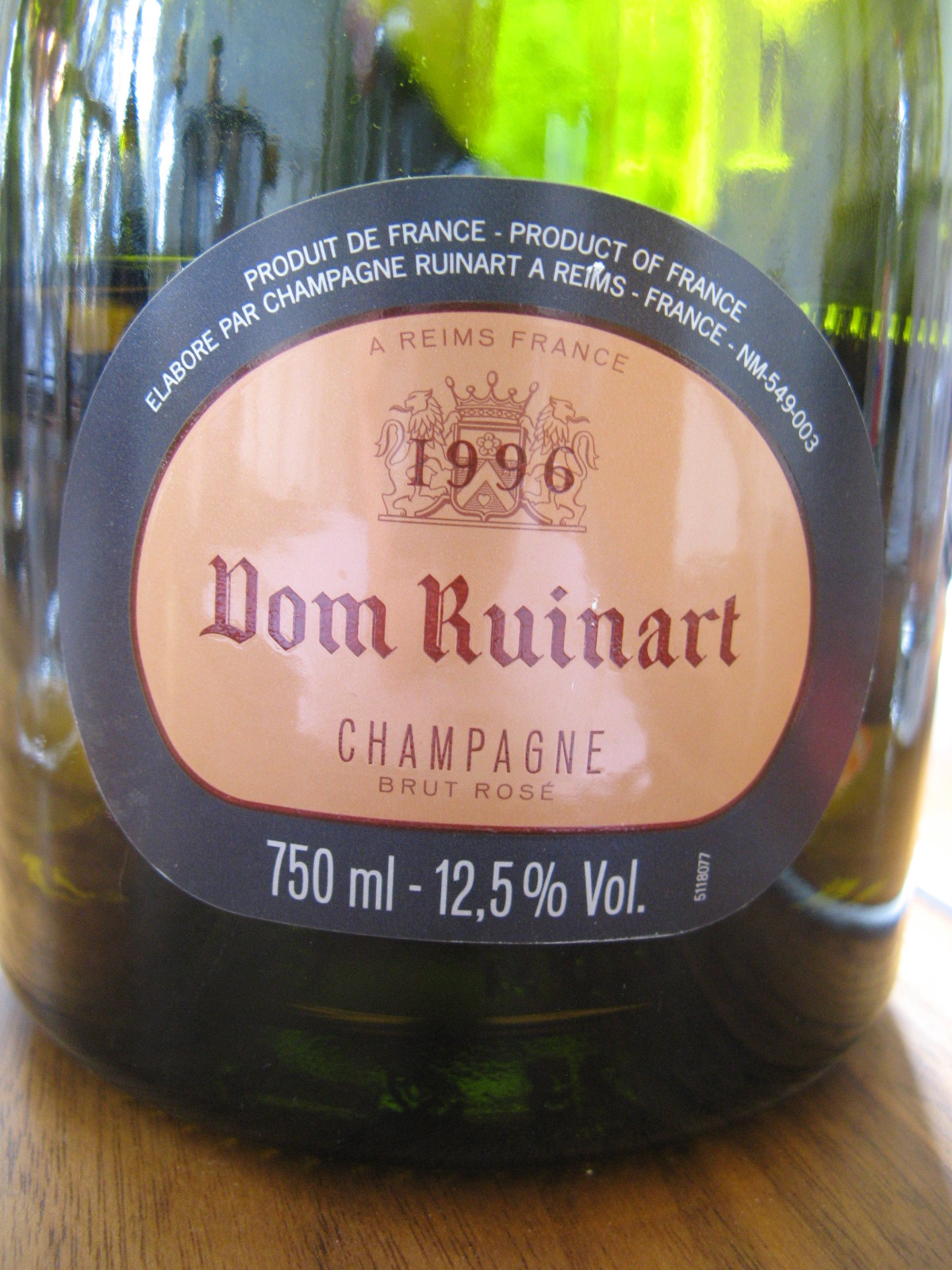
The day is set for our first meeting in Ruinart. Founded in 1729 by Nicolas Ruinart, this is the first Champagne house in existence with the present, young and charming Chef de Cave, Frederic Panaiotis. He is really a most charming person who gives you a warm welcome. In the spacious tasting room, he has prepared for us a variety of wines from the NV Brut to the Dom Ruinart Rose Brut 1996, he emphasizes the difference in champagne making philosophy between the Artisans we met the day before and that of the “great Houses” who sell millions of NV champagne bottles every year, and “have to conform to a TASTE” their customers got used to… still in the last 10 years they opted to cut vineyard yields by almost 50%, thus improving the quality of the wines tremendously and reaching the level of elegance and delicacy Panaiotis believes is in the essence of champagne in a glass!


We tasted the NV Brut, Blanc de Blancs (Ruinart Blanc de Blancs, 100% Chardonnay, and Ruinart Brut Rosé, 45% Chardonnay and 55% Pinot Noir, The Dom Ruinart Rose 1996 a very pleasant, precise wine with good touch, length and balance and the 1998 Dom Ruinart Brut with its lovely show of tiny bubbles in the glass. Dom Ruinart Brut 1998 is blended exclusively from Chardonnay grands crus, 66% from Cotes des Blancs and 34% from the northern part of Montagne de reims. I must say The 1998 Dom Ruinart is the most elegant wine of our visit, a very voluptuous wine with multilayer’s of white flowers and fruits with roasted blanched almonds and excellent freshness and balance, WONDERFUL! Merci Frederic.


Sadly we has to miss the house’s famous deep chalk cellars (called the crayeres) These were excavated around 50BC by the Romans, and are considered a French archeological monument. This is a magical place but alas we did not have time to take the cellar visit. (Some of these old “Grandes Maisons de Champagne” have kilometers upon kilometers of chalk cave/cellars at a constant 11º C, some of the tunneled caves require small trains to travel in or you spend the whole day underground (getting lost in the labyrinth of caves). But the virtual tour of the cellars on their internet site: http://www.ruinart.com is a “must visit”, check it out (there’s also a wonderful free, I pad app version).
Ruinart , 4 Rue Crayères, 51100 Reims, France. www.ruinart.com
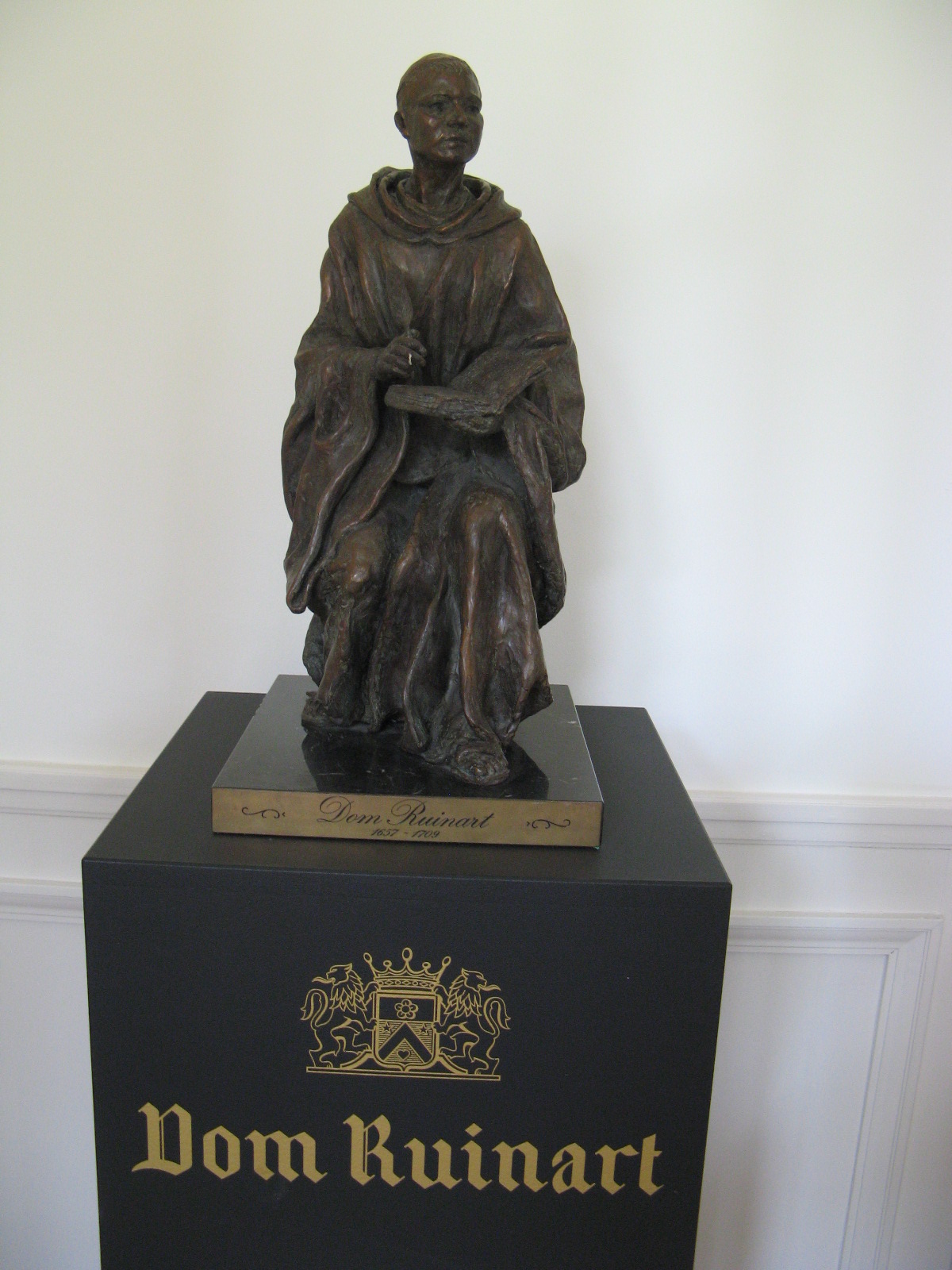
Dom Thierry Ruinart, was a learned Benedictine of the congregation of Saint-Maur, been born on June 10th, 1657 and died on September 27th, 1709, in the abbey of Hautvillers in Champagne region. Ruinart collaborated with dom Pérignon with whom he studied and perfected the secrets of champagne-making process. He and Dom Perignon were really good buddies and we are heading across the mountains to the “headquarters of Perignon” Moët & Chandon. A little-known fact is that the talented Chef de Cave of Dom Perignon, Richard Geoffroy, was one of the winemakers for the 1996 Dom Ruinart!
Now we have to cross the Parc Naturel Régional de la Montagne de Reims that separates Reims and Epernay, it is better not to let a busy person like Benoît Gouez, chef du cave at Moët & Chandon to wait for you and we already asked for a 20 minutes delay…
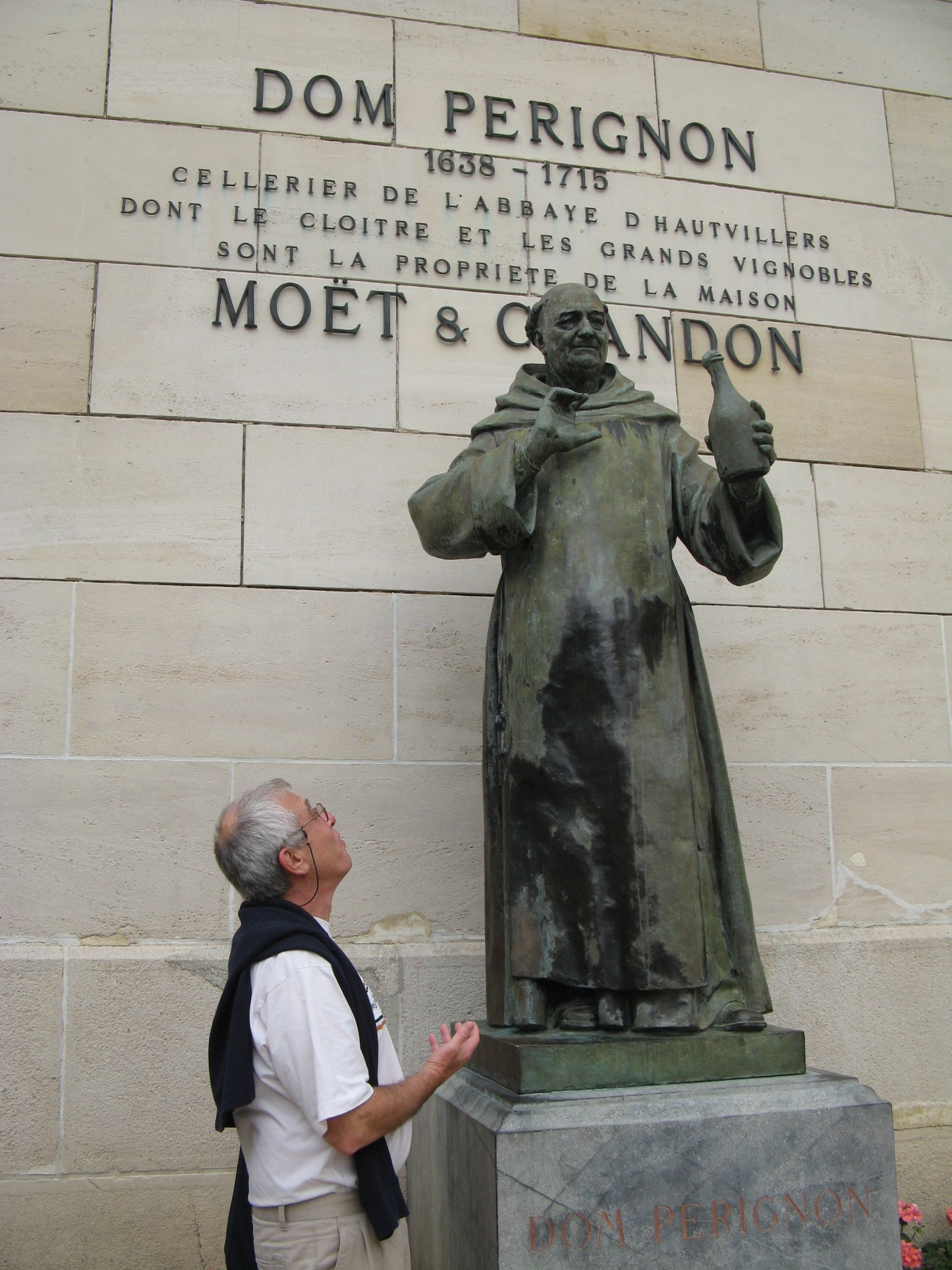
We park our car near Dom Perignon‘s statue at the entrance to Moët, as you know Dom Perignon was one of the developers of the clear, bubbly, Champagne and the initiator of using cork and cage to seal champagnes, almost in the same way we know it today… Dom Pérignon learned to select the best wine from different grape varieties grown in different soils of the area and blend them to a perfect effervescent drink.
It must be said that the Dom didn’t “invent” Champagne, since the art of the double-fermentation process to produce champagne came from the experimentation and later expertise of other cellar masters of his time as well, but his name is in the front of innovations in all aspects of developing the Champagne method to producing quality clear sparkling wine and it all began during his time in the second half of the 17th century partially due to his curiosity and relentless efforts (the mystery concerning the legend of popping bottles down Perignon cellar one morning lingers on either as a fact or maybe local urban legend?).
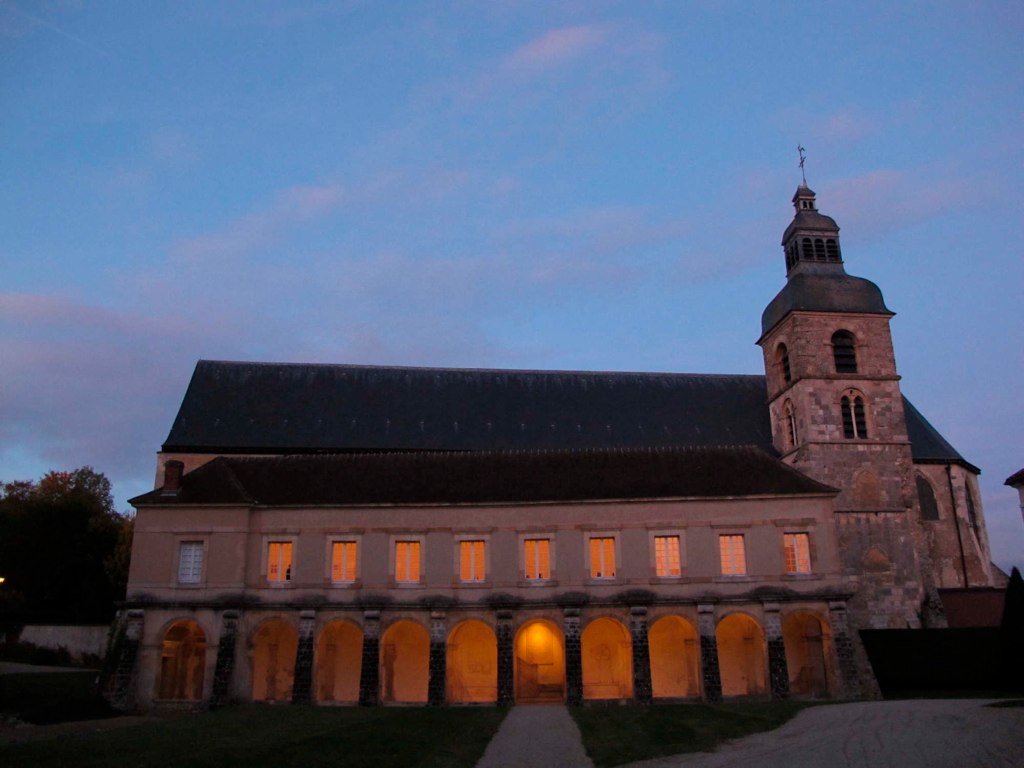
It is difficult to separate the monk Dom Pérignon from the trademark carrying his name (now belongs to Moët & Chandon) and this “line” is used for their high-end Champagne. Dom Pérignon and his close friend Dom Ruinart both ended up as namesakes of their trademark. Their abbey: Hautvillers, is located 4½ miles from Epernay, and overlooks the vineyards along the slopes of the Mountain of Reims is a testimony to their acheivments.
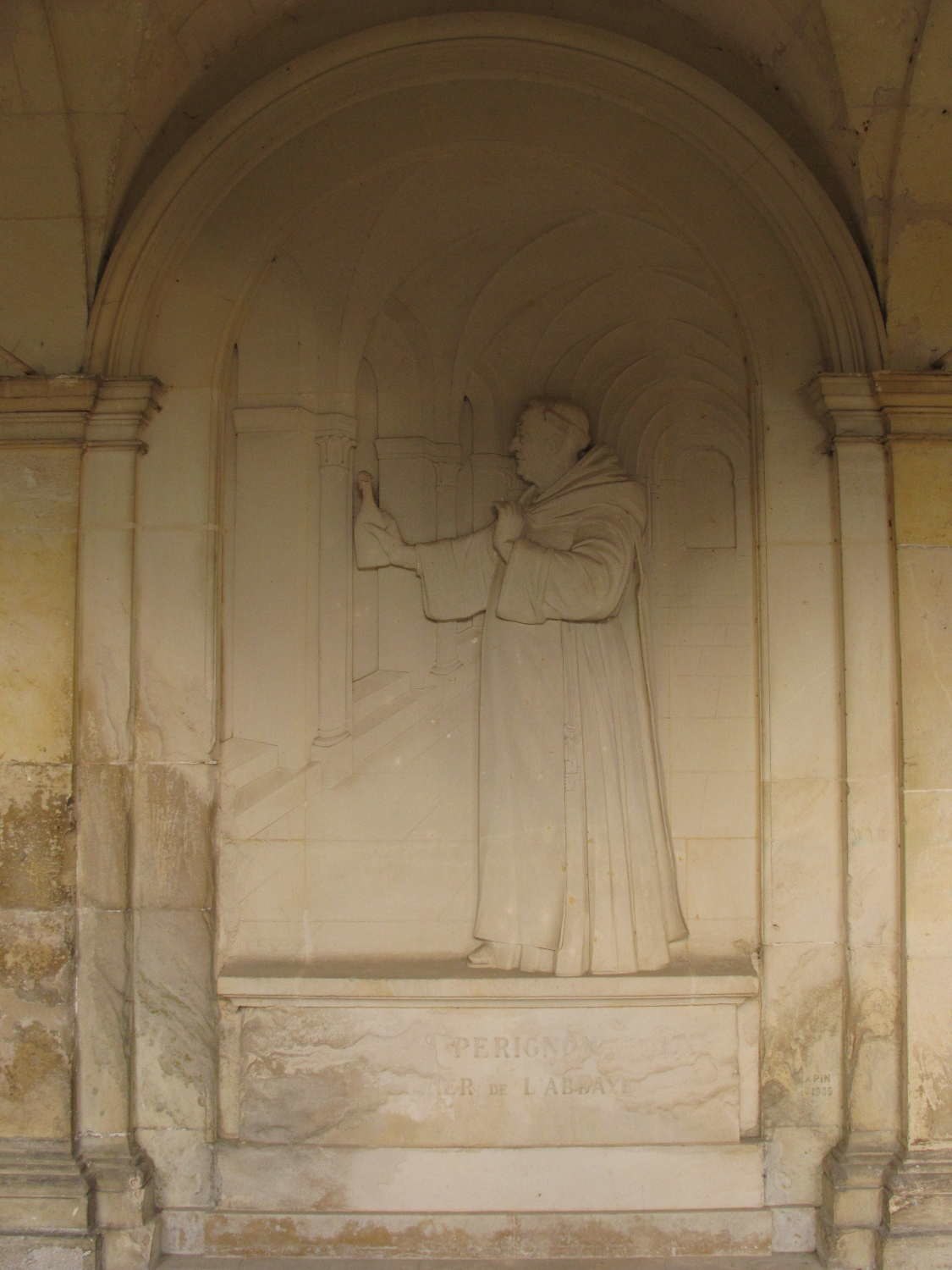
Dom Petrus (Pierre) Pérignon, (1639-1715) is burried in the abbey church of Hautvillers in Champagne France’s where he served as cellar master at the Benedictine Abbey of Hautvillers for many years.
The entrance to Moët & Chandon premises, is full of chic, style and elegance in black silver and gold colours, a chandelier made of champagne glasses hanging from the ceiling, a celeb feeling in the air (perfect for those who like this style),

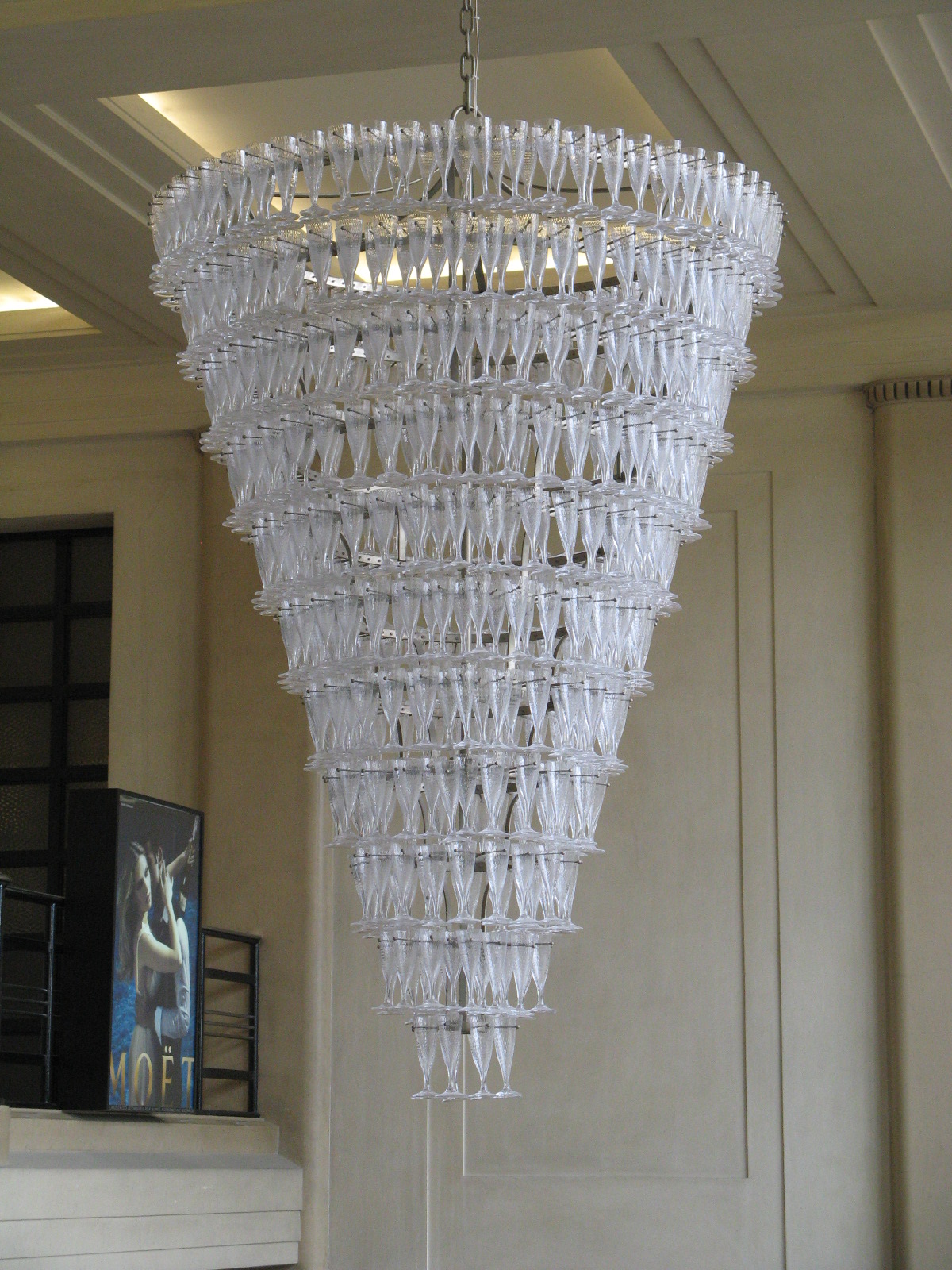
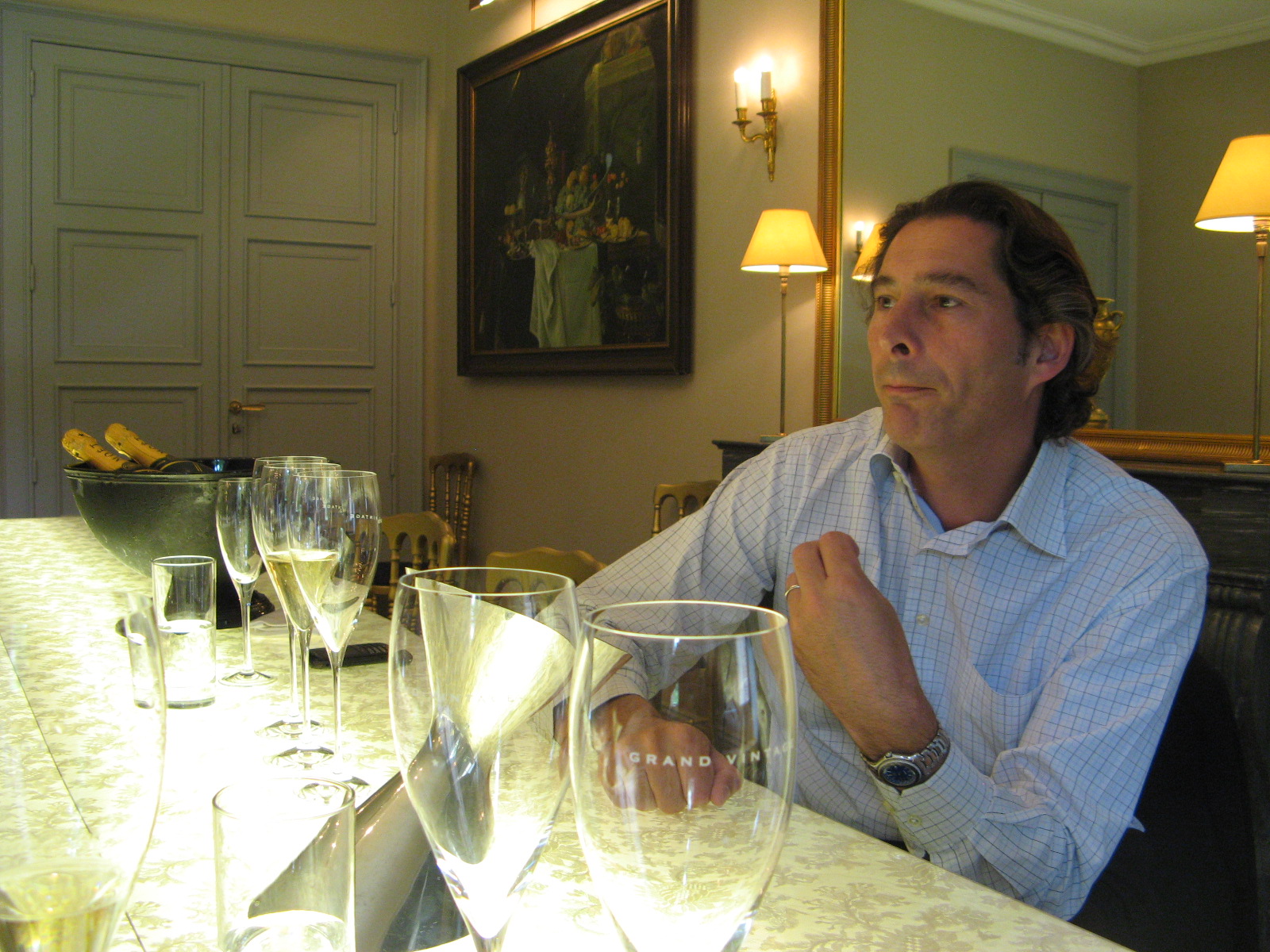
Benoît Gouez meets us in a more traditional setting of the tasting room. He conducts pleasant conversation re: Moët’s recent champagne’s aspirations and the influence of the Dom Pérignon’s label and champagnes on the Moët line. The meeting is backed by two exemplary Moet wines of the last 2 decades: The Moët & Chandon 2002 and the Moët & Chandon 1992 Grand Vintage Collection
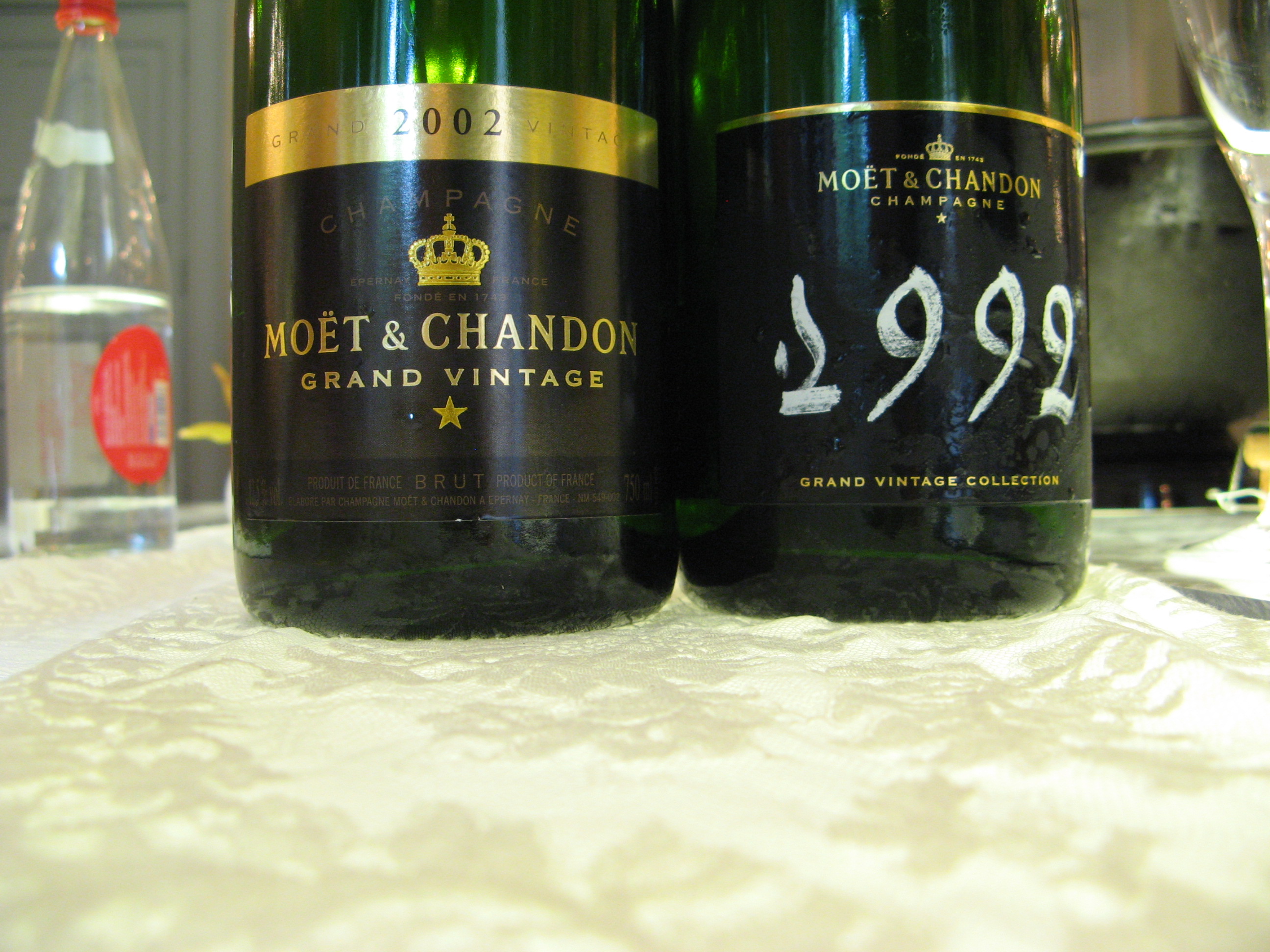
The Grand Vintage 2002 is one of the finest wine made under this label and can rival even some lesser vintages of Dom. It has fruit and elegance. Made from 45% Pinot noir, 15% Pinot meunie and 40% chardonnay. The aroma of apple blossom, pears and white wild flowers is apparent, with very long finish of rich and buttery brioche touch. Excellent champagne!
The Moët & Chandon 1992 Grand Vintage Collection Brut is a real keeper on it’s 19 years of age still a very fresh wine, with flinty, mineral, extremely dry texture. The acidity is fully present with a kick, still very refreshing, and crisp.
A different style from the wines we had yesterday and the from your usual NV Moët & Chandon People use to sprinkle on one another from the winner’s podium (This habit is beyond my understanding, still I guess mother earth needs a drink from time to time…)
I paid tribute to the Dom’s statue on our way out, Thank you Benoît for your hospitality and patience, we’re off to Ay to visit 2 smaller Houses in the afternoon
Moët & Chandon , 18 Avenue de Champagne 51200 Épernay, France
Our afternoon adventures and visits in the next post…
Your Wineguide
Utopia, Pienza,some cheese and The wines of ISOLE E OLENA


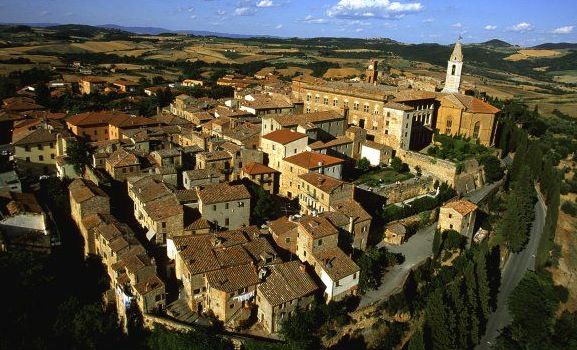
The town of Pienza was originally know as Corsignano, a small and humble Toscan village. But its most famous son, Enea Silvio de’Piccolomini, a well known poet, philosopher and politician and a ‘Renaissance humanist’, was elected Pope in 1458. A year later, as Pius II he hired architect Bernardo Rossellino to redesign the entire village of Corsignano along the ideas of ‘Renaissance humanism’ which are basically Utopian. No one is quite sure why Pius II, (born in Corsignano in 1405), decided to create a model city from his humble birthplace, but he did, and he hired the architect Rossellino to do the job. Another mystery that surrounds the birth of Pienza is the motivation of the architect: did Rossellino set out to build an original model city, a monument to Pius, or a faithful recreation of his patron’s dreams? No one is quite sure. What we do know is that the town was built as a model example of classic Renaissance architecture. It took only 4 years, from 1459 to 1462, to achieve this transformation and the town was built to a precise design encompassing the ideals of the Renaissance, a sort of perfect city…and the town is really magnificent. Set in a gorgeous archetypal Tuscan landscape, Pienza, christened so by Pius after his Papal name, draws visitors with Rosellino’s monuments to Pius II that form the core of this model city: its central piazza Piazza Pio II, , the Duomo, and the Papal Palace. All the major sights in Pienza sit here, on Rosellino’s famous piazza. The piazza itself is elegantly proportional, and appears simple in design. It is set much more as a place where citizens could carry out their daily lives, rather than an impressive and perhaps grandiose statement.
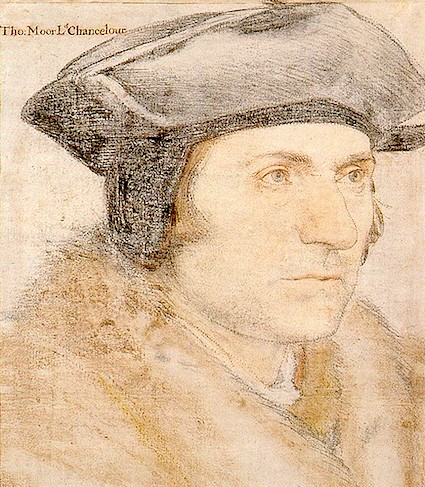 Half a century later the utopian concept of an Ideal City originated a book: Utopia. by Sir Thomas More (1516) where it is depicted as an imaginary island (the black and white picture top center), enjoying perfection in order of construction of the basic layout of the “city” and all other social elements: law, politics, and social justice. It describes an ideal place or state in all aspects.
The reference to agriculture states: “They cultivate their gardens with great care, so that they have both vines, fruits, herbs, and flowers in them; and all is so well ordered and so finely kept that I never saw gardens anywhere that were both so fruitful and so beautiful as theirs. And this humour of ordering their gardens so well is not only kept up by the pleasure they find in it, but also by an emulation between the inhabitants of the several streets, who vie with each other. And there is, indeed, nothing belonging to the whole town that is both more useful and more pleasant.
Utopia as an idea has expended to describe any visionary system of political social or esthetic perfection, and nowadays as the unattainable perfection in all aspects of human aspirations. In short as much as we strive to attain perfection it is beyond our grasp partially due to our basic human flaws.
The Cheese – Pecorino di Pienza
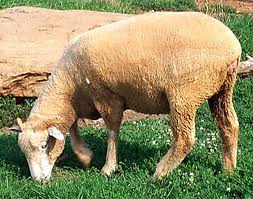

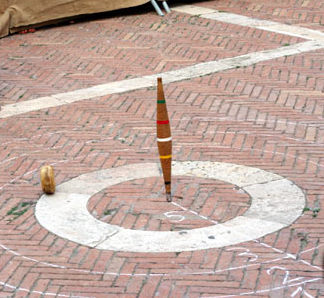
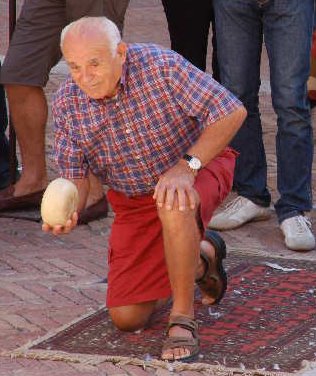
The word “pecorino”, from “pecora” – a ewe –sheep, is a quite recent invention. Until70 years ago, locals used the term “cacio”, and indeed the cheese rolling competition held in Pienza on the first Sunday of September is know as “cacio al fuso” – The aim of the participants in this popular festival is to see who can roll the cheese so that it stops closest to the spindle.
Pecorino di Pienza is a unique sheep’s milk cheese and it gets its name from the ancient city of Pienza, (just 13Km east of Montepulciano).
The pecorino cheese of Pienza is one of the best in Italy, especially the version ‘sotto cenere’ or ‘under the ashes’. The cheese has ancient origins and has probably been produced in the zone since man first settled here. This particular cheese is sometimes known as ‘Pecorino della Val d’Orcia’ or ‘Cacio di Pienza’ it is produced between October and July and seasoned for up to 2 months to give it its distinctive flavour. The sheep are raised out in the open and graze exclusively on the local flora. The aromas of rare plants that grow in the clay soil of the Crete Senesi (wormwood, meadow salsify, juniper, broom, and burnet ) Their aroma can be sensed in the sheep’s milk. After milking the sheep, the milk enters immediately into the cheese-making process. It is coagulated with veal rennet, or rennet made from the stamen of wild artichoke, marinated in vinegar and salt, or left to dry and then placed in warm water. The wheels of cheese mature in very humid cellars and periodically their walnut leaf-wrapped rinds are damped first with Tuscan olive oil, then with grease and wax.
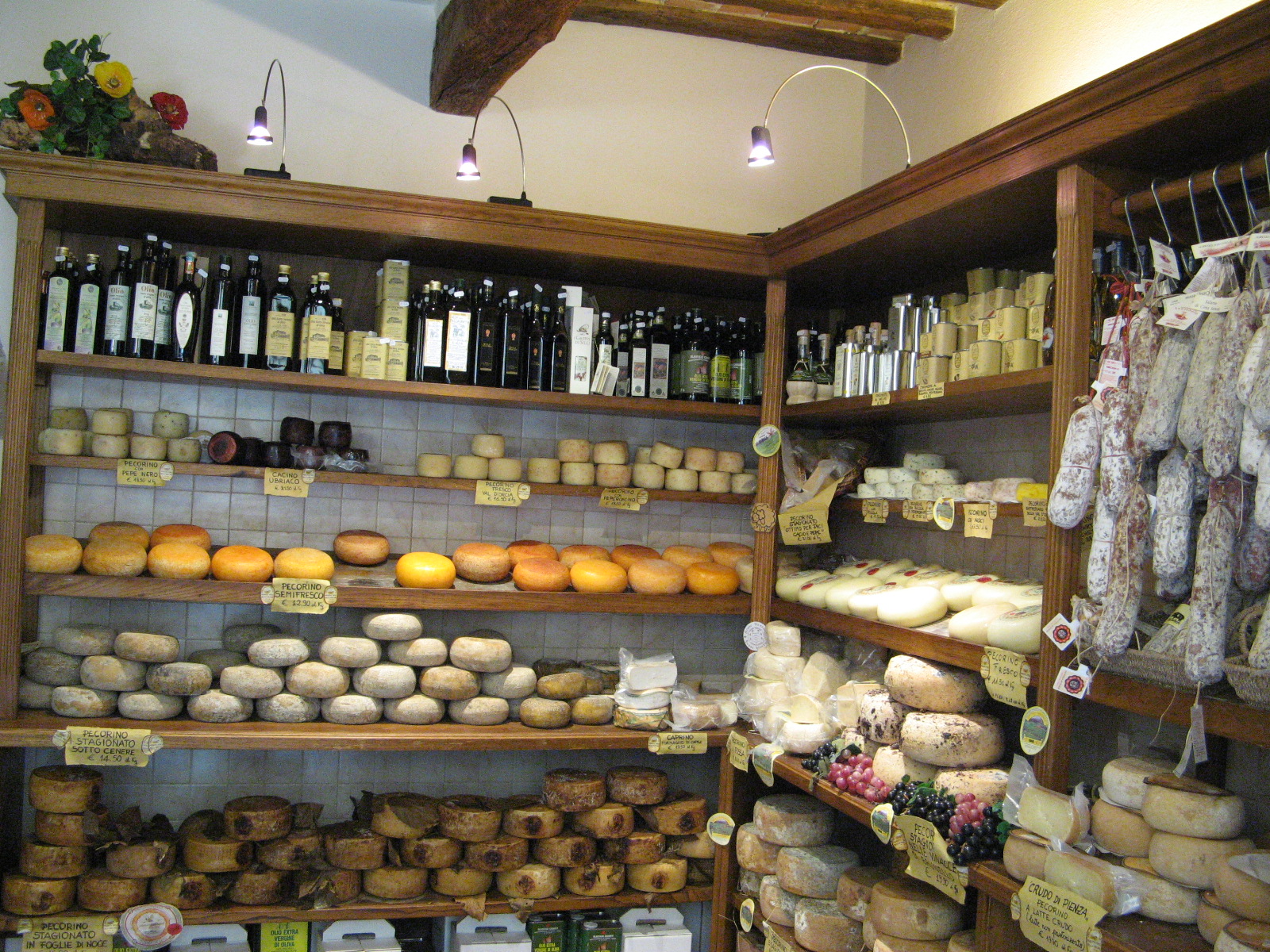
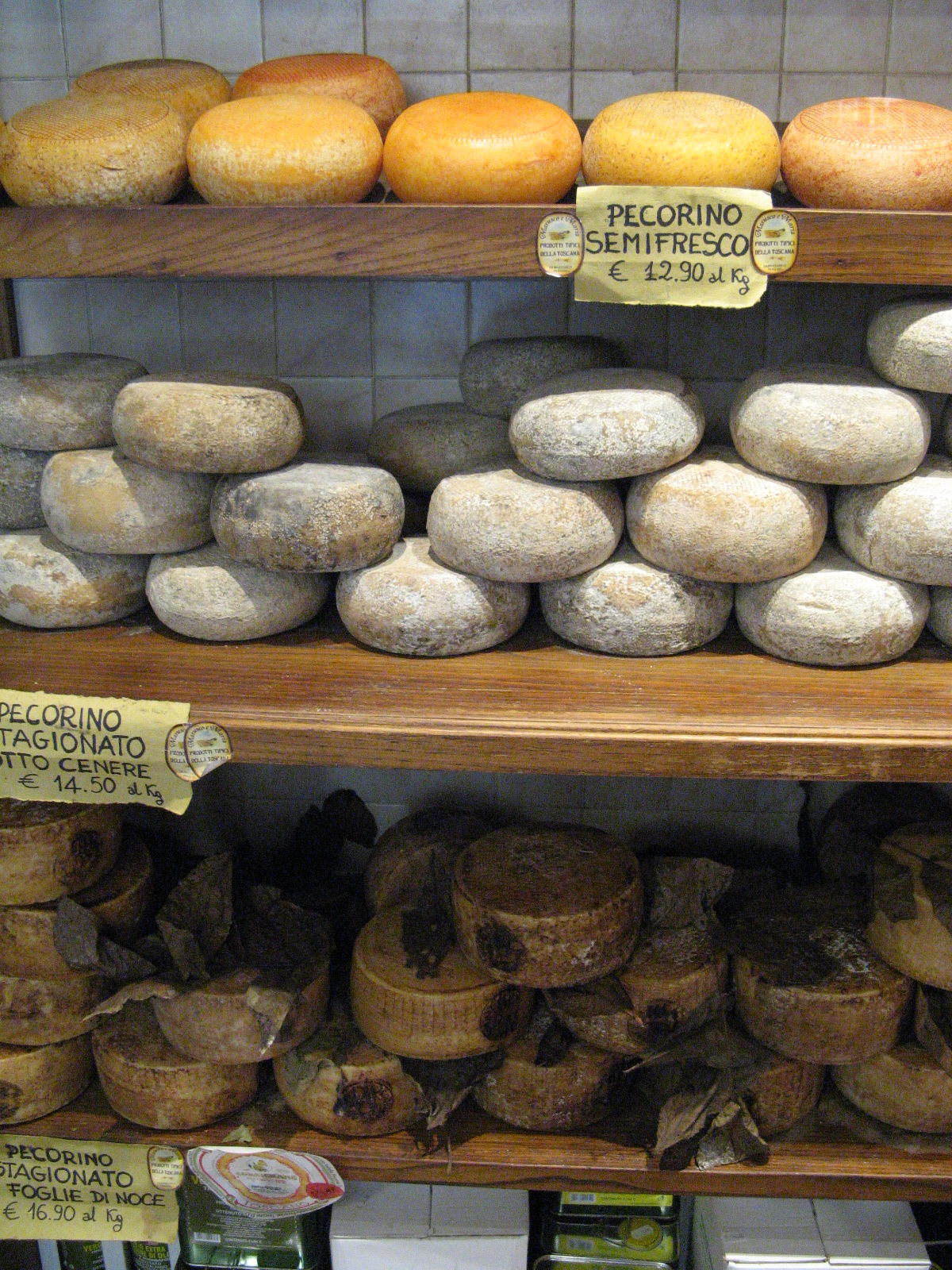
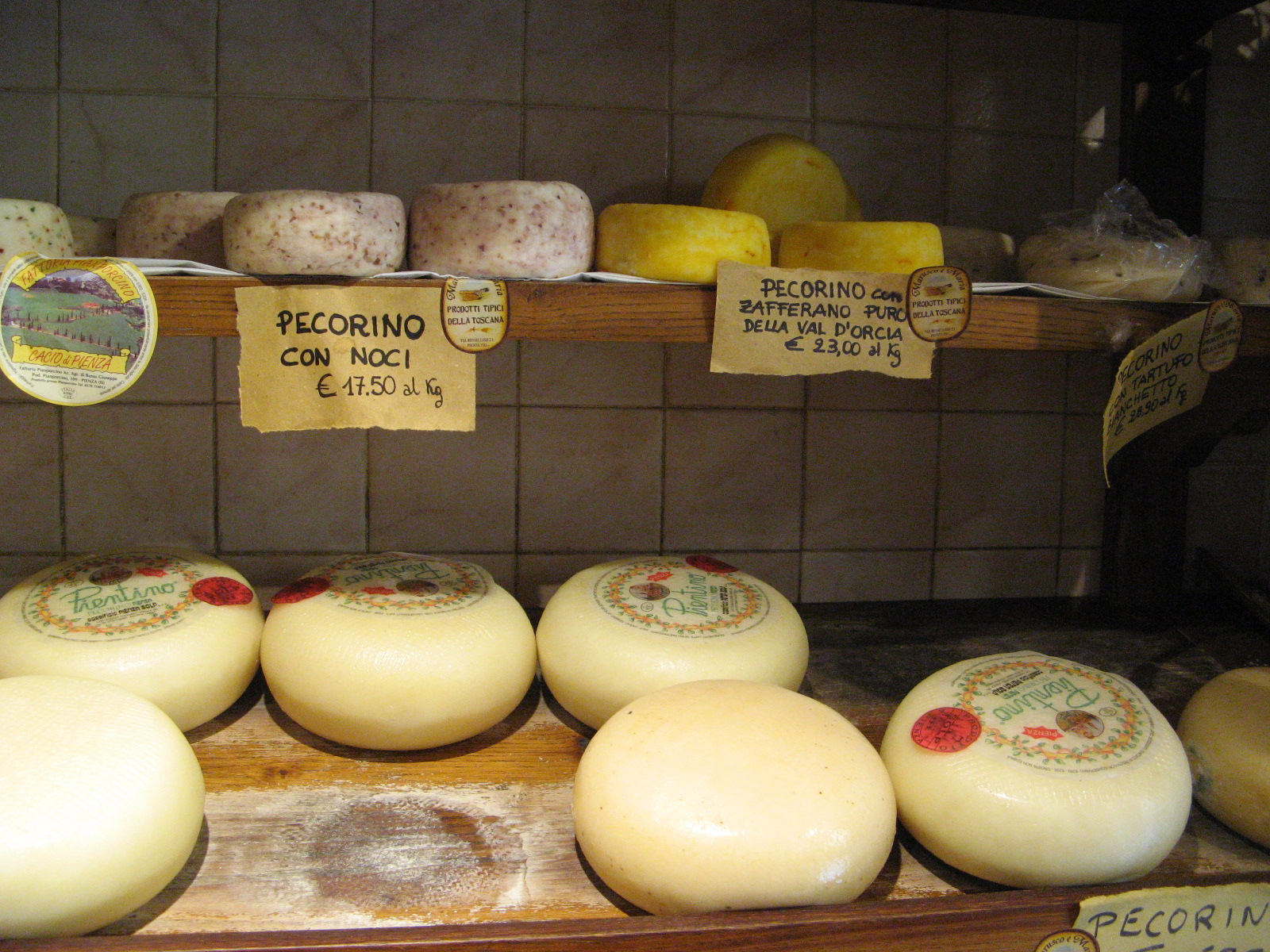
The round wheels can vary from around 10 -20cm in diameter around 1-2Kg. After about 40 to 60 days the fresh cheese is ready to be consumed and has a soft, slightly spicy flavor. If left to age for five to twelve, sometimes even eighteen months.
(The entire process can be seen in this video: http://www.youtube.com/watch?v=R7jZhDM51CU )
The aged cheese has a nutty tannic aftertaste which reminds fresh pecan nuts with the separating membrane, and a soft, crumbly texture in the mouth. Pecorino di Pienza pairs perfectly with the wines of the region, from Chianti to Montepulciano.
The fresh pecorino (pecorino fresco) is a soft, white cheese with a comparatively mild but still strong flavour. The texture can range from soft and moist to crumbly and granular, but is usually the former. A variety that is often eaten fresh is known as Pecorino Toscano and is made in Tuscany. It has a whiter colored paste that is creamier in texture, providing a somewhat nutty flavour. under recent laws, a cheese marketed as pecorino must now be made 100% from ewes’ milk. Another Tuscan pecorino is the Pecorino Senese or Senesi, which is a cheese that has a reddish rind due to the rind being rubbed with tomato paste. In years past, the rind was rubbed with sheep blood to obtain the red colour. These are so good on their own but also with red or white wine and locak bread of course YUMMM.
As the pecorino ages, the bone-coloured paste becomes darker in color with a firmer texture and a saltier flavor. The rind is light on pecorino fresco, and orange- or black-coloured on a medium and fully matured pecorino (pecorino stagionato).
…And The wines!
My favorite winery and wines of the Tuscan region come from a small but well known winery in the chianti region in a small commune between Castellina in chianti and Greve, Olena Barberino Val d’Elsa Firenze, Italy. Here between the small communes of Isole and Olena lies the beautiful winery and vineyards of Paulo the Marchi and his wife Marta; Isole e Olena winery.
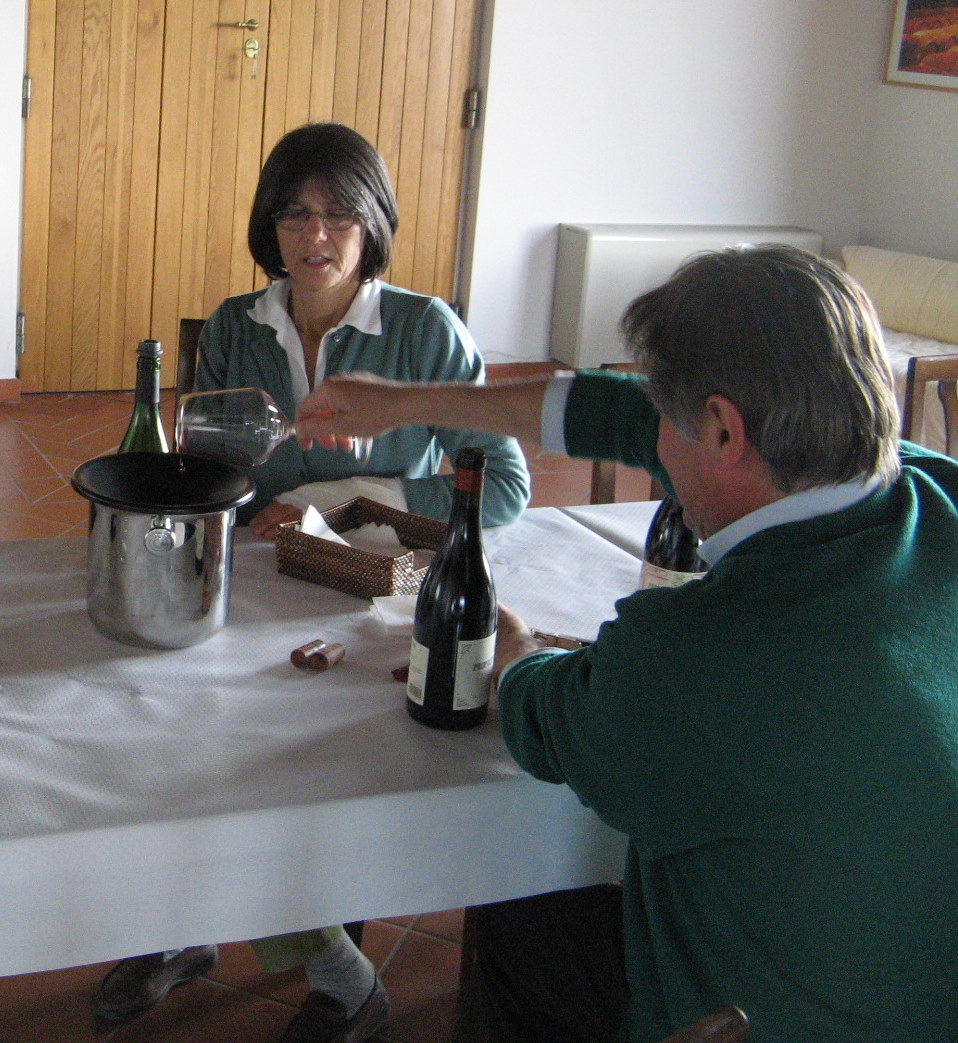


I have known Marta and Paolo for over 20 years now and even had the honor of having them and their children for Lunch at our house on their first and only visit to Israel.(amongst them was young Luca who is now a winemaker in his own right, making Piemonte wines in Proprieta Sperina in Lessona the old family estate) “We must come again for a visit to Israel next Easter” if I can find the time… but he is ALWAYS too busy with the vineyards and winery, so we meet from time to time in Toscana, and over the years Isole e Olena have been transformed from a farm house with muddy paths and winery razzamatazz to a country home with a ultra modern winery beside it and atmospheric, classic looking cellars, Inspiring.
Not only they make excellent wines that gained worldwide acclaim (picked amongst Italy’s greatest ever wines by Decanter magazine in 2008, make it to the top 100 list of Wine spectator Magazine almost every year since 1990’s, Isole e Olena’s flagship, Cepparello gets 90+ points since 1982 almost every year. (have a look at this list: http://90pluswines.com/Wine/21461091/Isole-e-Olena)
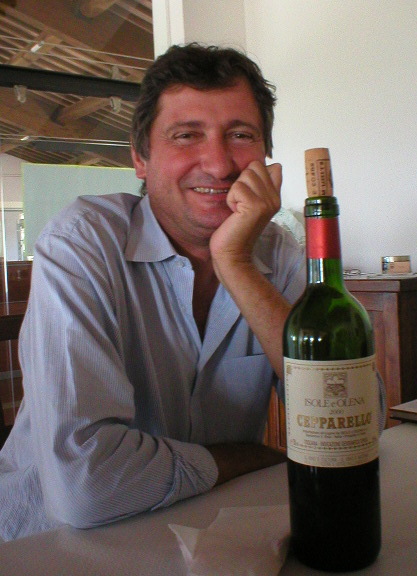
Cepparello was first produced in 1980, well before the change in local DOC regulations that allowed for a single varietal Sangiovese wine, I think you can say that Paolo was a pioneer of the pure Sangiovese movement.
Isole e Olena is comprised of two farms/communities: “Isole” and “Olena,” acquired by the De Marchi family in the 1950s. The family’s origins are from northern part of Piemonte. Paolo de Marchi, is the fourth generation of the family to make wine in Italy, but he moved from Sperino in Lessona, Nebbiolo country to Toscana and it’s Sangiovese. It took 15 hard years of work before he was producing the quality wines he aspired to. With the help of enologist Donato Lanati, he has continued to excel as one of the region’s top estates.
Paolo de Marchi’s belief in Toscana’s indigenous Sangiovese, and production of “Super-Tuscan” wines from grapes not indigenous to the Chianti region, together with his “contradicting” love to the characteristics of good Chianti, has set him apart from other producers in the early days, by making one of the finest Chianti Classico’s on the market. Paolo still produces small amounts of wine from international varieties, such as Cabernet Sauvignon, Syrah, and Chardonnay.
As a young winemaker Paolo was so over occupied with his strive to perfection, that he did not have time for tourism, “It would distract us from our wines.” That was in the 1980’s and 1990’s when the Utopian Idea of a perfect wine being possible was burning in his veins. (If it wasn’t for Marta’s support I cannot see this period passing by without ill effects.) In the last 10 years Paolo and Marta managed to build (mostly underground, and in spite of the strict building regulations of the region) one of the most exquisite and beautiful winery and underground cellars of all Toscana. From a small boutique winery adjacent to an old country farm house, it became a place of pride and joy and rightly so! Well worth a visit. Isole e Olena is also worth visiting if you like to talk wines (arrange well in advance), the passion and enthusiasm in the air when Polo talks about wine is contagious, educational, and inspiring.
I have a feeling that now the idea of making the best wine I can, rather than the BEST or the perfect wine, is at the core of the winery’s philosophy. It leads to wines produced at Isole e Olena: some superb Chianti Classico, of course the Cepparello, the pure Sangiovese with all its finesse and complexity, the most multilayered perfectly spiced Vinsanto of the region (in my mind), and the Collezione de Marchi line of Cabernet Sauvignon, Chardonnay, and L’Eremo, from local Syrah grapes, which Paolo originally intended to use to add color and depth to his Chianti Classico However nowadays a careful selection of Sangiovese (Chianti’s principal grape),is used to achieve this goal, and The Syrah is used to produce the wonderful L’Eremo .

I have tasted almost all the Cepparello’s from 1985 and on, but today we tasted the cepparello 2005 and 2006, the chianti classic 2006, The chardonnay 2007, and some older Cepparellos 2003, and 2000. (the legendry 1997 was packed as a “take away” present.) and Vinsanto 1997
Just a few tasting notes the rest you can look up on the net…
Isole e Olena, Collezione de Marchi Chardonnay, IGT Toscana 2007
light golden hue, sweet apple compote on the nose with a touch of ripe pineapple scent notes of sweet oak in the background, Very refreshing in spite of the alcohol feel at the finish.
2006 Isole e Olena Cepparello
This rich wine is a contradiction to the Vintage conditions. A hot year with full maturity still the wine is fairly light, medium bodied and none of the expected alcoholic over feel (14% alcohol). It has mint and nepitella herbal touch very floral on the nose with sweet spices aromas of blackberries and black cherries confiture with a touch of cinnamon and cloves that gives it a sweet jammy feel. But these are so well balanced with the bursting fruit acidity and firm but accessible tannins. It has extremely long finish. (I held on to my empty glass just for the alluring after sniff)
Isole e Olena Cepparello 2005: Dark red with purple robe than Explosuion of ripe red fruits and berries on the nose and firm tannins and good acidity on the palate which balances the wine very well and allow it to be a great keeper. It has the Cepparello elegance with undertones of green fresh peppered oregano. The alcoholic strength it felt and will mellow in time as all the elements combine in a few years.
Isole e Olena, Vin Santo 1997 (bottled 2003)
This the closest you get to the Nectar of the Gods (chosen by Zeus off Dionysus hands), Honeyed thick wine to the eye with rich scents dried figs and raisins and dried orange peel still light on the palate without the sugar overtones other Vin santo’s have, due to good balancing acidic touch some vanilla on the finish make it the perfect desert a blessing to god and men..
Another amazing afternoon with Marta and Paolo, Grazie mille per la vostra amicizia .
Visits by appointment only!
Contact details:
Address: Isole 1, Località Olena 50021 Barberino Val d’Elsa
Telephone: +39 055 807 2767 +39 055 807 2763
Email: isolena@tin.it
THE A B C: A- Amour, B- Beatles, C- Champagne DAY 1
(This is an interactive post! please press play for music as you go along reading)
A visit to Champagne with Yair – Day 1
June 7th 2011, My 58th Birthday is 4 days from today, Decided to treat myself with a visit to Paris and combine a two days trip to Champagne This is something I have been meaning to do for A LONG TIME… for me coming from Tel-Aviv the general direction due west …or as the Beatles say follow the sun…
We set out early morning from Paris its a rainy Day. The mini cooper is quick to gulp the 137Km to the village of Vertus Where we’re suppose to visit Pierre Larmandier, of Larmandier Bernier later this afternoon.
But we took off early and the mini is swift , so we have several hours to “kill” in the area before our meeting for a tasting at Larmandier starts.
Yair is the ultimate Guide in the wine regions of France and there is a structure to his wine Journeys for Pros and Novices alike, it contains much more than just some visits for tasting wines.
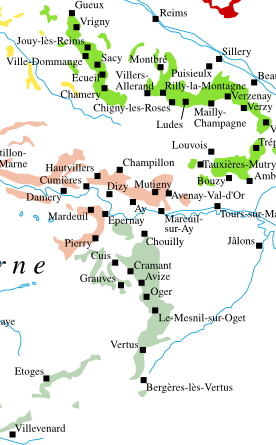
There are Visits to the vineyards,a bit of history, and other places of general or particular interest are all included. So we set out into the vineyards of the Côte de Blancs Our destination for the first day with the Men and Legends of the sub region. This is the source of the vines of the Best Chardonnay lots of champagne. We take the vineyards road all the way up to the top of the cote de blanc up to the forest,

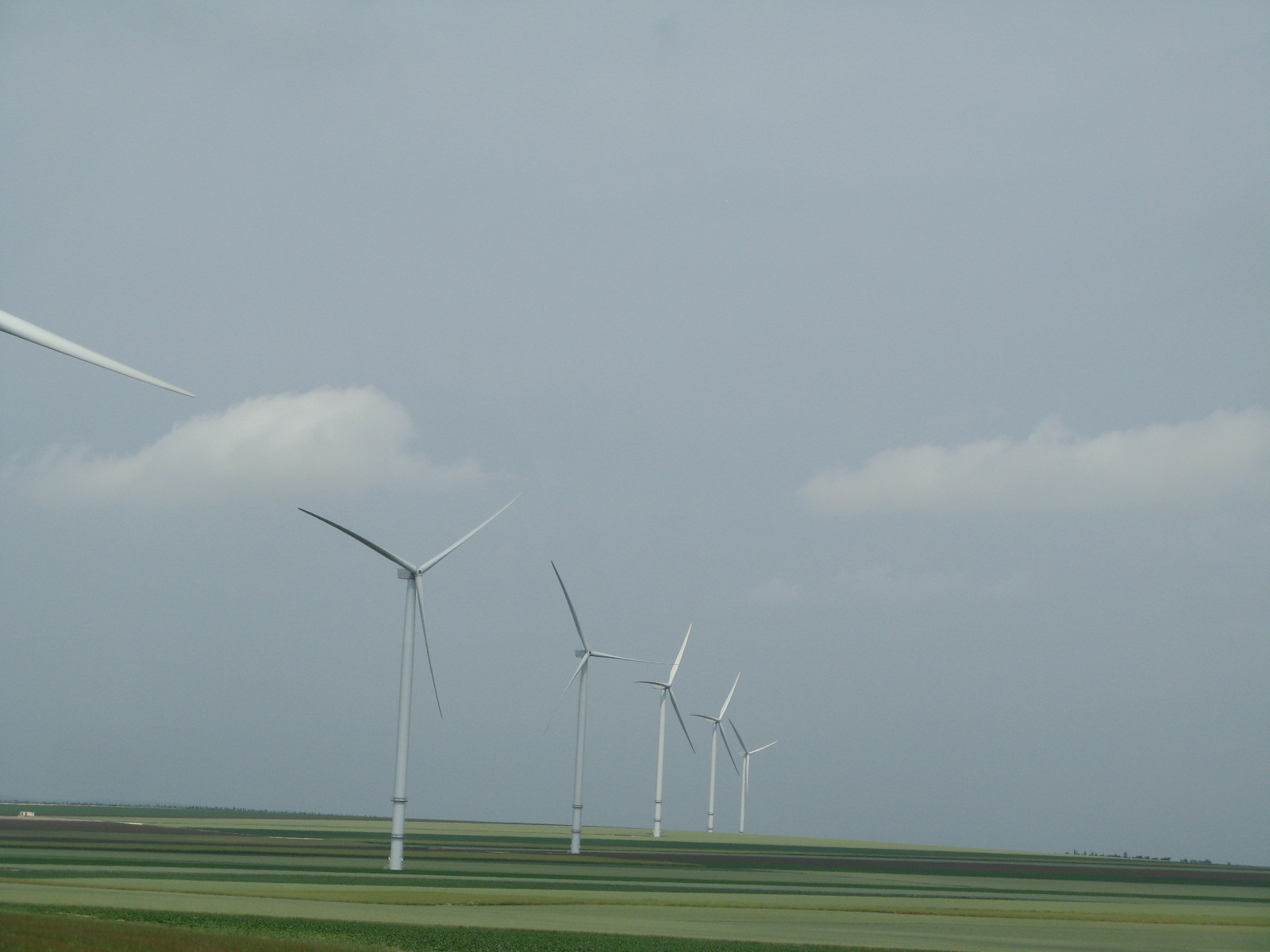
we look down the slope of the rows of chardonnay vines to the valley below and the sun comes up The sun rays caressing the vine leaves and the air gets warmer. Now I understand (at least I think I do), why those farmers of champagne installed those giant Ventilators in the entry to the Valley, it gets pretty warm here even though we are on the 49th parallel, in fact this is the northern most wine region on the northern Hemisphere.
We stroll carefully amongst the vines, the grapes are just starting to cluster, we look down the rows, what a sight. I must show you something says Yair we drive into a little village: Mesnil-sur-Oger. Tucked in between the small houses, just off one of the streets is the the renowned Clos du Mesnil vineyard. The small ally leading to it is almost unseen called: Allee clos du Mensil (the S in silent pronounced Menil).

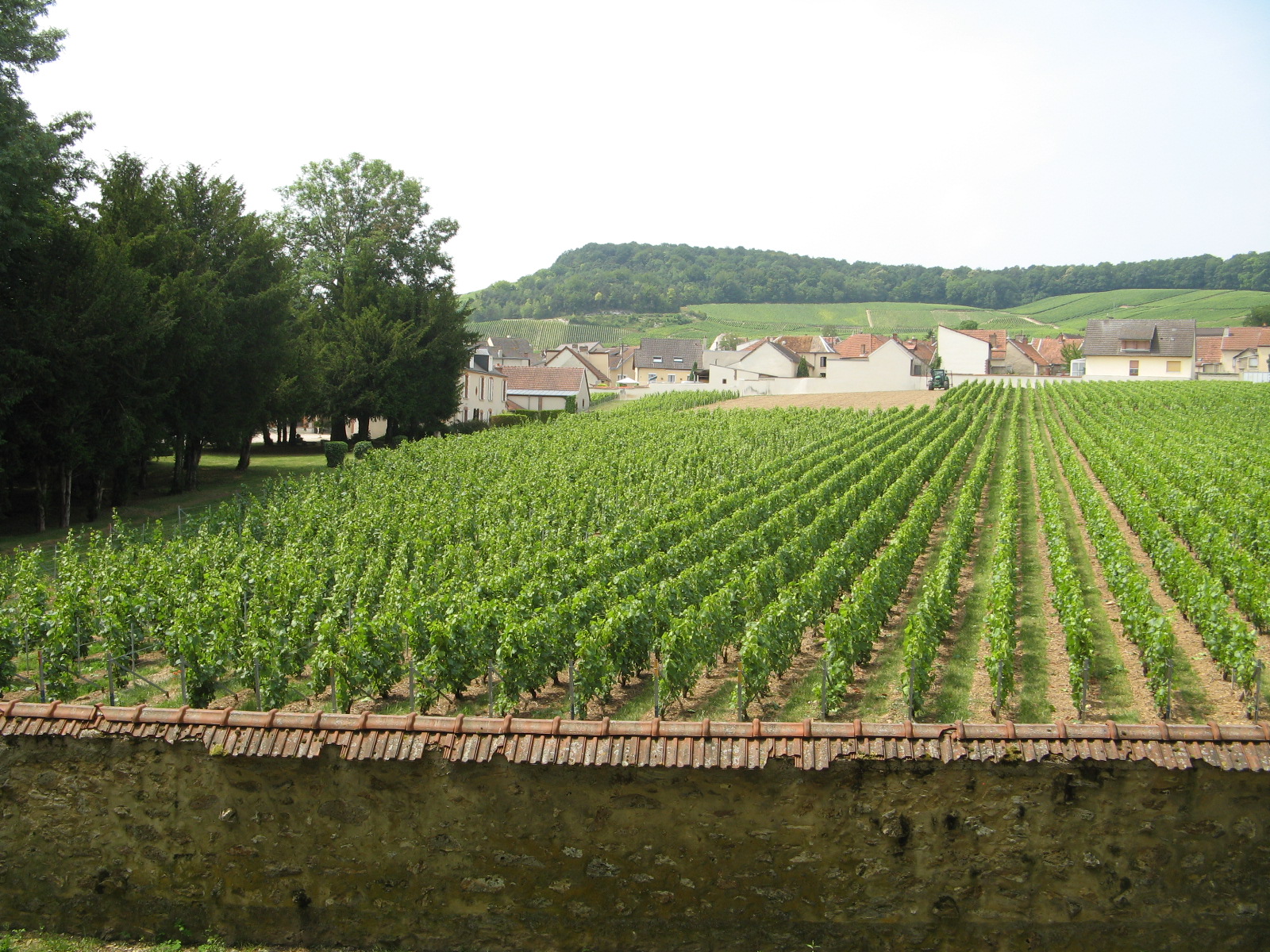
This historic 1.85ha vineyard has been enclosed by a stone wall since 1698 and is set on a southeast-facing slope and is sheltered from the weather by its wall and the Vilaage houses. Purchased by the Krug family in 1971 it was restored to its previous glory by replanting the Chardonnay vines one section at a time. The 1979 vintage finally achieved expected quality by Krug standards and the first vintage of the Krug Clos du Mesnil was produced since than about 12,000 bottles of this wine are made in only the top vintages. We climbed an elevation of the ground which set us just above the wall line, The “Legend” infront of our eyes and the wall separating us humans and wine Royalty. I was not humbled but certainly excited. A sip from a 1985 Clos du Mensil would make this moment perfect, Alas Krug do not have a stall of wine by the glass on site.

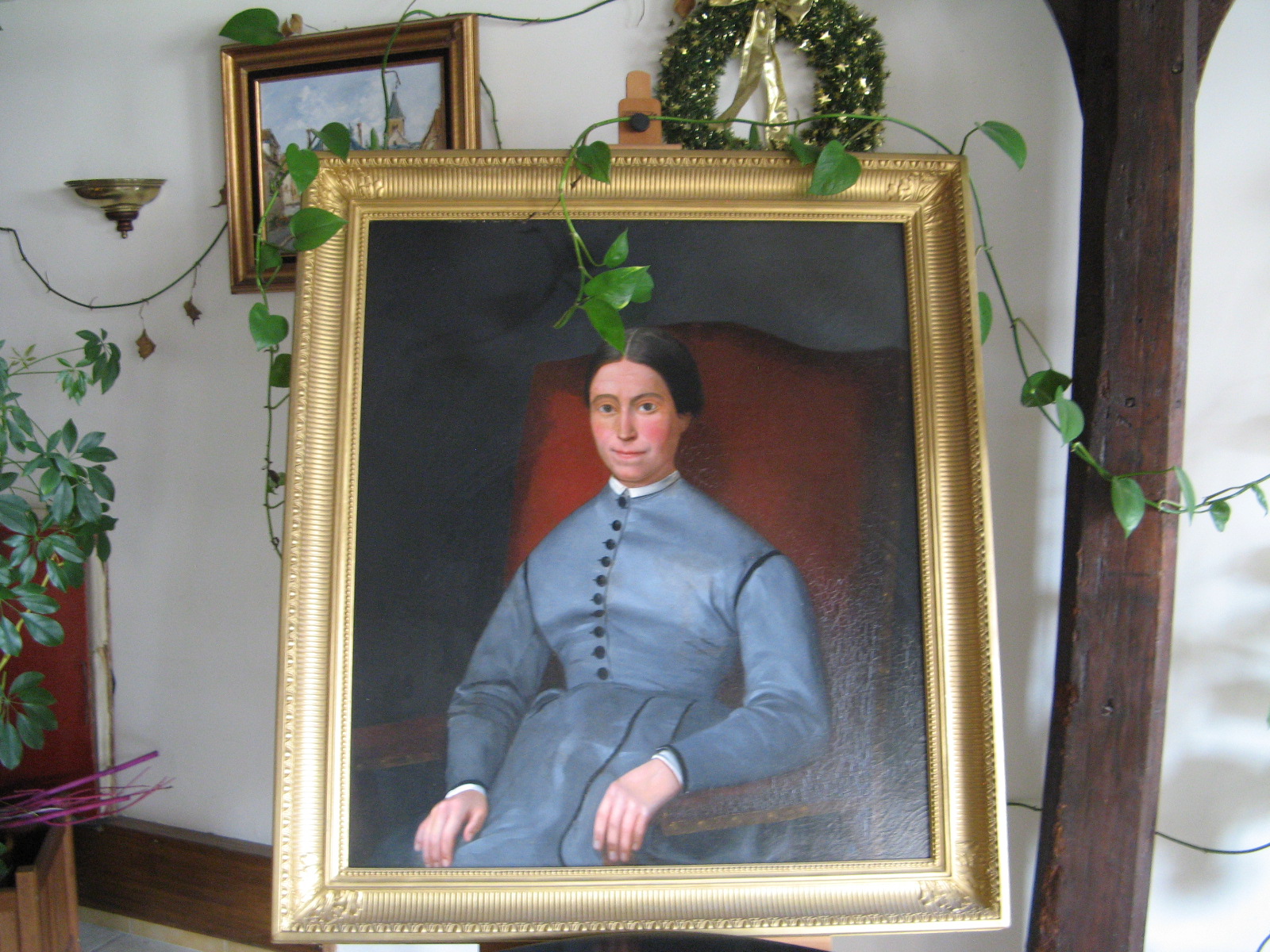
Lets pop in to see my friend Pierre Gonet and his sister Chantal says Yair since we’re in Mensil Sur Oger, Only Chantal is there but she gives us a very warm welcome and a proper tasting of ALL their wines The one with the intriguing name: Philippe Gonet EXTRA-BRUT 3210 Blanc de Blancs, means Aged 3 years, 2 terroirs, 1 variety, 0 dosage is the crisp, fresh and the most acidic of them all and they start with higher acidity than your usual blended champagnes here at the Côte de Blancs! It’s a backbone that stretches through all the other different wines, an excellent start to a sunny day in the countryside CAMPAGNE. ..Grandma Gonet (picture above, deceased over a century and a half ago), was overlooking the tasting with her stern posture
We depart and set out the short ride south to VERTUS to our first “booked” visit of the day at Larmandier Bernier. Sophie Larmandier welcomes us to the wonderful tasting room on the ground floor


Pierre ia an artisan producer, he says: “we do disgorge the bottles, we add the dosage, to give the final touch to the champagne. But while most brut Champagnes are dosed at around 12 grams per litre, we never exceed 5 grams for our brut cuvées. For the ‘Terre de Vertus’ Non Dosé’, it’s simple: we add no sugar at all. Generally speaking, there is about 1 gram of residual sugar anyway”.
“We prefer to favour the maturity of the grapes and their natural sugar rather than adding sugar when the bottles are disgorged and running the risk of making the Champagne heavier and losing sight of the terroir”.
First we go down the spiral stairs to the cellars to have some of last vintage wines before bottling. The acidity at the moment is sky rocketing though it will mellow at the end of the process but keep an elegant, tight, dense and fresh, but delicate champagnes of the highest order.
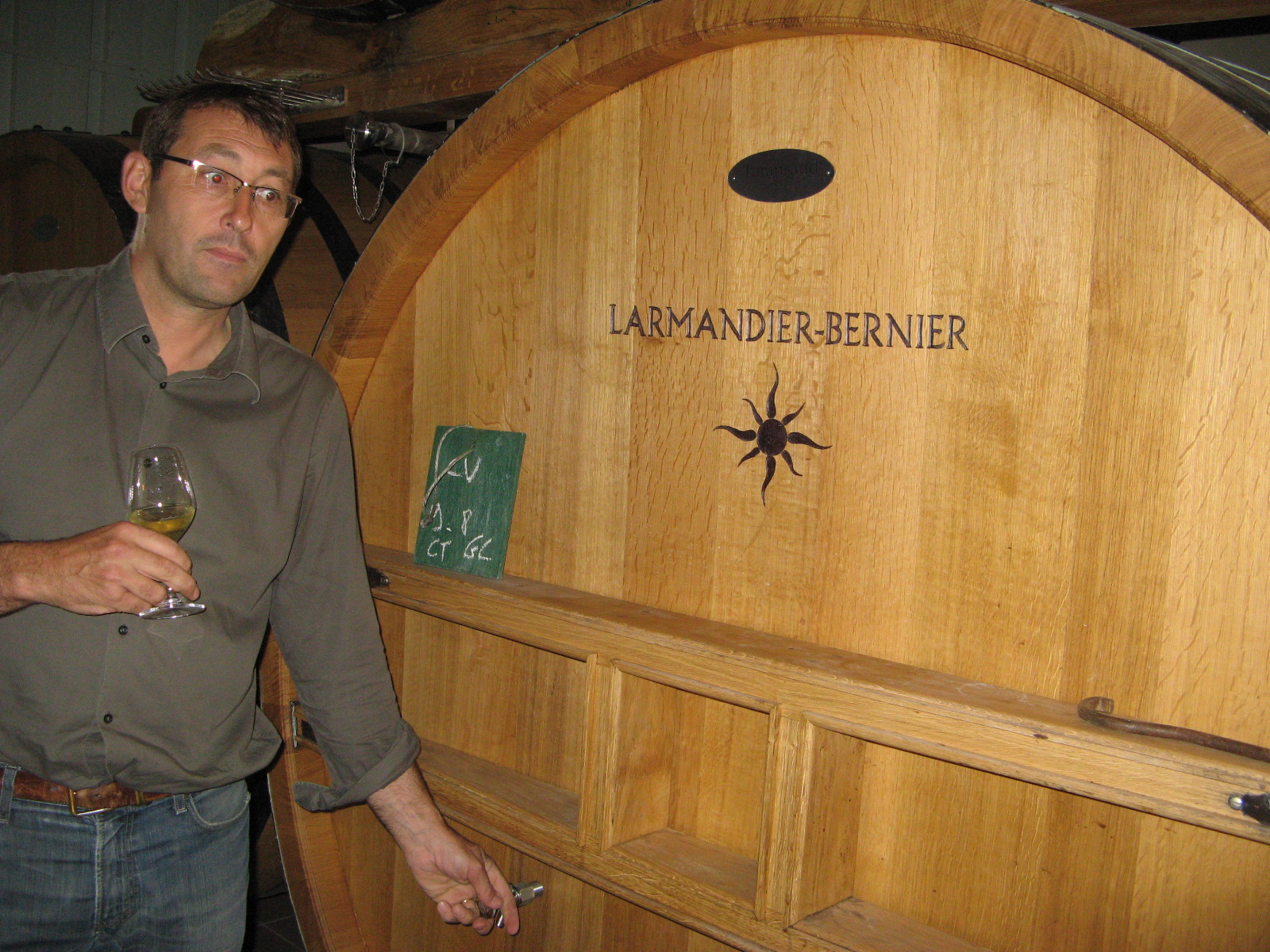

Pierre is so enthusiastic and feels at home amongst the Oak barrels on one hand and the strangely looking egg-shaped concrete tanks. These small tanks assist in oxygenation of the wine. Their shape aids fluid movement for temperature and reduces pressure on the lees. The shape also aids the deposition of the lees across a larger floor area than a barrel and avoids the need for stirring. The material is porous, allowing fermenting wine to breathe without imparting the oaky flavors. Concrete is insulative while stainless is conductive, so concrete acts as a low-tech temperature control.
This is not your everyday champagne these are “terroir-related” champagnes, with very little interference in the essence of the initial wine produced.
” Current trends among these artisan producers include decreasing yields, increasing use of oak for fermenting and ageing the still wines, lower levels of dosage with the likes of Gimmonet, Larmandier-Bernier and Jérôme Prévost offering wines with no dosage at all, and wines that are rather less aggressively fizzy than the champagne norm. Many of these producers also give far more information about make up of the blend and disgorgement dates than the average champagne producer.” Jancis Robinson
We tasted the :
Larmandier-Bernier Tradition Premier Cru NV
Larmandier-Bernier, Extra Brut Blanc de Blancs Premier Cru NV
Larmandier-Bernier, Terre de Vertus Non-Dosé Blanc de Blancs Premier Cru NV
Larmandier-Bernier, Vieille Vigne de Cramant Extra Brut Blanc de Blancs Grand Cru 2005 and 2006
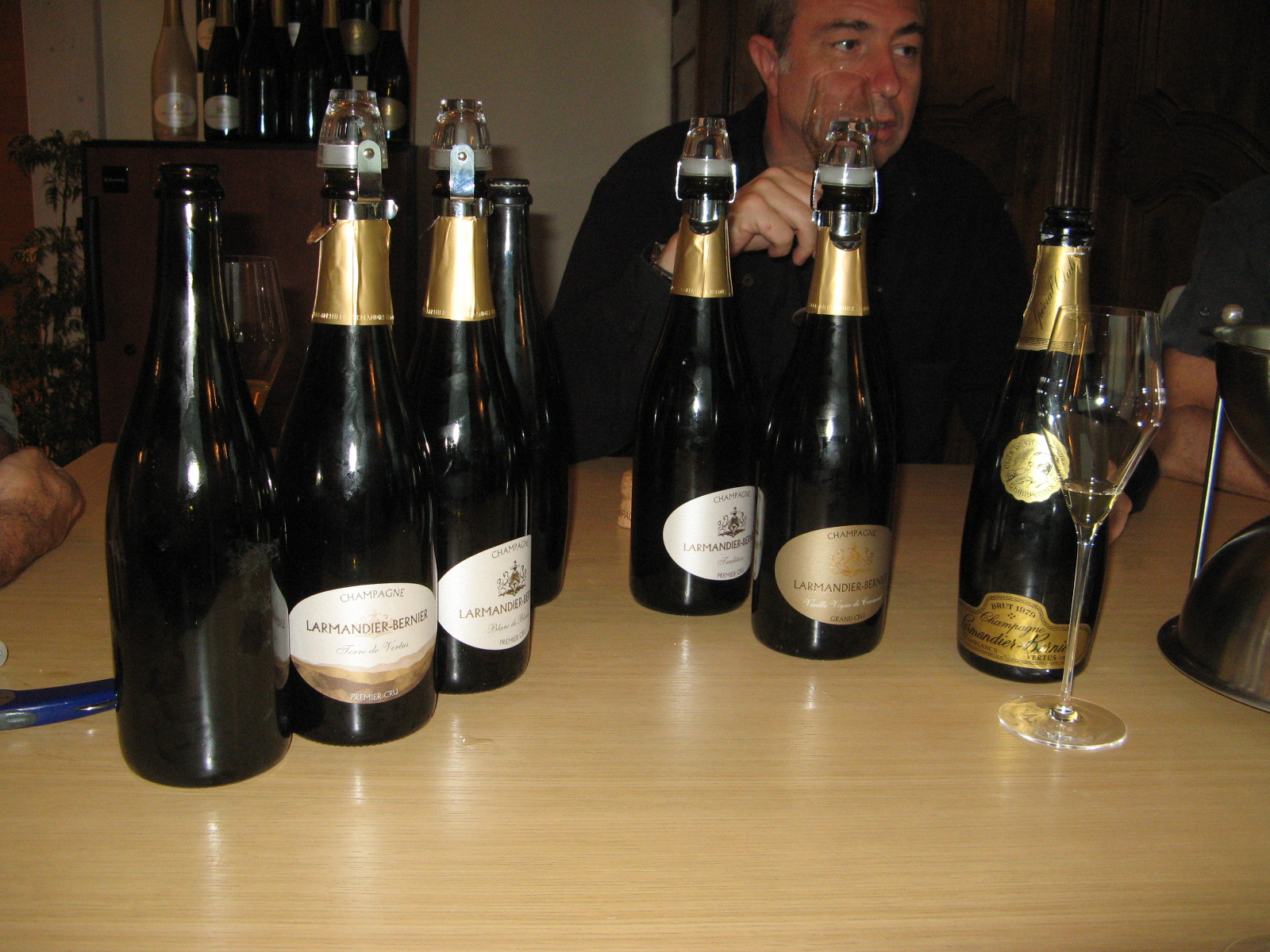
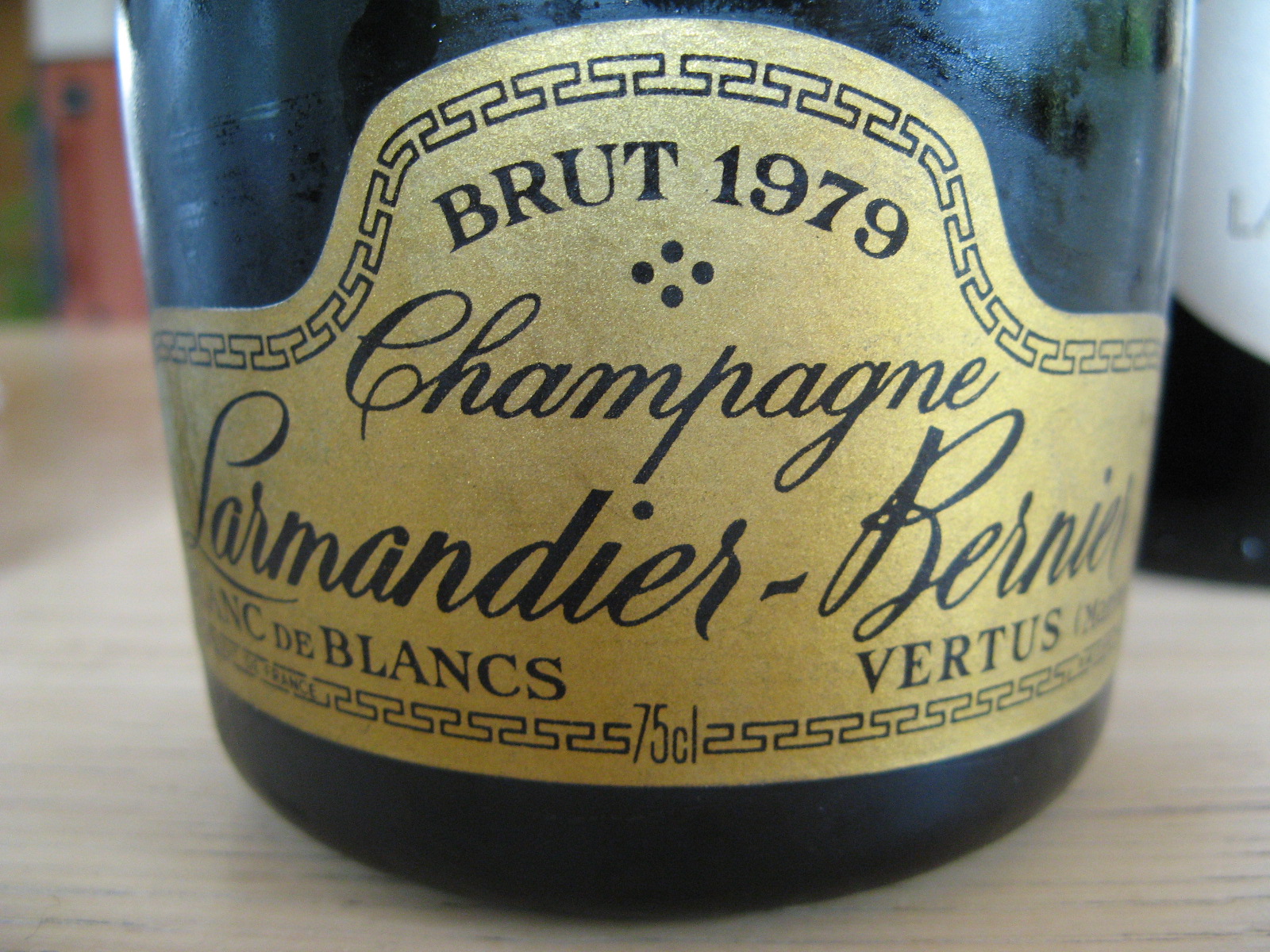


Some non disgorged cloudy 2009’s which had the scent and feel of a delicate cloudy fresh apple and grapefruit juice.
 These were rushed up from the cellar and opened on the porch spitting their enchanting scent as they were allowed to burst out into the air when the crown cork was opened.
And the Brut 1979 Larmandier Bernier Blanc de Blancs
All the above are excellent champagnes each with its own character according to “pedigree” They can be described as very delicate with smooth small bubbles size, delicate to creamy mousse and excellent balance with long and lingering presence of citrus fruit and mineral touch of “Pierre à fusil” (It is the smell of heated flint or burned gun powder), aromas associated with the mineral character of the wine and that of the terroir. They are lighter champagnes when young with perfumes of flowers, slight aromas of grilled bread spread with butter, brioche and hazelnut. When getting older, they gain in smoothness, developing notes of fully ripe white pears and peaches. Wonderful precision!!!
As Pierre was preparing to fly abroad the next morning, we parted with sorrow but fully content and joyous
We are now heading to our final destination of the day to meet champagne’s “High Priest” in Aviz, Anselme Selosse, a good friend of Yair, what a lucky guy I am to have such friends.

It is hard to think of a single winemaker in Champagne today whose work is more influential on the new generation and on the philosophy of champagne production than that of Anselme Selosse. In heart he is a farmer, a wine grower, who happens to have this genius sparkle, which come to him with ease. (He answers to nobody but himself in the vineyard and the cellars…at home he answer to the wife like we all do)
I do not know him well enough but they say that his brilliance he has change the course of wine making in champagne region and that Anselme is the man most responsible for the revolution that’s taking Champagne to a new level. Since he studied oenology in Burgundy, he coined the idea that first you have to produce a great wine and only than make them into a great champagne all produced from grand cru vineyard in Avize, Oger, and Cramant.
In the winery, Selosse uses only indigenous yeasts for fermentations and by minimizing the use of SO2. He ferments his wines in wood barrels on their lees for more than 2 years, and in 1994, Gault-Millau named him France’s best winemaker in every category take that for an achievement. Some describe him as the most original winemaker in France today, and still he goes on with his aspiration and interests and seemed to me utterly unaffected by all the Razzmatazz around him. He is friendly, humble and thank god still eager to improve the small intricacies on the path to perfection. “Chapeau”!!!!
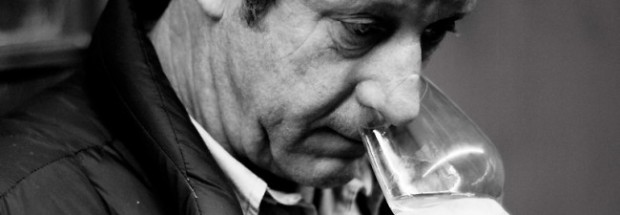
We tasted great (young) chardonnays from the Barrels bursting with fruit and livelihood some almost 2 years old and still expressing youth characteristic of a month old wine from a steel tank rather than a wine in an oak barrel on it’s lees.
The Champagnes: (we did not taste them all, left a few for the next visit)

Blanc de Blancs
Initial. A “classic” Brut. An assemblage of three vintages. Aged 2 years before degorgement.
Version Originale. Anselme’s great multi-vintage cuvée is aged 42 months before degorgement, and bottled with very little (1.2gr) or no dosage.
Millésime. The expression of character of a single vintage year.
Substance. The taste and character Avize’s vineyards.
Exquise. With a slightly higher dosage
Blanc de Noirs & Assemblage
Contraste. Show off with Pinot Noir from Aÿ.
There’s something very correct and precise about these wines on both the wine and the champagne stage, but it also has its “sexy” side. It is voluptuous. elegant with tons of finesse. BRAVO!
I had so many exquisite wines on the day for tasting which seldom went into the spittoon (sheer greed) with nothing to eat since last night , I was beginning to feel a bit weary and tired.
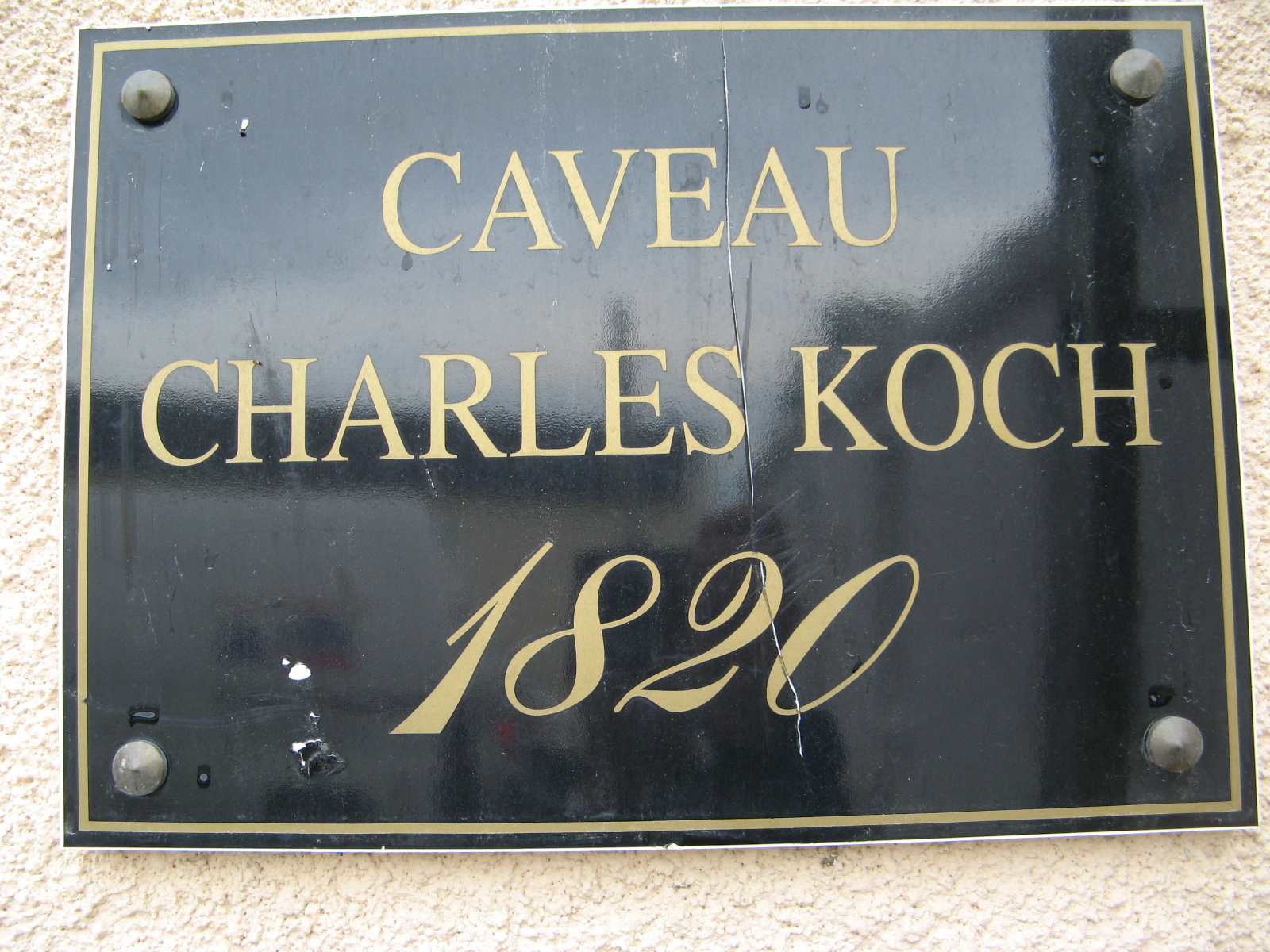
I was thankful that we were invited to spend the night, at the exquisite almost finished new hotel his wife Corinne erected. a nice neoclassical residence linked to the production of wine CHARLES KOCH since 1820 it make you share the soul of champagne in the past with the luxuries and amenities of the present. It is a perfect place to stay rest eat with style and quality
At the moment I leave you only with the details of the Hotel (below)

Hôtel Restaurant Les Avisés – 59, rue de Cramant – 51190 Avize
Tél (33) 326 577 006 – Fax (33) 326 577 007 – Email : hotel@selosse-lesavises.com
Check the dates with reception
A separate post, about the Hotel and Restaurant will be posted in the near future.
Your wineguide
KUNLEY The Drunken saint, Ara, and the school of Non dual insight of one taste.
Tashi Delek my dear disciples it’s your wineguide, Been to Bhutan (late April 2011)
Tashi means auspicious and Delek means fine or well.It is quite difficult to translate properly into English, but: “Blessings and good luck” or “May all auspicious signs come to this environment” is a good proximity to the intention of this blessing, and so… I bless you all.
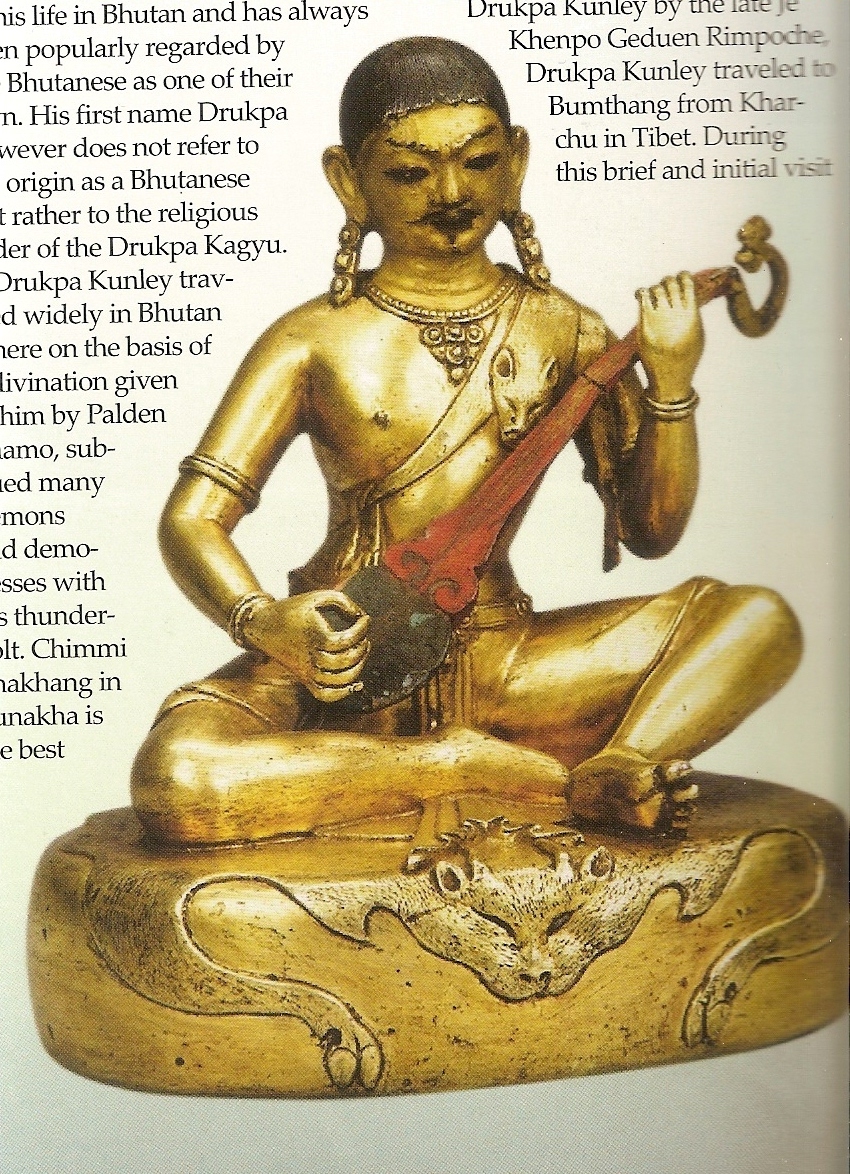
Bhutan, not a place of food or wine But… who is the most Loved and revered saint of the land? A guy who called himself “crazy dragon Kunga Legpa“, named Drukpa Kunley (1455-1529). Drukpa refers to a person from Bhutan or of Bhutanese descent. Kunley is also known as the “crazy wise” or the Divine Madman, the crazy monk the drunken monk.
Drukpa Kunley is the patron saint of Bhutan, belongs to the Drukpa (Dragon) school of Tibetan Buddhism. He is greatly loved by all the people of Bhutan and Tibet as an enlightened master and an exponent of ‘crazy wisdom’. He taught through outrageous behavior and humor in order to awaken the people he met to a higher awareness free from conventional morality and self-obsession.

He took his female friends and disciples along the path of sexual desire and relationship to free them from attachment to the illusory world and to awaken their buddha-nature. He would constantly taunt the monks with jest and insult to dissolve their hypocrisy and hidden faults.
Drukpa Kunley who traveled throughout Bhutan is known to have subdued many demons of both sexes. Bhutan was full of demons who were “tamed” by Kunley with his thunder bolt (sometimes his phallus) to transfer people from the ” Dark side” of ignorance, to the side of “non dual insight of one taste” or in more simple words: The great liberation consists in being freed of the pairs of opposites (light and darkness, good and evil etc). Freed of duality-and finding instead the Non-dual One Taste that gives rise to both. This is liberation because we cease the impossible, painful dream of spending our entire lives trying to find an up without a down, an inside without an outside, a good without an evil, a pleasure without its inevitable pain, or which allows no duality between creator and created – all are reflections or manifestations of the one, which is not and cannot be an object of sense (one taste), which is the underlying reality or consciousness.
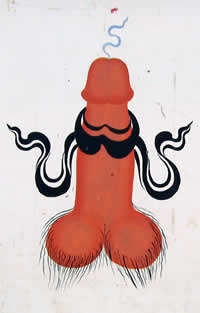
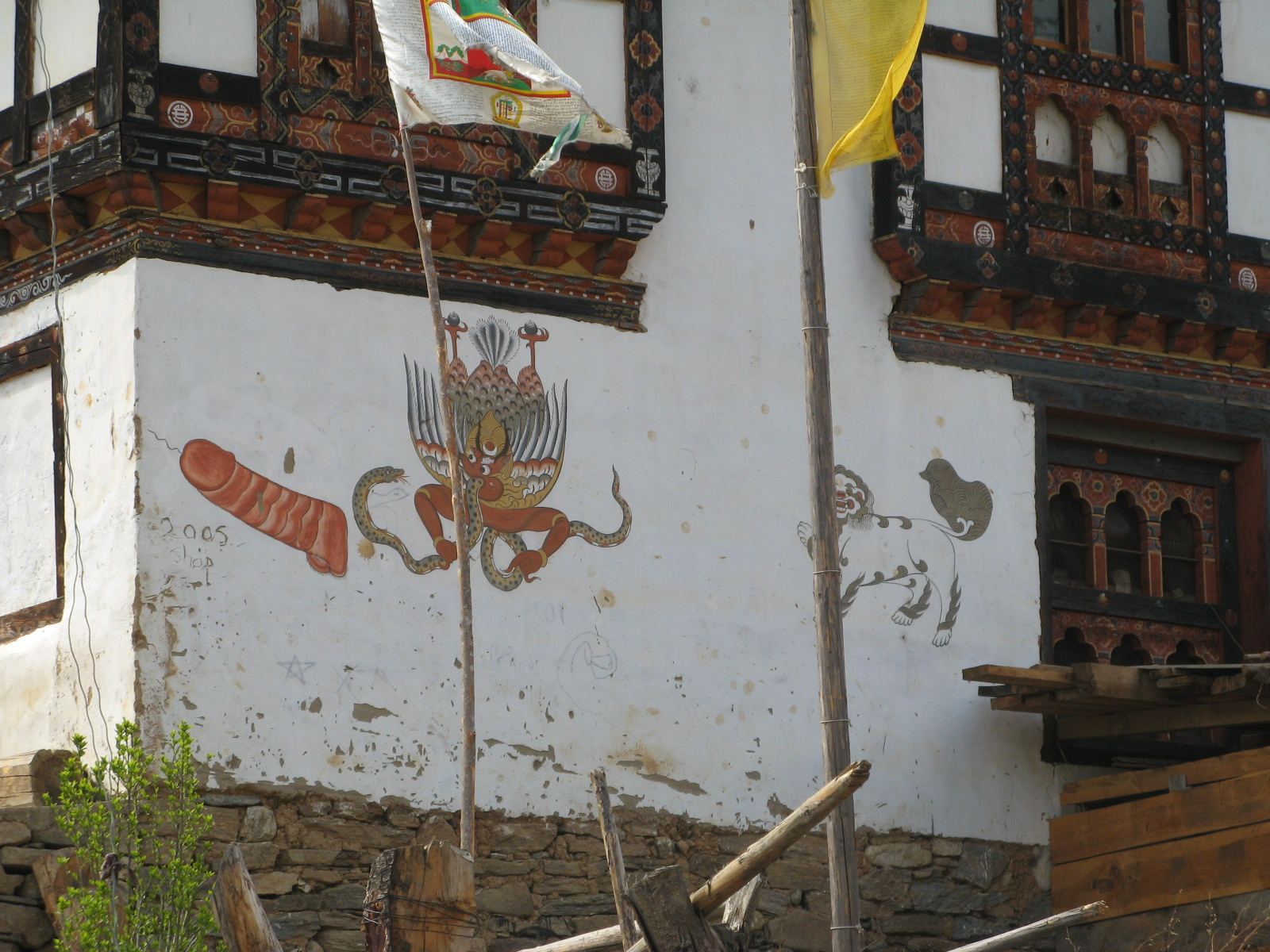 Drukpa Kunley’s anecdotes are ribald beyond belief. Wherever he went he carried his ‘divine thunderbolt of wisdom’ (his penis) before him. It penetrated the mysteries of life as it did willing virgins. The bawdy tales of fornication and copious intake of chung wine are interspersed with words of wisdom, and attain nirvana. The god-fearing but high-living Lama Drukpa Kunley sums up his philosophy:
“The best chung wine lies at the bottom of the pail / And Happiness lies below the navel.”
As in one of Drukpa Kunley’s Teaching Songs:
‘In the rosary of my many lives
I have taken the form of every creature;
I remember it only darkly,
Yet I feel it was something like this:
Since now I thrive on chung,
Once I must have been bee;
Since now I am so lustful
Once I must have been a cock;
Since now I am so angry,
Once I must have been a snake;
Since now I am so slothful,
Once I must have been a pig;
Since now I am so mean,
Once I must have been a rich man;
Since now I am so shameless,
Once I must have been a madman;
Since now I am such a liar,
Once I must have been an actor;
Since now my manners are so rude,
and so on…
More of his tales and songs could be found in : http://www.keithdowman.net/books/dm.htm#BOOKS
Playing the Dramyen (a traditional lute)- MUSIC, reciting stories and songs Story Telling and POETRY were two important ways to convey his teachings to all aspects of society rich and poor, uneducated and scholars.
Drinking wine was a means loosening up open to the seven stages of life: the seven original jokes, these make a “mockery” of the universe as a laughing matter, so that man will transcend it. When you have fulfilled the teaching of truth than you get the “joke” of human existence, your path must include the seven stages which are stages of laughter, each one must in turn become a great laugh to you. You must be able to feel total pleasure in the face of each stage of experience before you can go on to complete the next stage, it’s just like opening several great bottles of wine and if tasted in the right order and you are patient enough to get into the pleasure of the wine you can get on to the next great bottle that awaits you at the next stage. Too often have I participated in such events that missed their purpose because the “total pleasure” has not been reached by some pricks (who manage to ruin it also for the others), and this is not derogatory …it is served with compassion.
If you ask yourselves, what did Drukpa Kunley drink mostly is seems to be Ara a local brew, an alcoholic potion brewed from grains like wheat, barley, millet, maize, jowar, barja, buckwheat and rice, than undergoes a steam distillery process. Ara business (not production) is illegal today in Bhutan,


because Ara is mostly home-brewed so its quality is not regulated, almost every family has its own Ara distillery for personal use and it is drunk everyday throughout the day from dawn to midnight from the palace to the last broken down rural hut, Every time it has a different taste, quality and special distinctive name for the occasion Dhong-chang as a reception drink, To-chang as appetizer, Shell-chang (a wash of the throat), Droe-chang during discussion and gossip, Zim-chang (when drunk as a night cap), Lam-change (is the one for the road), and khal-chang as a farewell drink, you don’t have to sweat to find a fitting occasion to drink Ara in Bhutan (if you like the drink, it has what I would call an acquired taste, it comes in various strengths from 5%-40% alcohol it is distinctly different in flavor and aroma from one place to another, from one family to the other, from the different grain it is prepared (no rules any grain or their combination will do. It comes plain or with added flavors of local flowers and herbs poured to the glass/cup (Zapchi)
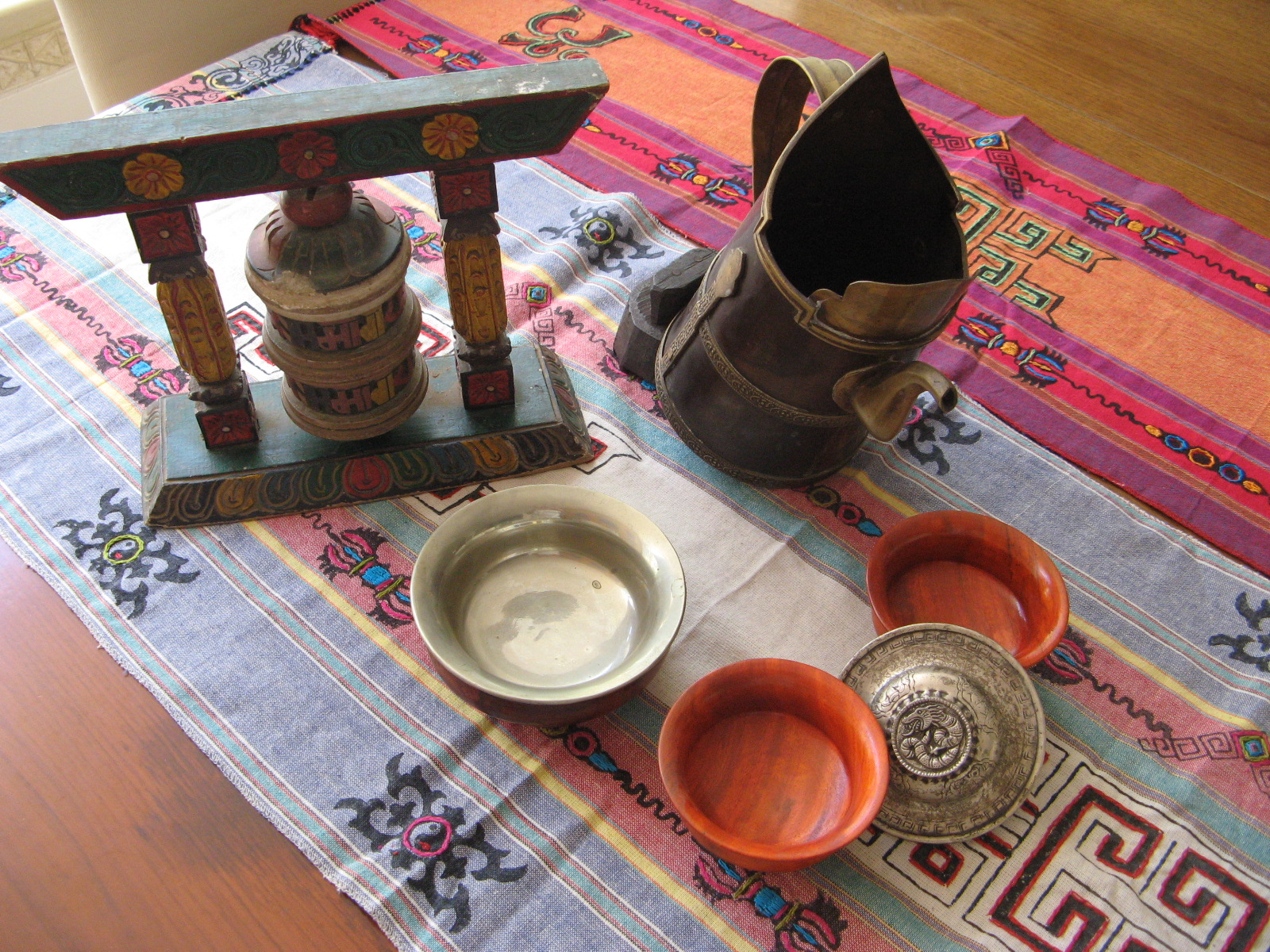
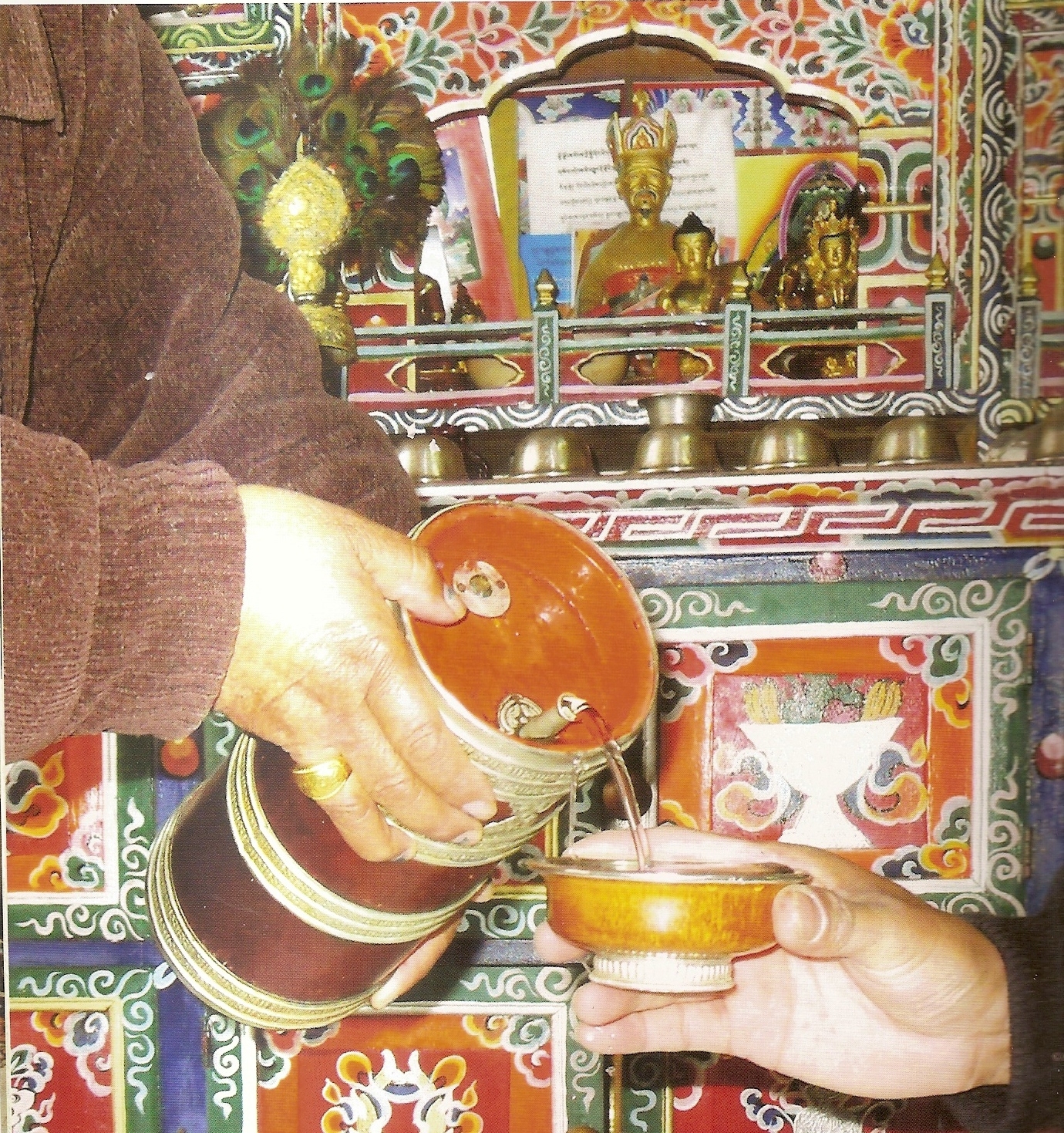
made from white or red maple trees. It is served on its own, or heated in milk butter or Yak cheese, with eggs or bone marrow, Yak dry meat and bone, fish and hornet with ginger and garlic (it stings!!!!!!).
No local festival (and there are many) is celebrated without Ara , Bhutanese new year and other celebrations of private, family’ religious or secular nature all have one thing in common – ARA. Is that what keeps everybody in Bhutan happy?, they are all content, relaxed patient and polite. Probably because instead of measuring the wealth of the land in gross domestic or national product (GDP).a concept of gross national happiness or “GNH” (this is for real and it is a great idea coming to think of it).
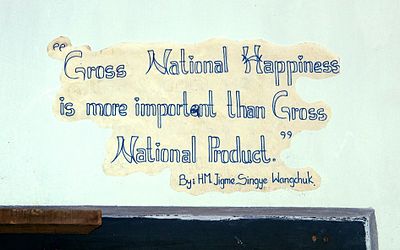
It was developed by the former King, in an attempt to define an indicator that measures quality of life or social progress in more holistic and psychological terms and live by it, really and I wonder if Ara contibuts to this nation’s fine, happy and dignified nature. I guess Ara alone cannot do the trick.
I toast a cup of Ara and say to you khal-chang !
your wineguide
The magnificence of the Douro A Visit to Niepoort
This is our first visit to Portugal, though my love of Port (the wine), always allured me to this lovely country it is only now the opportunity of a short visit came about…
The Romans arrived here a long time before me, around the 2nd Century A.D., conquering the Celtic inhabitants and establishing cities like Conimbrigia Setúbal, Aveiro, Obidos and Lamego to name but a few. The Romans brought wine and vines with them, and are responsible for introducing some eastern Mediterranean grape Varieties such as Muscatel Graudo, to the Iberian Peninsula. Its distinctive aroma is quite easy to recognize being one of the few grapes whose wine smells like the fresh grapes, plus scents of young raisins, lemons, tropical fruits, lime and citrus bloom. It has good, fresh acidity. Elsewhere in the world, it is known as Muscat of Alexandria, mainly used for sweet, fortified wines, most famous of which is Moscatel de Setúbal with its firm aromas of acacia blossom.
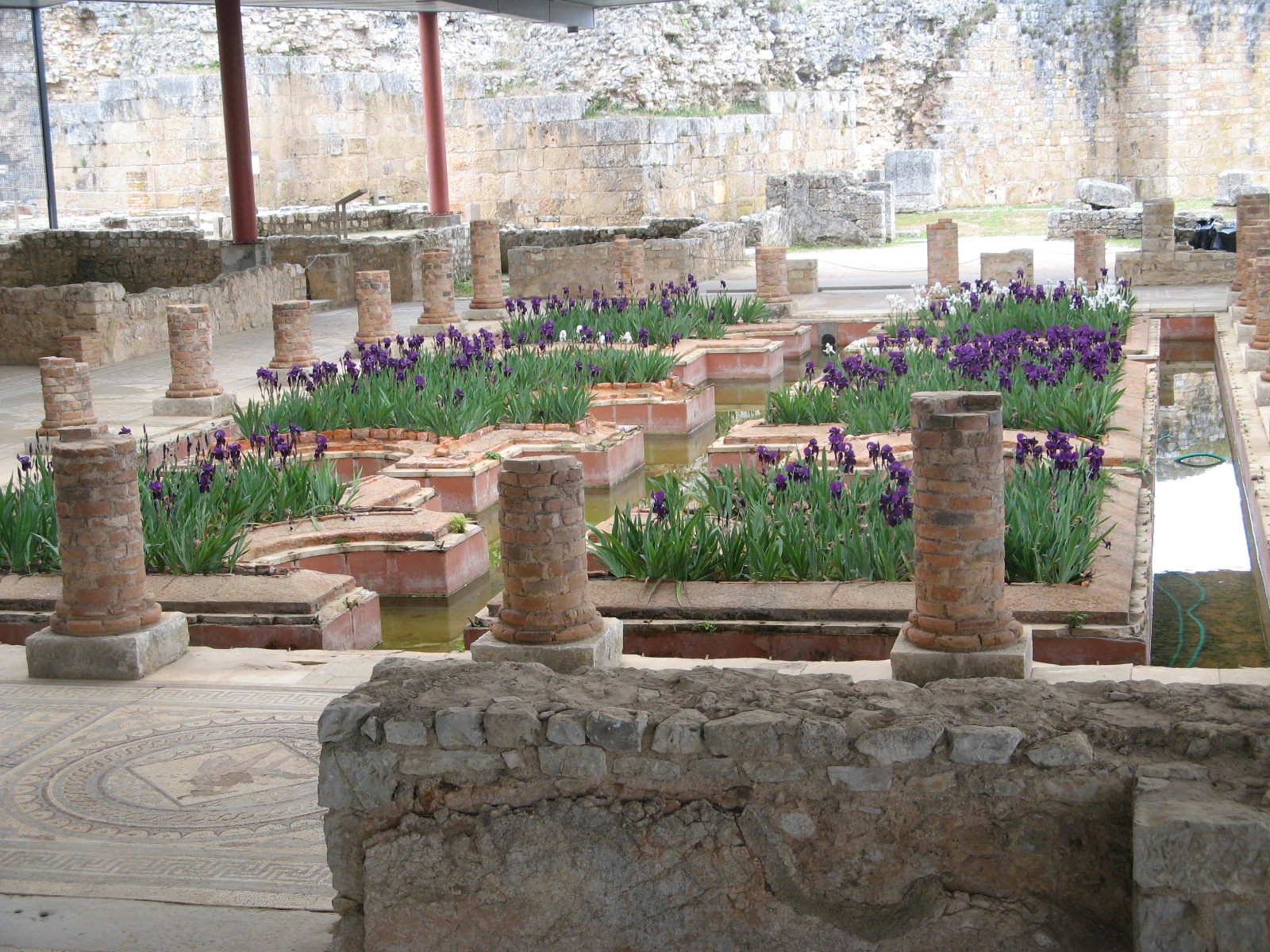

It is mid April and the fields are flowering with some wild flowers (it hardly rained this year in the Cima Corgo region, but this is an arid piece of land in European standards, still the vines are used to water shortage and hardship, and the vintners, as always complain about the weather…
We are leaving ancient Conimrigia, the largest Roman settlement in Portugal. Driving due north and entered through the “gate” to the Northern wine regions of Portugal, via Lamego the small town with the monumental baroque Sanctuary of Nossa Senhora dos Remédios.
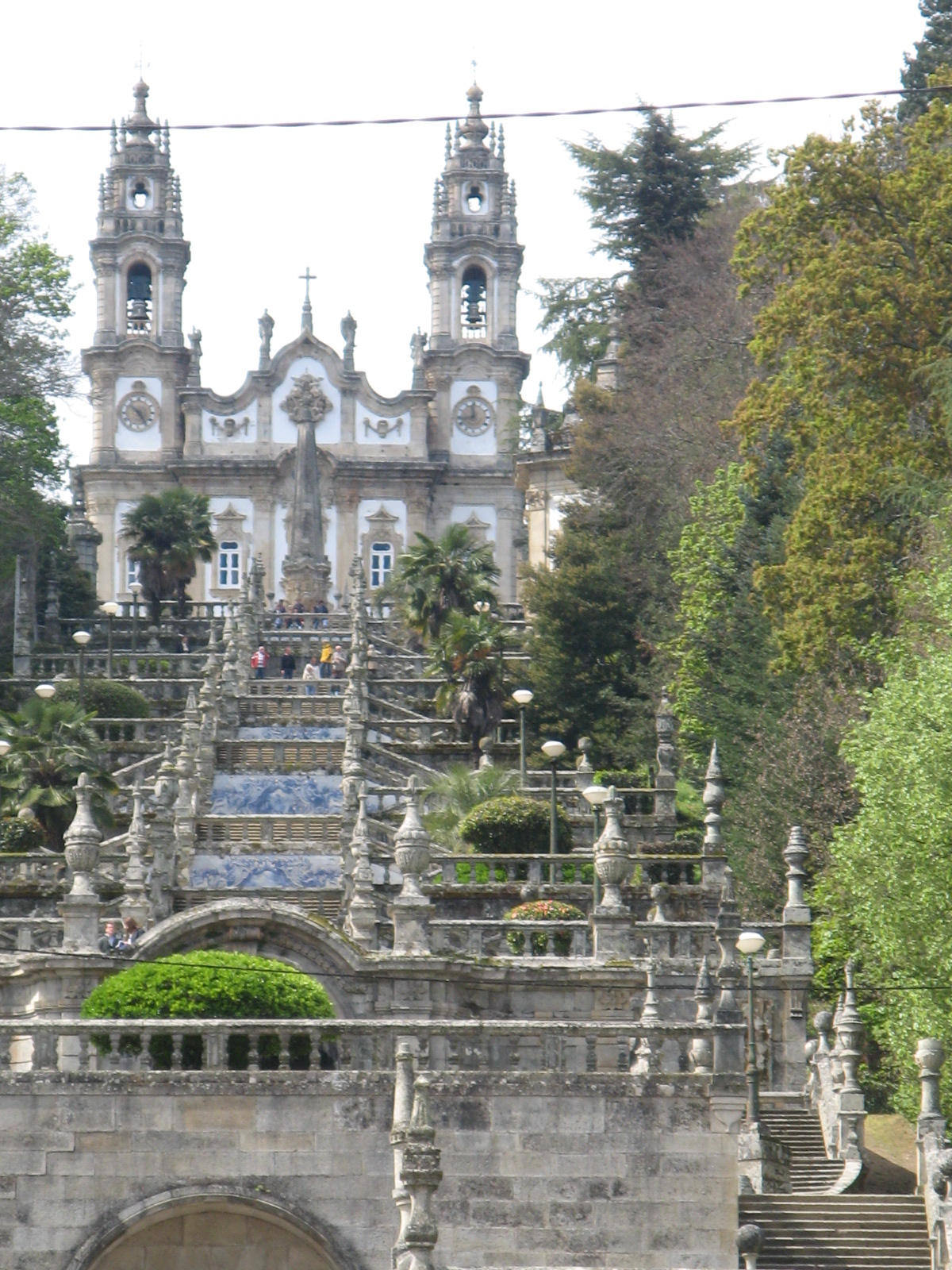
 A marvelous granite staircase decorated with tiles, allegorical fountains, small chapels, and statues which lead to a baroque church up the hill. What a wonderful sight, with views all over the town.
Next stop Pinhão in the Cima Corgo, one of the three sub regions that form the Duoro wine region. Cima Corgo – Located further upstream from the Baixo Corgo in the west, centered on the town of Pinhão (municipality of Alijó). The rainfall is about 600 mm a year. We’re heading towards the centre of the meticulously terraced Duoro Valley, enjoying the magnificent view of this spectacle: The oldest legally defined (AOC), wine-producing region of the world!


As a local saying goes, “God created the Earth and man created the Douro”, with its dramatic landscapes on the steep banks of the river created over centuries of human cultivation, made up of carefully terraced vineyards of the home of port wine. the Douro Valley is breathtaking with its hills covered with terraces of vines falling down steeply all the way to the river banks. The Douro River originates in Spain and flows west in the north of Portugal until it reaches the ocean in the town of Porto.
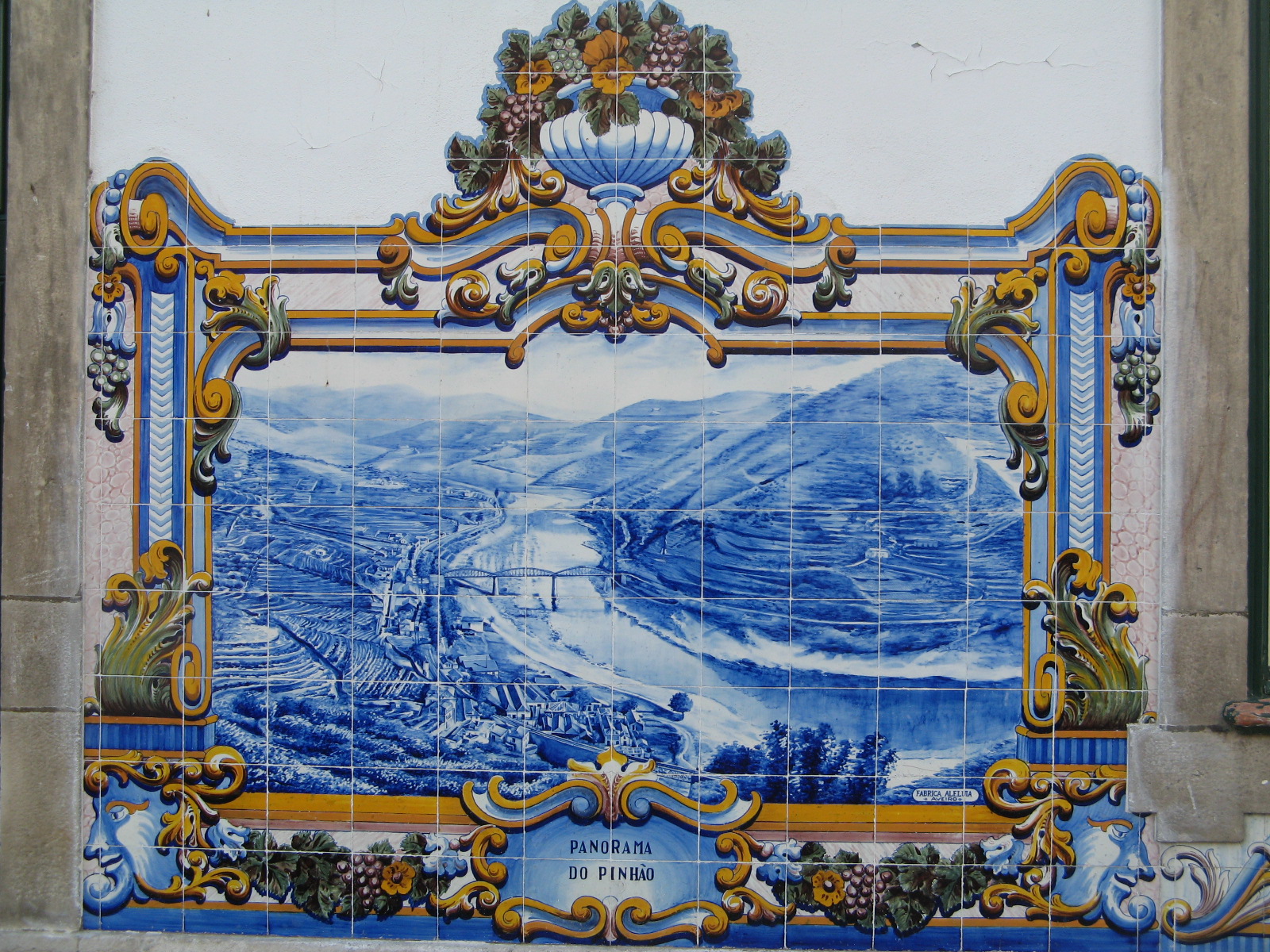
Today we enjoy the view and some wine and Port from various producers, and a good rest in The splendid C S VINTAGE HOUSE HOTEL, on the river bank in Pinhão, tomorrow we are invited to a visit at Quinta de Nápoles Just outside the town of Pinhão. It is one of Niepoort’s acquisitions of own vineyards, with wineries adjacent to them.


We cross the river to the north bank. The winery building designed by Austrian architect Andreas Burghardt, is camouflaged in the terraced hillside. Grapes travel a short ride from the vineyards to the reception area, which is the “roof” of the winery, and from there brought down the four floors of the building. Everything is there from the clusters stage start to the finished wine stage in the basement. It seems to fulfill Dirk Niepoort’s wine making philosophy. It enables a close watch on quality control of the wine, on the wine drop level, rather than the bulk Juice that starts in the “lagares”. (A lagare is the traditional container made of granite or cement where grapes are foot pressed for juice extraction).

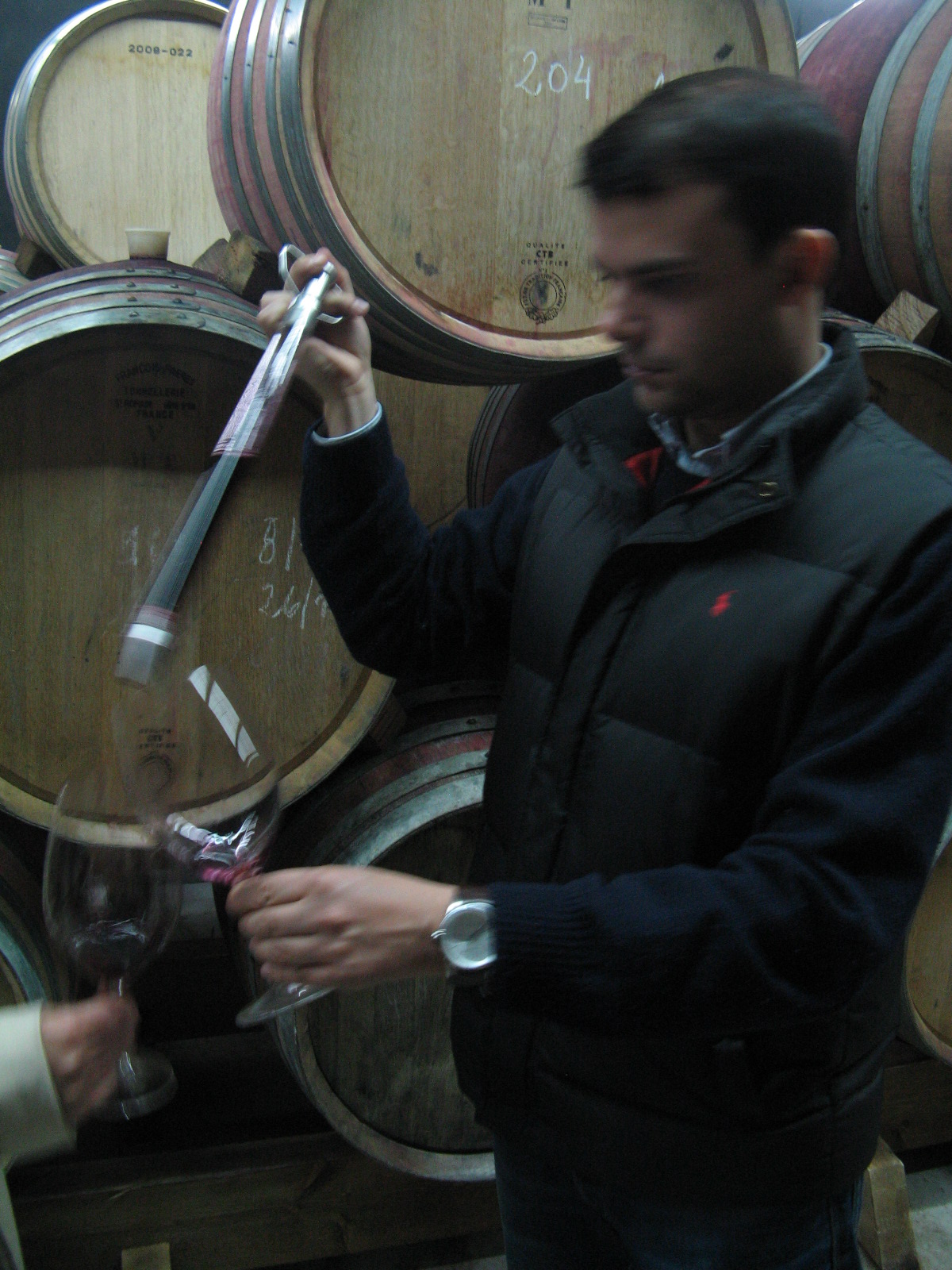
As our hosts Gabriela Santos and Carlos Raposo emphasized, that owning Quintas and vineyards in the Douro was an important step in the continuation of the port wine tradition and the first step for the creation of Niepoort table/dry wines. Niepoort is now at the top of Douro winemaking, I guess this is because he originates from the love of excellent wine in general, placing him amongst the leaders of the new generation of quality winemakers who combine the best of both the world, that of 350 years old local tradition with a desire to produce world class wines. Some of which we will taste shortly from the barrels and from the bottled past vintages.
Till today Niepoort, was in my mind, the winery that produces the best Colheita Ports and as it turned out it produces serious and sophisticated dry red and white table wines.
I will not bore you with the laborious job of barrel tasting we did in the barrel cellars, some of which were absolutely surprising to me as a novice to those Portuguese grape Varieties for whites: Rabigato, Codega do Larinho, Arinto, Gouveio and Viosinho, for reds: Tinta Amarela, Touriga Franca and Nacional, Tinta Roriz, Tinto Cão, and several others. The region’s geology of mica slate and schist’s soils of the region, the usually harsh climate and the fact that most wines are made from old age vines 60-100 years old and that all wines are blends.
Here is where the secret lies, and the Art shows. Lead by the winemaker at Quinta do Nápoles Luis Seabra. The aim is for blended wines which sum up to much more than their separate parts, and it works!


Food is prepared with love and attention by the Quinta’s cook Maria José da Fonseca Mansilha. Who cooks and serves and over sees the lunch country style fare meticulously presented as you can see. With us set to the table Paulo Dinis Barreto the owner of EnoMania wine Distributor from the Isle of Madeira and his friend .
We start with Redoma Branco 2010 here you find an intense mineral flinty character, combined with the a touch of grapefruit bitter flavor with a sweet finish and added aroma of citrus blossom. A bit of smoky oak aroma, that does not mask the aromatic elements of the wine. A good crisp start
We move on to the more complex Coche 2010 a great wine with substantial character, Coche shows intense red grapefruit aroma with a touch of fresia floral notes with multiple layers of flinty mineral touch. A very long multilayered finish on the palate. A wonderful wine!
Than the reds come pouring in
First, the Vertente 2009. It has deep and cloudy purple color. Red and black fruit aromas, a touch of green pepper with mineral finish. Good balance, and elegant but powerful fruit with great freshness. The tannins are firm but not obtrusive. Will keep for another 5-6 years and even improve as the tannins round up.
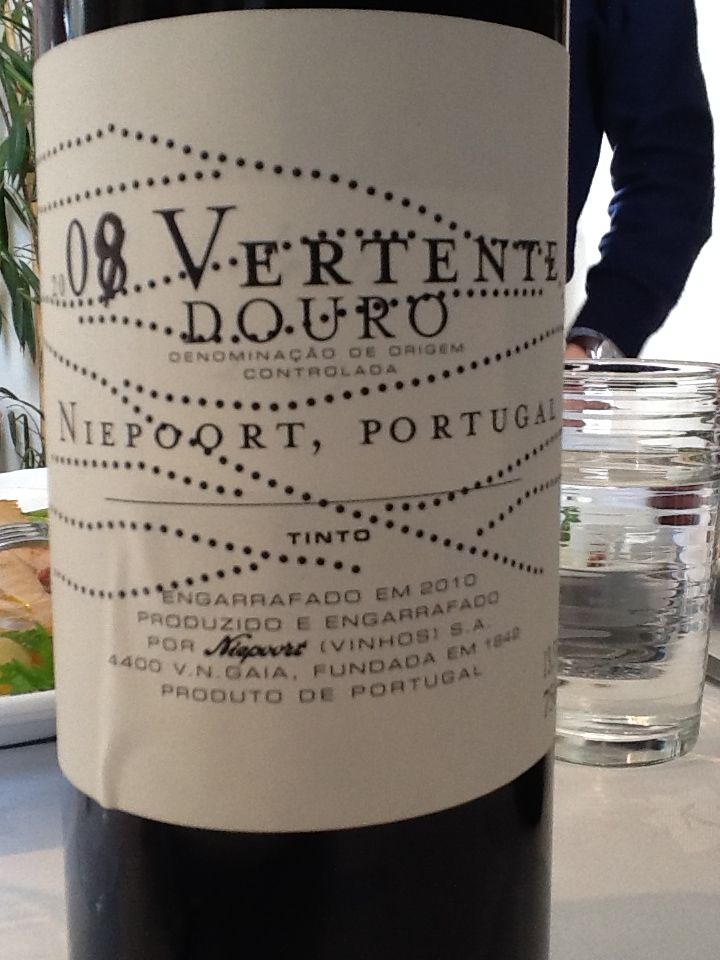

Than came the Charme 2009 although quite Dark in color, the first thing that comes to mind when you sniff in the earthy mushroomy aroma is Bourgogne and it may well be what was on the blenders mind as the wine evolved. Even after 14 months in the barrels not every barrel is chosen to be bottled as Charme. There is an aim here and if not reached the wine will be used in other blends. The Charme 2009 is rich and elegant, with dark cherry, plums compote aromas, deep wet earth, mushrooms and a touch of truffles aroma engulfs the palate, the wine is totally hedonistic aimed at the pursuit of pleasure in the same manner a good Époisses de Bourgogne is. The finish is long with extremely good balance; tannins are well integrated and appear soft but will keep the wine for at least another 10 years. This was my favorite wine of our lunch/tasting.
But the most characteristic of the region in my mind is the Redoma Tinto 2009 Dark in color Mainly ripe black fruit aromas, with plenty of dark plums, a strong aroma of mint and thyme and of wet forest leaves. Flint stone touch and good tannic touch turning velvety well balanced with good acidity and fruitiness. The wine is very expressive almost extrovert, and rich, with very long and persistent finish. A wine true to its origin and Paulo’s favorite of the reds.
And to sum it all up, we had 2 Wonderful Ports

The Neipoort Vintage Port 2009 (Paulo’s preference for dessert).
The color is deep ruby blood red, and the aroma is all about sensuality, with freshly ground mixed sweet spices of cinnamon stick with cloves and English pepper with green cardamom. On the palate, amazing presence of huge tannins and high concentration of ripe re and black forest berries, very powerful but elegant, which is so well balanced that it seems it may keep forever (almost). I would buy a case to keep for my grandchildren and the generation to follow.
And the Neipoort 2001 Colheita (my choice for dessert).
Colheita’s are tawny Ports matured in wood for at least 7 years but most are taken even further before bottling. In Neipoort the grapes were trodden (by feet) in cast cement lagares and later the port is matured in small old oak casks. Colheita Ports are Tawny Ports from a single vintage year.
Wonderful brick reddish brown colour. It remindes the mysterious aromas of the spices street in an oriental souk. Scents of dried fruits, black shriveled grapes with burnet tea leaves, coffee and tobacco all with flavour of dried prunes and Figs in sweet liquor it has a long finish of soft and oily honeyed alcohol. A sip of that and with your eyes closed you can almost see shehrazad dancing in the palace of the Sultan. (Imagine what you see when you drink the 1900 or the 1970 Colheita! Alas we did not have that chance on the day. Maybe on our next visit)
We had the Ports with the amazing cheeses and Marias Orange cake.
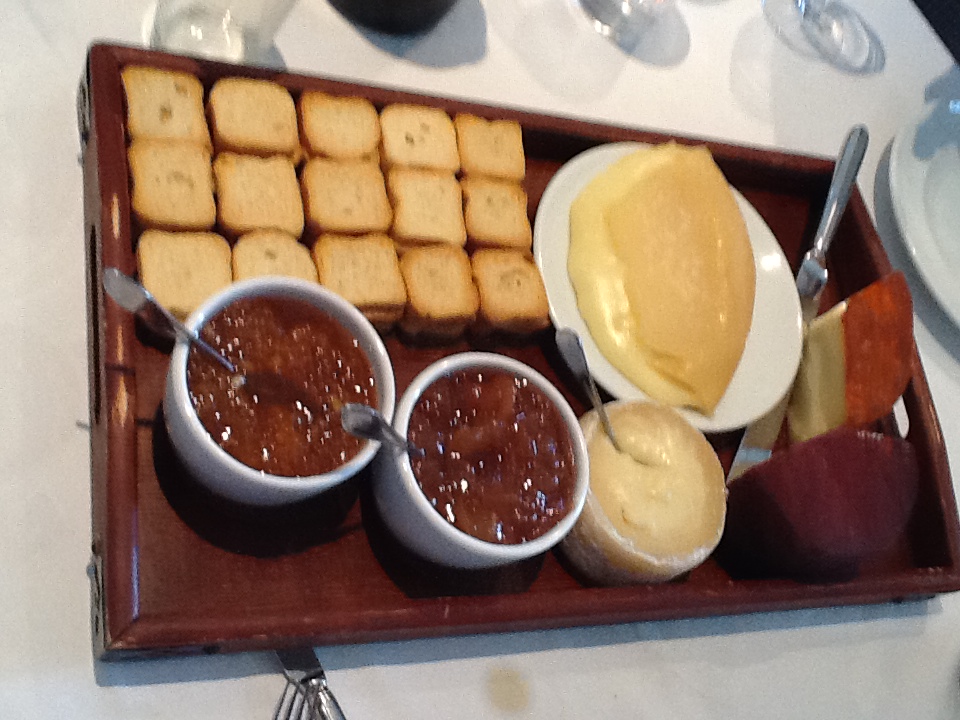
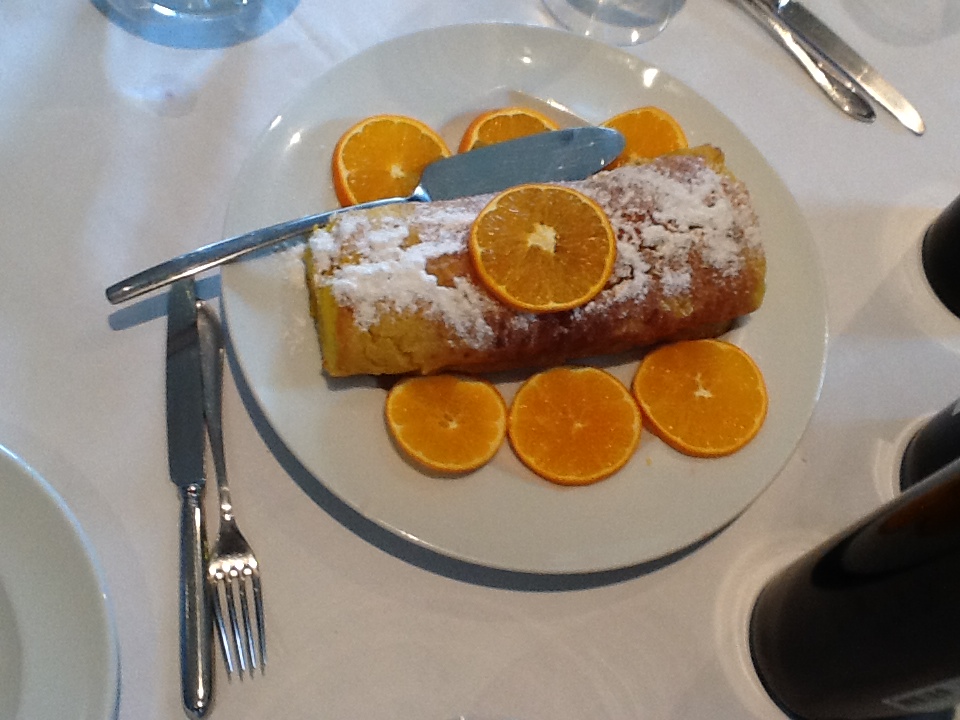
And had to excuse ourselves we still had 2 hours drive to Porto and a fair amount of alcohol in our blood. Vilanova de Gaia looked a far reach But tomorrow we have a plane to catch to London where for ages these wines headed across the ocean and the English channel to it’s destination on the London Docks.
We parted our wonderful hosts sorry we were not staying in the region for at least another day with the magic taste of the Ports still lingering on our palates.
Adeus Porto hasta pronto.
P.S.
The Neipoort Iphone Ipad App is on : http://itunes.apple.com/en/app/niepoort/id517958040#
The wineguide
Perfect wine and the Paradox of perfection
We had a perfect meal; we drank the perfect wine … What is perfection? When is perfection? Is there perfection or near perfection in food or wine?
Let us try to define perfection: is it conforming absolutely to the description or definition of an ideal type: a perfect sphere;? Or is it: excellent or complete beyond practical or even theoretical improvement: a perfect meal, or is it: entirely without any flaws, defects, or shortcomings: a perfect dish; the perfect wine. . What is perfect?

The oldest definition of “perfection”, goes back to Aristotle. In the Metaphysics, he distinguishes three meanings of
the term perfect, or variations to one meaning, but in any case three different concepts
1. Which is complete — which contains all the requisite parts;
2. Which is so good that nothing of the kind could be better;
3. Which has attained its purpose
The parallel existence of two concepts of perfection, one strict (“perfection,” as such) and the other loose (“excellence”), has given rise — perhaps since antiquity but certainly since the Renaissance — to a singular paradox: that the greatest perfection is imperfection. This was formulated by Lucilio Vanini (1585–1619). The paradox of perfection is that imperfection is perfect, applies to cooking and oenology in the same manner it applies to technology. Thus, the irregularity in semiconductor crystals (an imperfection, in the form of contaminants) is requisite for the production of “perfect” semiconductors. (loosely aided by WIKI) The solution to the apparent paradox lies in a distinction between two concepts of “perfection”: that of regularity, and that of utility. Imperfection is perfect only when that irregularity is useful. In short, very often the accumulation of small imperfections lead to perfection
But before the Renaissance paradox there was the fact.
 That of Dualism and “Daoist” or “Taoist” belief that the “whole” is a combination of its contrasts: there’s no good without evil, light without darkness Yin and Yang…Hence the perfection of the whole is relying on the imperfection of its parts. Eastern philosophy does not look at the imperfections within the “perfect” as a paradox, but rather as a ,, where two opposites co-exist in harmony and are able to transmute into each other. So balance is what it is all about!!
Think of “…the wine is perfectly balanced” or “…the dish is well balanced” or even “…an amazingly balanced meal ” these all contain numerous balancing factors which are often opposing to one another in character shape taste flavor aroma and color, are not necessarily in even quantities and their assembly creates the “Perfect” balance which is a combination of a variety of imperfect irregularities that contributes to the perfection of the end product be it wine dish or a whole meal (with or without the wine).. The solution to the apparent paradox lies in a distinction between two concepts of “perfection”: that of regularity, and that of utility. Imperfection is perfect in technology, in the sense that irregularity/imperfection is useful. This applies always to cooking and wine making. The term “perfection” is actually used to designate a range of diverse concepts. If perfection is, broadly a state of completeness and flawlessness and in food and wine balance is the “gate” to perfection let us look (in this post), at the components in the balance of wine: A balanced wine is considered to be in proper harmony of acidity, fruit, sugar and tannins. A wine may show many good characteristics, but it will not be complete in other words perfect!!! unless it is balanced.
Balance is a wine characteristic quite unrelated to flavor of wine, it means that the alcoholic strength, acidity, residual sugar, and tannins complement each other so that no single one of them is obtrusive on the palate.(from The Concise wine companion, by Jancis Robinson). All the imperfect components “meet” to create perfection i.e. the perfect wine! A paradox? Not at all. Why? Because anyone of us had a perfect wine on a day or a perfect meal and not just once but we tend to “describe” it always as a “near perfect” I guess we are afraid to “reach” perfection, after which none would look or taste or smell the same?
Should any great wine be the Nadia Comanechi of wine? A perfect 10 on all counts?
Or is a perfect wine, the wine you felt was perfect for that moment? Personally as a complete hedonist I prefer to sense a special wine I am having as a source of pleasure and self-gratification. Therefore I had and will have many perfect wines. I am not sure that all the “perfect” wines some of which listed were always perfect on the occasion (some of which I “heard” of and some I did have), like Chateau Cheval Blanc 1928, 1947 0r 1961? Fonseca Vintage Port 1927 1948 1977? A bottle of Krug 1982 or Mouton Rothchild 1945? Latour 1982 or many other that are considered top scorers, perfect wines 100 points from all directions, many of which I had over the years were perfect on the occaison for various reasons, but rather a wine you had which at the time and till this very day is unforgettable hey? Like the Roumier. Chambolle Musigny. “Les Amoureuses” 1982 I used to have as a special treat and every time whichever the occasion was had this magic touch of a perfect wine,
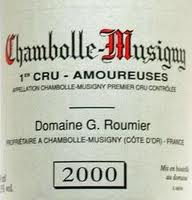
or a 1995 Bollinger that knocked me down with its completeness and is not up there with the so called or considered “greats”, or La mission Haut Brion 1976 some of which were waiting in a dark corner down my cellar and was a celebration and had the grandeur of a mythical genie in a bottle, or the 50 bottles of NV Krug and 6 magmums of Cos d’Estournel 1986 I served at my 50th birthday, even the oxidized 1962 Maison Noemie Verneaux Mersault Charmes I had not long ago with friends had all the components that make a great wine certainly after 48 years in the womb/bottle. So many others come into mind of good (that’s all) wine bottles that were perfect on the day.

I feel lucky to have had the chance to have them with the company of people I like or with just the right food and never on my own! A perfect wine bottle is something to share and admire in company not alone!
The Wineguide is urging you to write in your very own perfect wine or wines. It is a great pleasure to relive those moments, Try it and see.
I await for your “perfect wines” with anticipation and curiosity.
The Wineguide
 WINE FOR SOUL