A Feast at the Fat Duck

“Bring the sense of FUN”.

A Feast at The FAT DUCK
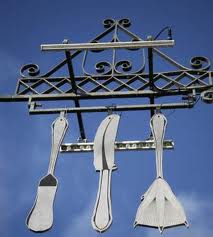
10:38pm Late September 2011 a “rain” of emails from my old buddy Spike in London, came pouring down on me: Hey Buddy – we have a table for lunch @ the Fat Duck next Tues. – really really really looking forward to it buddy sweet dreams SPIKEY X”
“The table is booked 12.30 as that was all they could get so we have 2 leave earlier – fergus p.r@ st J. did it & he said it was a right carry-on lets make sure we get there on time innit?
looking forward 2 it buddy sweet dreams SPIKEY X”
The buzz of enthusiasm caught me as well, a visit to the Fat duck, is a meal I “promised” myself for the last 10 years (since the Restaurant got its first Michelin Star) and the raves regarding a new star in the culinary sky started to tickle my taste buds and imagination, but somehow I never got down to arranging it well ahead enough and kept missing my opportunities for a meal at “The Restaurant at the end of the Universe”. This is: “The ultimate hot spot for an evening of apocalyptic entertainment and fine dining, where the food (literally) speaks for itself”. (From “The Restaurant at the End of the Universe”, by Douglas Adams.).
Spike, through his web of connections finally managed to arrange a meal at the Fat Duck, the restaurant that serves Bacon and egg ice cream, snail porridge and all, molecular cooking (As it is often described in the media)
Such a sense of culinary anticipation had not struck me since I (obsessively) dined, ( 20 years earlier), with the world greatest: Fredy Girardet, Joel Robuchon, Bernard Loiseaux, George Blanc, Jacques Lamellose, Pierre Gagnaire, Alain Ducasse, Marco Pierre White, Pierre Koffman, Daniel Boulud to name but a few…
As a matter of fact I like this feeling of tastes and flavors hype that engulfs you at a perfect meal, (a kind of addiction), it is as if these guys (Top Chefs), know of the anticipation and expectations most of their customers come with… and have this magic touch to form the perfect setting for that very day, for the man who came to dine (ME).
I must admit I’m not much into culinary terms such as Molecular gastronomy or molecular cooking as the “great” Mr. Herve This, calls the cooking at El Bulli or The Fat Duck, or the “late” term”: nouvelle cuisine”, which is actually an old term (since the 1740s) used throughout the centuries for anything new at the time, in the preparation combination or presentation of food, for example, the cooking of Vincent La Chapelle 1735, or François Marin was described as nouvelle cuisine of the time, in 1890s the cooking of the great Auguste Escoffier, the epitome of traditional cuisine was described with the term “The modern” – Nouvelle..
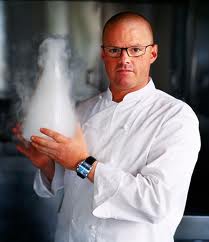
 I like restaurants that try and succeed to “give pleasure and meaning to people through the medium of food”. As our host Heston Blumenthal neatly put it: “Build food while predicting the effect on the eater.”
We did arrive on time, and Bray is not a big place, but if you don’t look up and catch a glimpse of the Restaurants Logo you will not find it as it is well hidden behind the walls a modest looking English country House, no boasting, very dignified, and we missed it (what anticipation does to you…) so we strolled up the street to peek inside the ‘The Hinds Head Pub’ 30 yards down the road and ask for DIRECTIONS. You open the door yourself (I like that), it feels like entering your own home, no gate keepers, or other paraphernalia which is inseparable in some 3 Michelin star restaurants. Thank God I can’t stand these tedious manners.
They let you settle down and do all the necessary bits and bobs of bread, water and wine. Which is if you think about it a necessity of any restaurant, but also a traditional welcome almost in all cultures: bread and water or bread and wine were served as a welcome gesture since biblical times.
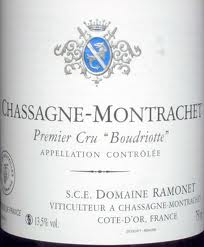
So we ordered a 2004 Chassagne-Montrachet 1er Cru, Boudriotte, Domaine Ramonet That went very well with the first half of the dishes in the menu.
Now we are “all set” as the restaurant needs our full attention with the opener which I would call an Amuse-bouche, usually a “mouth amuser” which serves here as a Meal amuser The LIME GROVE- Nitro poached green tea and Lime mousse. The liquid Nitrogen is bubbling and evaporating in a white mist in a container into which a ball of lime mousse is tossed in and turned around in a freezing temperature of −196 °C as the mousse hardens, a dust
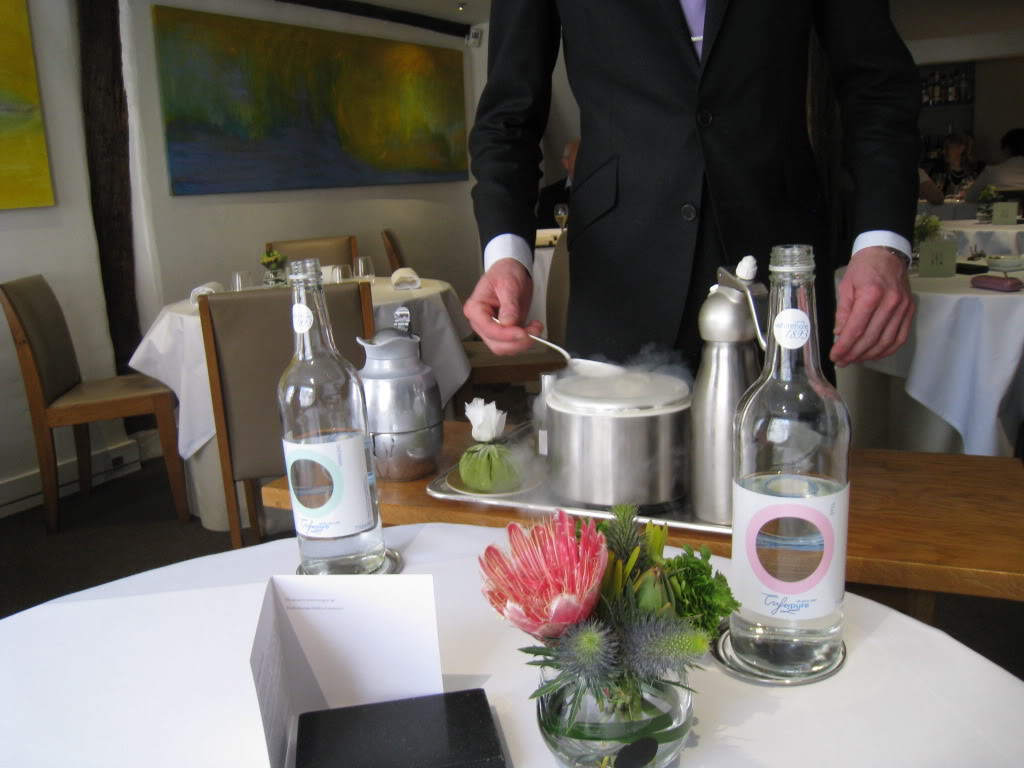
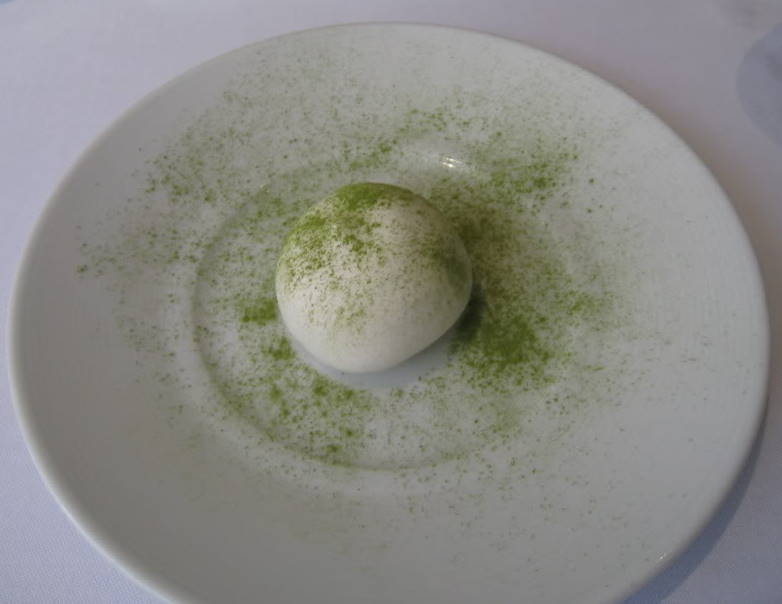
of green tea is sprinkled over and just before you’re requested to put it whole in your mouth the finishing touch of Lime fragrance is sprayed over your head and engulfs you with the aroma of lime inside and out and the mousse melts in your mouth as you bite the “hard / soft” ball of delight. It is fresh and fun and tingles your taste buds with the sense of fun it is intended, still with the correct concentration of the flavor of what it is meant to be: a lime mousse in a bite. Welcome to the Fat Duck, Here life is beautiful…
The theatrical curtain opener is over, but as in the theatre the show must go on and the first course is served: RED CABBAGE GAZPACHO served with ice cream of Pommery Grain Mustard.
Well, Pommery mustard, also known as Moutarde de Meaux, this is truly a culinary historic gem. This jewel of condiment comes from Meaux, France, (just northeast of Paris). It is said that French kings have been dining on this mustard since the early 1600s. Of all gourmet mustards, this particular mustards blend is on the top of the list, both for its richness and its simplicity. It is said that the secret recipe for pommery mustard originated with an ancient religious sect that lived in the town of Meaux,. In the year 1760, the secret was revealed to the Pommery family, and they have kept it safe ever since.
Back to the dish, though the photo speaks for itself, a deep purple smooth Gazpacho or traditional Russian Borscht (both would fit the description) decorated with a delicate grained white ice cream with a hint of very fine mustardy flavor that looked like the sun setting into an ocean of purple bliss,
 
as in the Deep Purple song Lalena that came right to my mind (press play to listen to the song as you read on, to ease the pain)

When the sun goes to bed

That’s the time you raise your head

That’s your lot and life, Lalena

Can’t blame ya, Lalena!

Lalena is the name of the Russian girl eating her Borscht and sour cream…
You dig? I can’t blame YA.
Aren’t we having fun??? I am now as I was then, slurping the meticulously spiced almost “Gazpacho essence” with a morsel of ice cream to melt on my tongue on every bite.
We’re through the first two dishes and your Tenzo is giving you a “break”, as I was given between each and every dish (of around 15-20 leisurely moments) for our five senses to sink into the meal’s atmosphere
We slid down the rabbit hole and still have 10 more dishes to go,so patience my friends,

Create one mouth full of food with 3 separate flavors Feast at the Fat Duck

…We cleared our palate from the delicate Gazpacho, flavored with a hint of the tiny cucumber cubes (brunoise) and mustard, with the excellent breads on offer (which bread would you like Sir?.. a bit of both, of course! …) especially when enhanced with the voluptuous sea salted french butter, I love good bread it is so basic yet can reach heights of pleasurably delights under the loving care of a good Baker, and even better, wrapped up with some more sips of the fresh Chassagne-Montrachet 1er Cru, Boudriotte, Domaine Ramonet 2004 , served by the capable, gentle, and knowledgeable Mr. ISA BAL the Duck’s head sommelier . Though the 2004 is not the best vintage year for Bourgogne’s whites, Boudriotte always displays finesse, elegance with a long, ripe finish yet crisp with a strong sense of green apple peel, balanced with notes of crème patissière and toasted butter brioche. My wine of choice to fit the occasion, it went very well with the first four offerings.
Now, the table is being laid down with the stage setting of act 3 of the show: “welcome to your very own tiny oak forest, the only place truffles grow…”.
It is a wonderfully orchestrated Homage to Alain Chapel legendary dish Jelly of Pigeons with 3 chicken oysters and young vegetables, The FAT DUCK version: Jelly of Quail, crayfish cream, chicken Liver Parfait, Oak Moss & Truffle Toast.
 
A game of associations…A long name and an elaborate setting to go with it, first a wooden box with Oak moss that looks like a rectangle piece of grass, which brought another smile and sense of fun to the table with two “fat duck Oak films” to melt over your tongue which has a delicate aroma of Oak that spreads around your mouth and evaporates through your nose with an oaky bark sensation and a touch of wet oak moss,
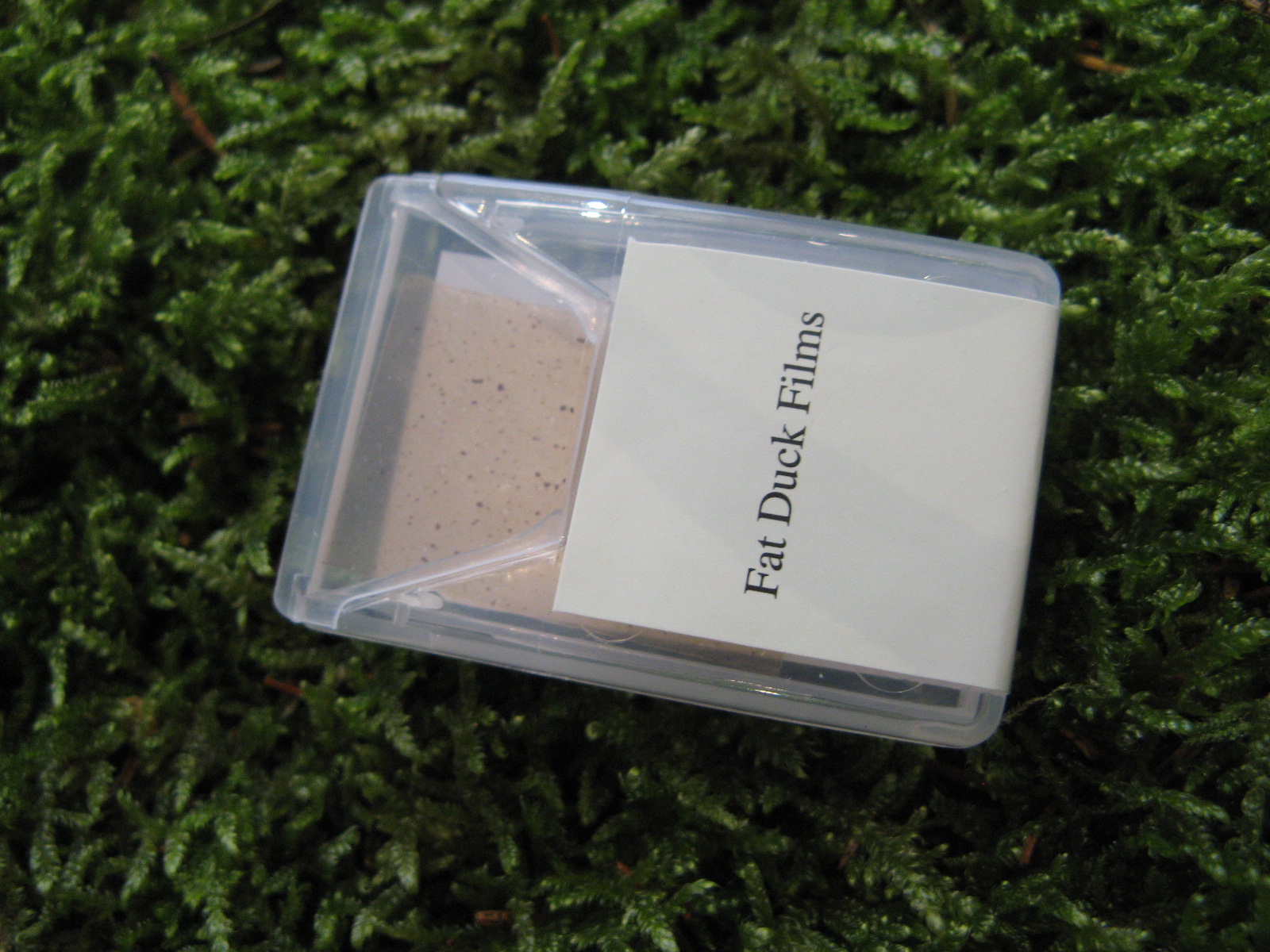
as the films melt over our tongues the waiter pours hot water and oak scented oil on the turf box causing vapors of oak scented mist, to crawl out of the box and over the table cloth onto our laps,
 what a wonderful sight luring you into an enchanted forest where truffles may be found under the Oak trees.

Quite rightly Spike said: “Heston Blumenthal must b mad as a brush!” What a load of fun… And that is the basic Idea behind all this so far wonderful meal, innit? The whole scene immediately reminded me of Woody Allen’s father’s “Piece of Land” from the movie Love and Death (Have a look and tell me I’m wrong!

The rest of the dish is laid around with sensuous pastel colors of brownish peach and some surprises after you dug in (if you dare) to disturb the beauty of the triple wrapping “Babushka” arrangement of, outer layer of liver parfait covering the quail’s jelly with the “mushy peas” inside like a savory “Mozart” chocolate (Salzburg Mozartkugeln) course you do bite on it almost impatiently, after all we came to eat!!

All the rest is a bonus. The liver parfait is light and smooth coating a concentrate of quail stock jelly that really tastes of quail stew that bursts open to reveal a galantine pea mousse a smooth “mushy peas” style flavor and all of that swimming in a bowl of Langoustine cream.

We ordered some more bread and wiped the bowls shining clean Superb!The truffle and oak toast was forgiven due to mitigating circumstance concerning the time of the year being way beyond the truffle season. Most diners, (I know I would), could easily be fooled by some drops of good truffle oil or white truffle paste to enhance the aroma and flavor of the truffle toast, we happily settled with the Oaky atmosphere that was bestowed upon us.We were in a state of constant blissful smile which threatened our facial skin so I looked around the restaurant and literally every guest was HAPPY! The sense of fun caught all forty four of us diners, mission accomplished as far as the Kitchen and the Ducks philosophy is concerned : ” We believe that cooking can affect people in profound ways, and that a spirit of collaboration and sharing is essential to true progress in developing this potential.“
So Bring in the sense of FUN in life” through food and a visit to the restaurant. I too, always felt, that this is the idea behind a good restaurant, a good meal, a good food and wine outing.

Next came the Snail Porridge, Jabugo Ham, Shaved fennel. A dish always mentioned when the restaurant is in the media.
 Personally I’m not too keen on “Porridge” in its traditional preparation form, it’s not a food I was raised on or “learned to like” at early age, and you can’t deny it’s an acquired taste kinda food and consistency… neither am I hot for snails, they usually disappear in tons of herbs and garlic. This is my “challenge” dish and there it came the first thing that came to mind was the fresh parsley green color the same unique parsley green color of Bernard Loiseau’s legendry dish: Escargots Au Veloute De Persil. The Porridge was not overcooked and mushy (which is probably what I dislike about porridge), and the scent of the Jabugo Ham* added depth to the dish that was decorated with some braised and then butter sautéed snails, and some shavings of fennel.
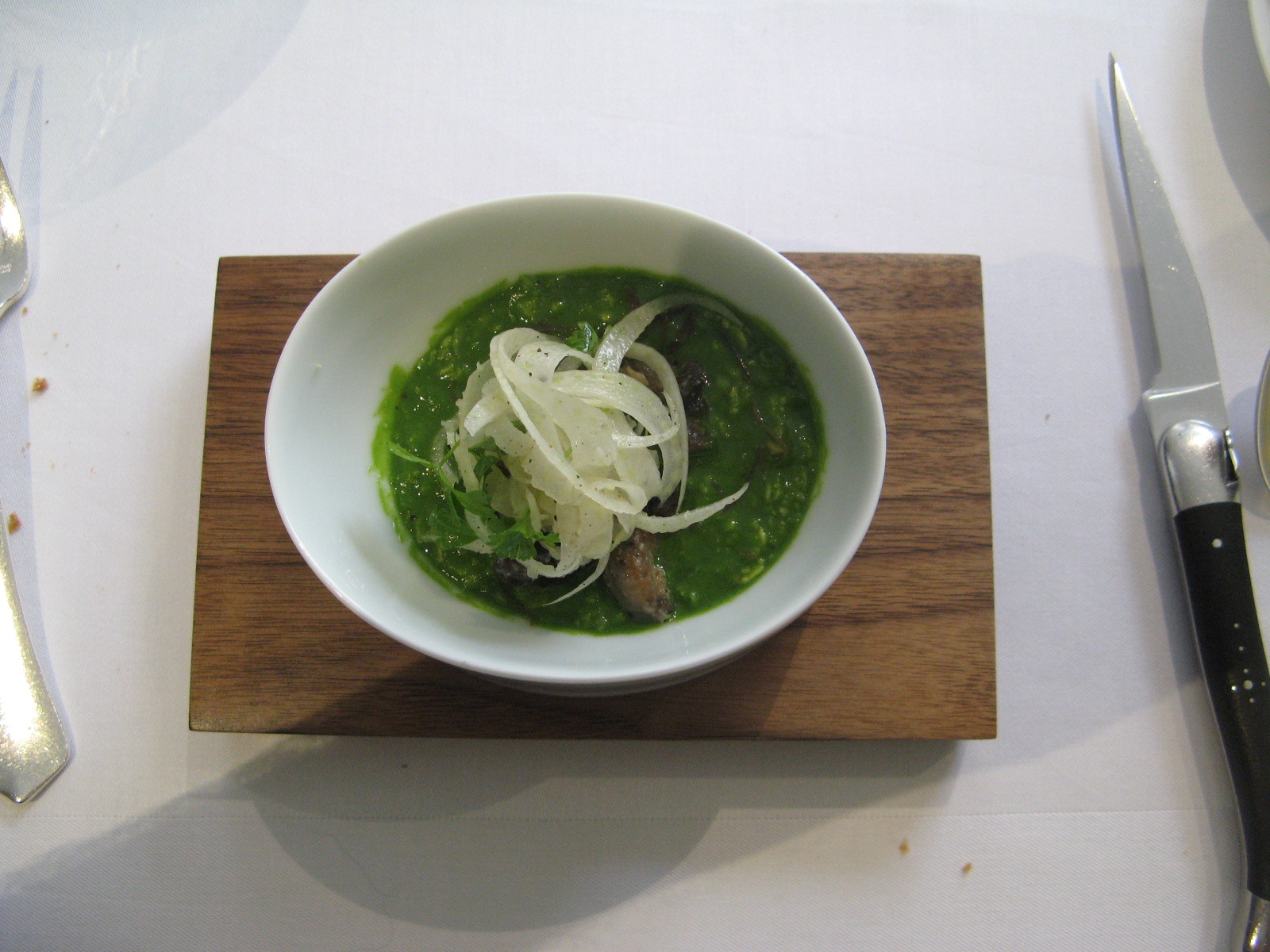
Needless to say it was again meticulously spiced and well balanced.
 *They say that “Jabugo breed pigs are the only animals of this species in which stored fat is redistributed thoughout the body, infiltrating the muscle fibers. These pigs consume a diet with a high acorn content their fat is of superior quality, giving the flesh its characteristic texture, aroma and flavour.

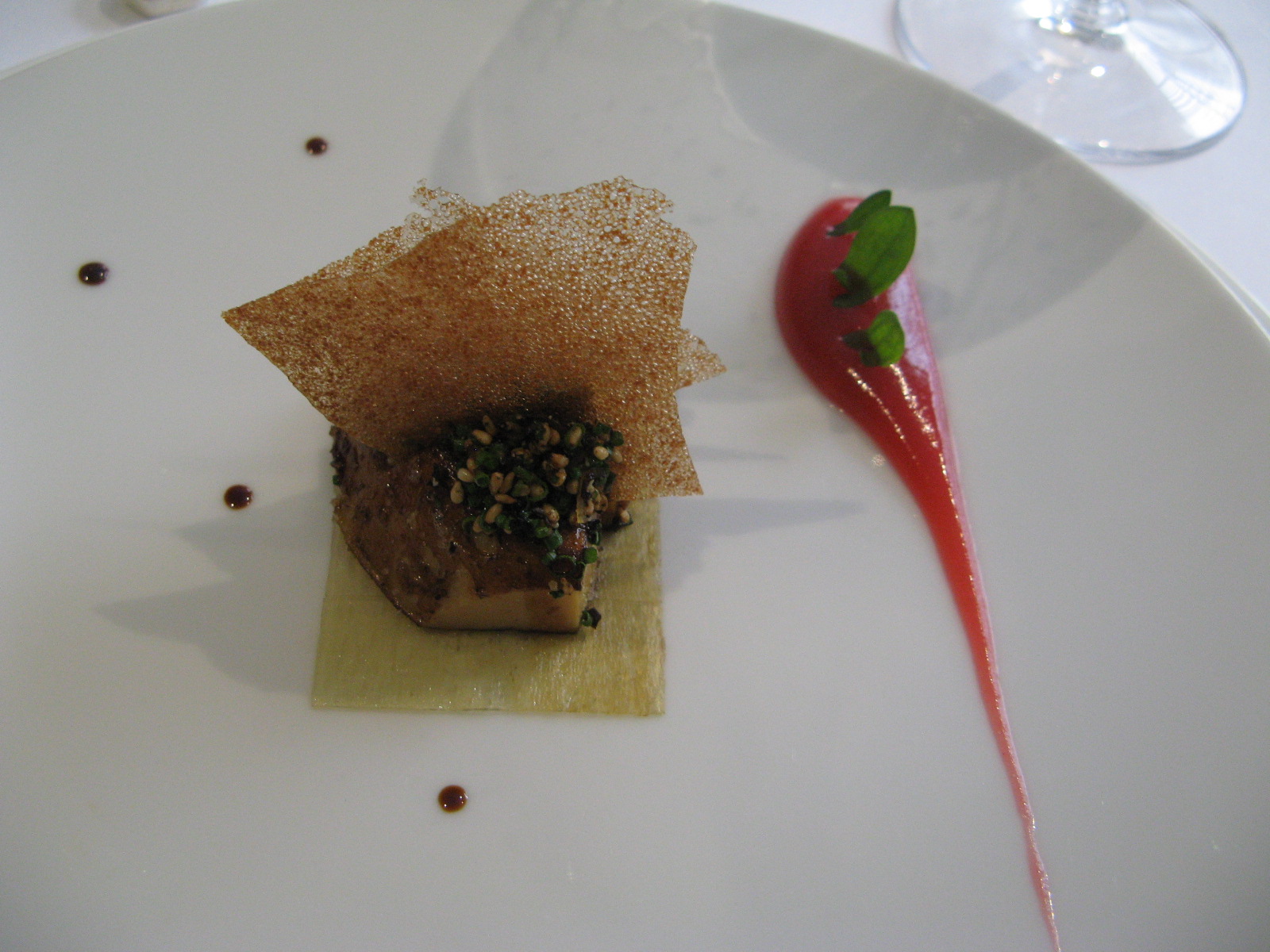
We were now served the Roast Foie Gras, Gooseberry, Braised Konbu and crab biscuit.

The foie gras was made to perfection, the pinkish late season, gooseberry coulis was a great compliment to the foie gras yearning for a touch of fruity acidity and the Konbu (Japanese sea weed) and crab thin and crunchy biscuits added antagonism in texture and taste with its sea saltiness to complete the balance. Great !!!
As I went out for a short break and a phone call to my dear friend Yair to consult on the next wine I am about to order from a shortlist I have prepared the night before, I thought to myself, what a pleasure it is to enjoy a really good meal in the right lighthearted manner and pleasant fellow dinners
And until I do decide upon the suitable wine I leave you till next time…with seven more dishes to go, where we’re invited to A Mad Tea-Party with ALICE.
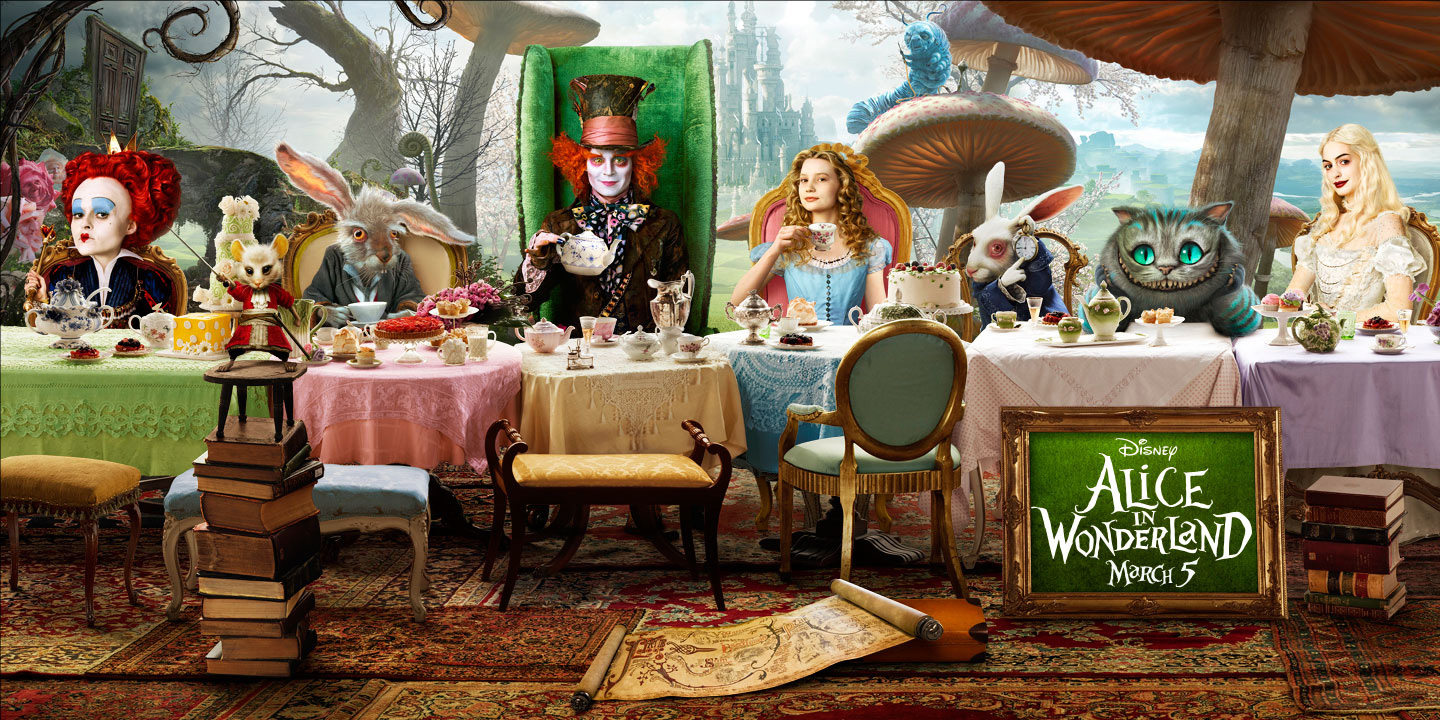
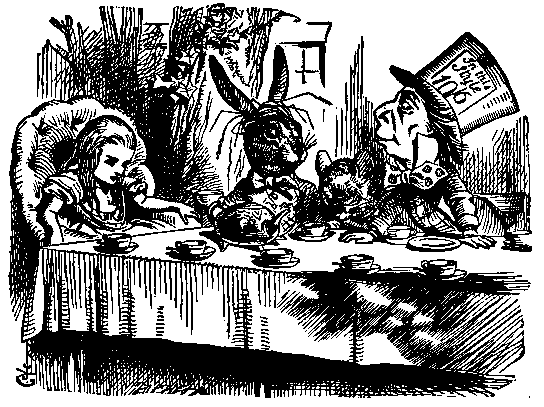
Like Alice in wonderland we were only half way down the rabbit hole, we were falling the very deep and wondrous well, and had plenty of time as we went down, Alice, Spike and I, to look about us and to wonder what was going to happen next.
 One thing I was sure of the wine we ordered is about to finish and a new bottle suitable for the next 4 courses should be ordered. Now the wine list at the Fat Duck is fairly large in volume and selection and I dislike reading book size wine lists in the middle of a pleasant meal so I made the effort and looked into it, the night before (Hooray for a good internet site) such as the Fat Ducks: http://www.thefatduck.co.uk/The-Menus/The-Wine-List/ and made myself a shortlist of about 5 wines (Spike drinks only whites) after being satisfied with my first choice I thought a more “reddish” white wine will be more suitable, and the meal was so enjoyable up till now, I decided to consult with a “telephone friend”. Yair my dear friend was the obvious choice and although he and later Isa (the house sommelier) tried to direct me in a more fresh and elegant direction, and even tried to “warn” me of the extra oakiness of Mounir Saouma touch, on this specific wine. Still I knew I wanted to taste the wine of my fellow countryman Mounir who “made it big” in Bourgogne which is not a trifle matter and so I opted for the Chassagne-Montrachet 1er Cru, La Romanée, Lucien Le Moine 2004, which turned to be on the day a wine well suited for the rest of the meal. While the bottle is opened and given a much needed “breather” let us have another look at the oaky mist (this time) from our very own table:The break is over and I felt like the March Hare mumbling to himself: ‘Oh dear! Oh dear! I shall be late!’ I returned to our table to get ready for the next dish: MOCK TURTLE SOUP “Mad Hatter Tea” , In the words of Lewis Carroll it is : A Mad Tea-Party (CHAPTER 7, Alice’s Adventures in Wonderland by Lewis Carroll 1865)

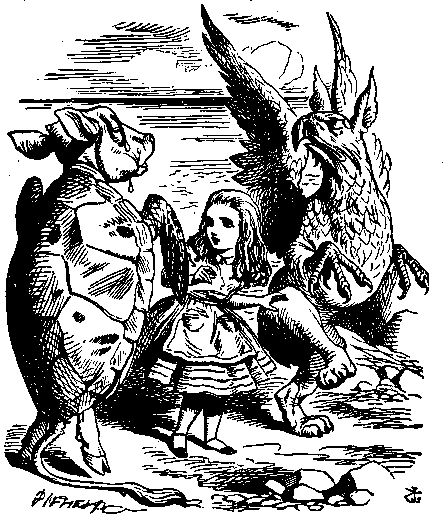
 As the card by our plates explains Turtle soup was highly popular in 19th century England but was so expensive and hard to get (sea turtles were rare and difficult to import) that a mock turtle soup was developed using calves head and feat (that is why Lewis Carroll, mentions in length the story of the mock turtle and John Tenniel whose drawings accompany “Alice in Wonderland” drew the Mock Turtle with calves head and feet).
 
Welcome to our very own Mad Hatters tea party. We are each served a 24 karat gold leaf plated, fob watch, which we put (or dip) into a cup of tea and boiling water are poured over it, we’re in the scene: “The March Hare took the watch and looked at it gloomily: then he dipped it into his cup of tea”

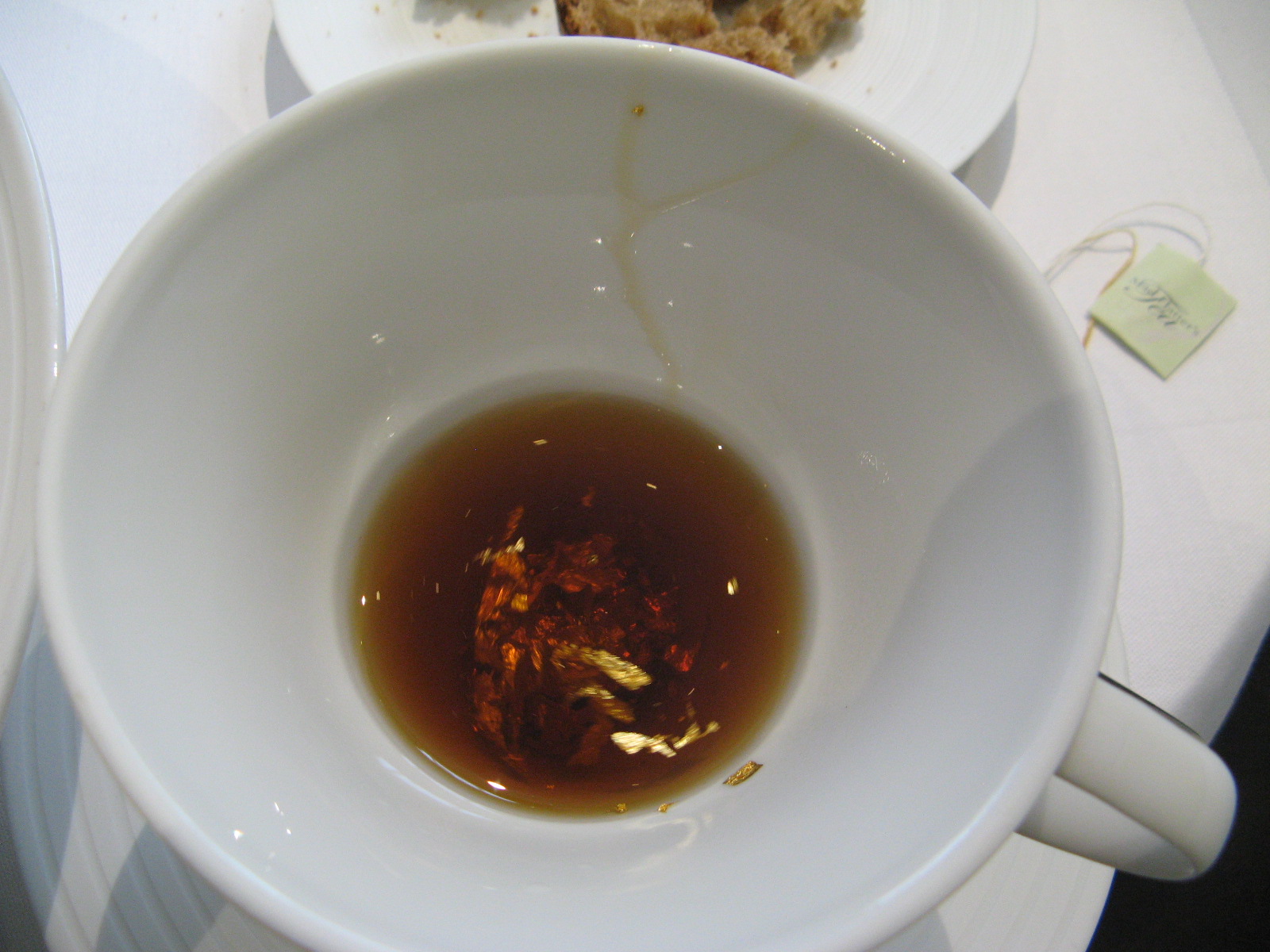
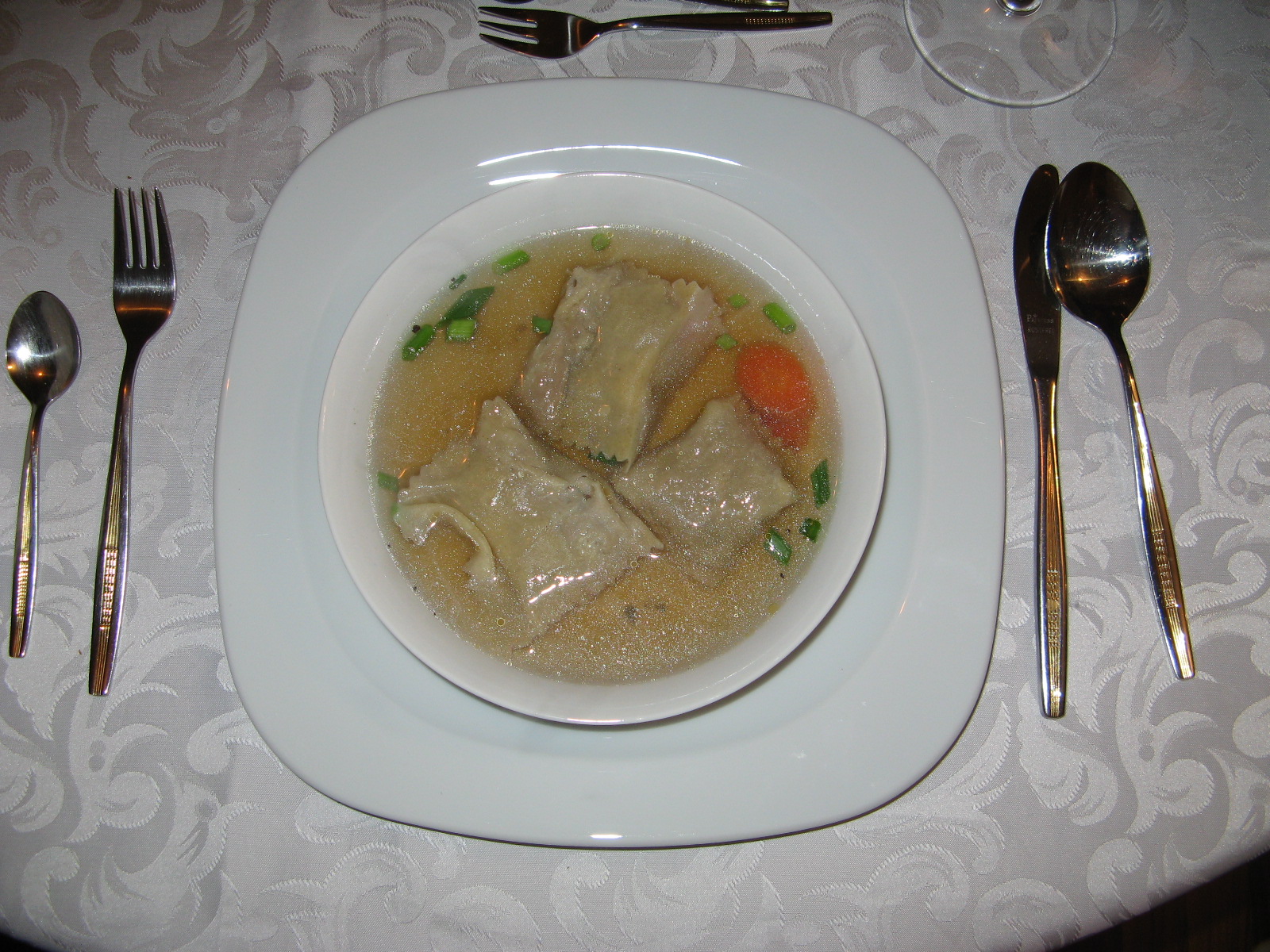
our mock fob watch dissolves like a tea bag and glitters of gold leaf “swim” in a cup of boiling water that turns into a brownish broth (the mock turtle soup), with a deep meaty concentrate aroma and flavor. The bowl in front of us is a setting of the complimentary scene: what goes with mock turtle? Mock turtle egg It looks like an egg but the white is turnip mousse and the yolk is Swede and saffron nothing is what it is it just looks like what we think it is… confused?? Add some enoki mushrooms to keep the wonderland atmosphere going, and an ox tongue and Colonnata Lardo (from Fausto Guadagni) Terrine that gives the fatty feel of what is described as genuine turtle soup.

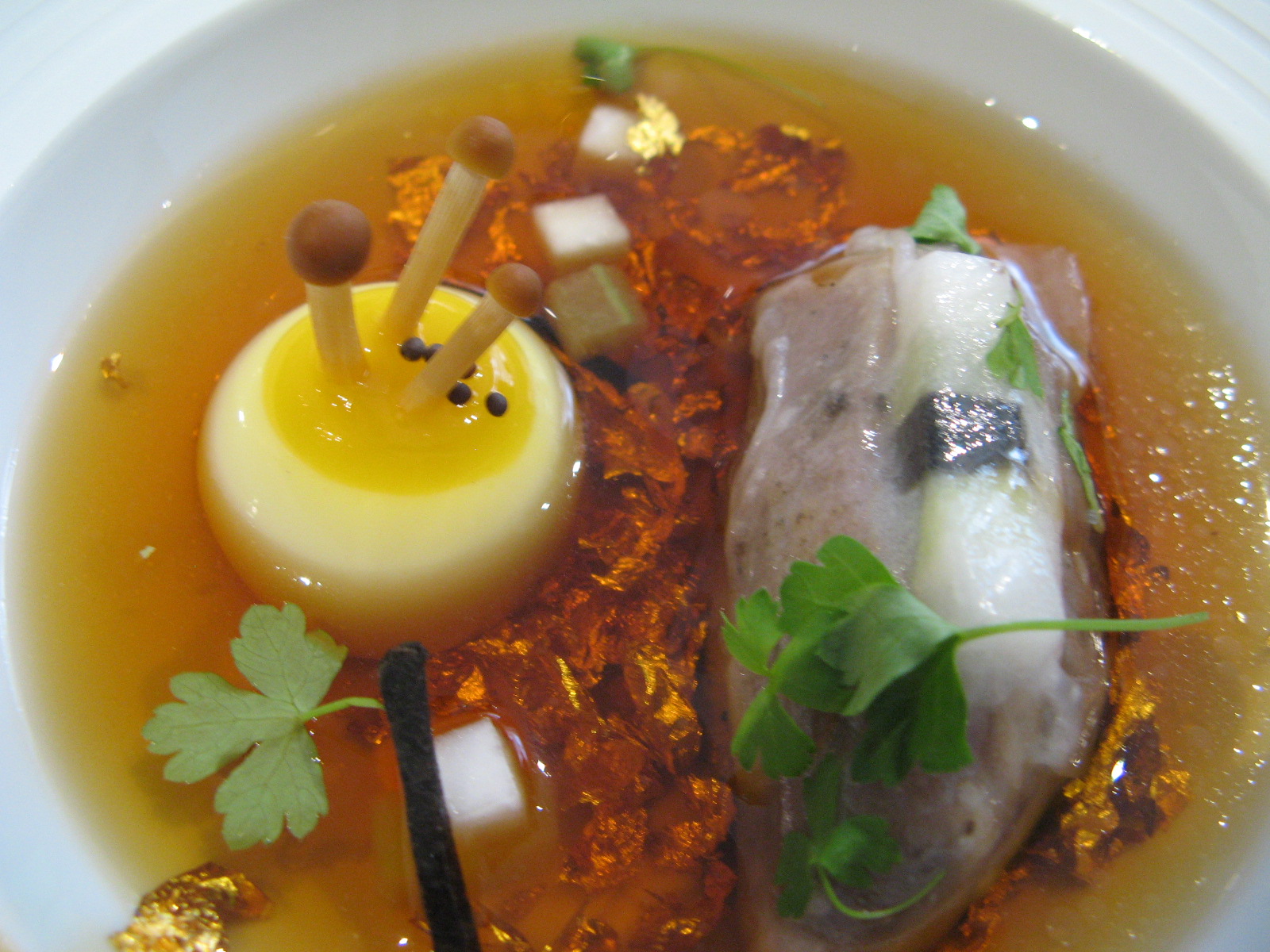
“Colonnata is a small village in the hills of Tuscany that happens to make the world’s best lard. Fausto Guadagni is one of the last, and best, of the traditional producers. The Lardo is treated with spices and matured for six to eight months in marble tubs, known as conche, in caves cut out of the same stone. The result is fragrant, melting and joyous.”
Now, garnish the bowl in your mind with cucumber, pickled turnip, truffle cubes, and some leaves of micro parsley. pour the golden broth from the cup onto the enchanted scene bowl, and there you have it; Mock turtle soup. I trust Heston this is as close to turtle soup as you can get!! And as in the the Mock turtle sad song, on the day it was:Beautiful Soup, so rich and green,
Waiting in a hot tureen!
Who for such dainties would not stoop?
Soup of the evening, beautiful Soup! Soup of the evening, beautiful Soup!It was glorious in the bowl and wonderful on your tongue and over your palate as you swallowed each spoonful of golden fairytale in a bowl. And yes we’re still having fun and yes the wine is a bit over oaky but the bourgognian Chardonnay from La Romanee, (chassagne) is powerful enough to withstand the wood without losing its character.
Can we hope to proceed with anything to match the ingenuity and originality of the wonderland soup?

A large Conch a symbol of old, is laid down in front of us with a pair of modern I Pod ear phones sticking out of it…

The conch, this is one of the most important emblems of the India God Vishnu. He is the protector of the world and the restorer of moral order (dharma). He is peaceful, merciful, and compassionate. The blowing of the conch symbolizes the primordial creative voice and Indian mysticism links it to the sacred sound OM , which is said to be the breath of Vishnu, pervading all space.
This is a good sign to what is going to come, but are we going to say OM or sigh UMMM to the taste of THE SOUND OF THE SEA.

A sea shore scene on a glass slab is laid before us here’s the sand made of Tapioca mixed with fried grounded baby eels, some Japanese sea weed for taste and decoration, with a triptych of sashimi of mackerel, Halibut and yellow tail, and the foam of the sea I guess a foam of a fish consommé to “kiss” the sand and the fish. The sound of sea waves and sea gulls take you to somewhere on a British shore line, the tapioca sand is really sandy between your teeth, with a deep but delicate sea saltiness flavor and aroma added by the ground eels, and the foam is a fine touch to wrap the sea taste in your mouth and mind, we went UMMM, but felt the breath of Vishnu pervading our taste buds and nose, OM we blessed the chef…for serving us a “sunny day down at the beach”, on a plate.
Today, the conch is used in Tibetan Buddhism to call together religious assemblies. During the actual practice of rituals, it is used both as a musical instrument and as a container for holy water.
We kept the earphones in for a longer while as the sound is calming and the total effect is outrageous or as Spike put it on an email to his friends: “…a dish called SOUND OF THE SEA came: a conch shell with headphones 2 put in yr ears (it had an ipod inside) b4 they brought over a beach on a tray with frothing sea + sand + seafood – all edible – whilst u listened 2 seagulls + waves, I kid u not baby!” 
We are still before our main dishes of fish and than Pigeon and a whole lot of desserts and sweets. All or at least mostly in part 4 to come real soon. but at the moment we savor our Chassagne-Montrachet, and cherish the joy this meal is giving us.

Our next dish Salmon poached in Liquorice with Artichoke, Vanilla Mayonnaise and Golden Trout Roe, is a perfect example of cooking which utilizes the scientific knowledge of what is called Molecular Gastronomy, and turns the knowledge into eatable food of the highest quality and finesse which is in one word cooking or even Haut cuisine for some. Not the bubbling mist of ultra cold gases in their “frozen” liquid form as they warm up in room Temperature, (although I must say it is a lot of fun), or other stunning paraphernalia (I like firework displays), but cooking at its highest standard with precision and care in which the ingredients are scrupulously picked from the best producers of each ingredient around the globe, and then prepared to perfection. (Pommery Mustered from Meaux, France, Jabugo ham from Huelva, Andalusia, Spain, Konbu from Japan,Lard.From Fausto Guadagni in ColonnataToscana, Pigeons from Anjou etc.). Still, all the time keeping the flavor taste and texture of each ingredient meticulously.
Two separate ingredients rarely or never assembled together in one dish are combined together because they contain a mutual chemical compound, Asparagine; (One of the 20 most common natural amino acids on Earth). Originally the dish was constructed of liquorices and asparagus both have very high content of Asparagine, combination that in Blumenthal words brings the Bitter sweet effect (bitter being the Asparagus and sweet the liquorice) but kitchens get “tired” of the same dish looking the same and tasting the same day in and day out, so changes are made with the “decor” or the secondary ingredient of the dish, but not with the idea behind the basic thought, or the essential core that combines the dish. We were served the Salmon poached in Liquorice, with Artichoke as a veggie bitter touch. Artichoke contains mostly phenolic compounds such as chlorogenic acid, but also asparagine and other substances. Connection re achieved!!!

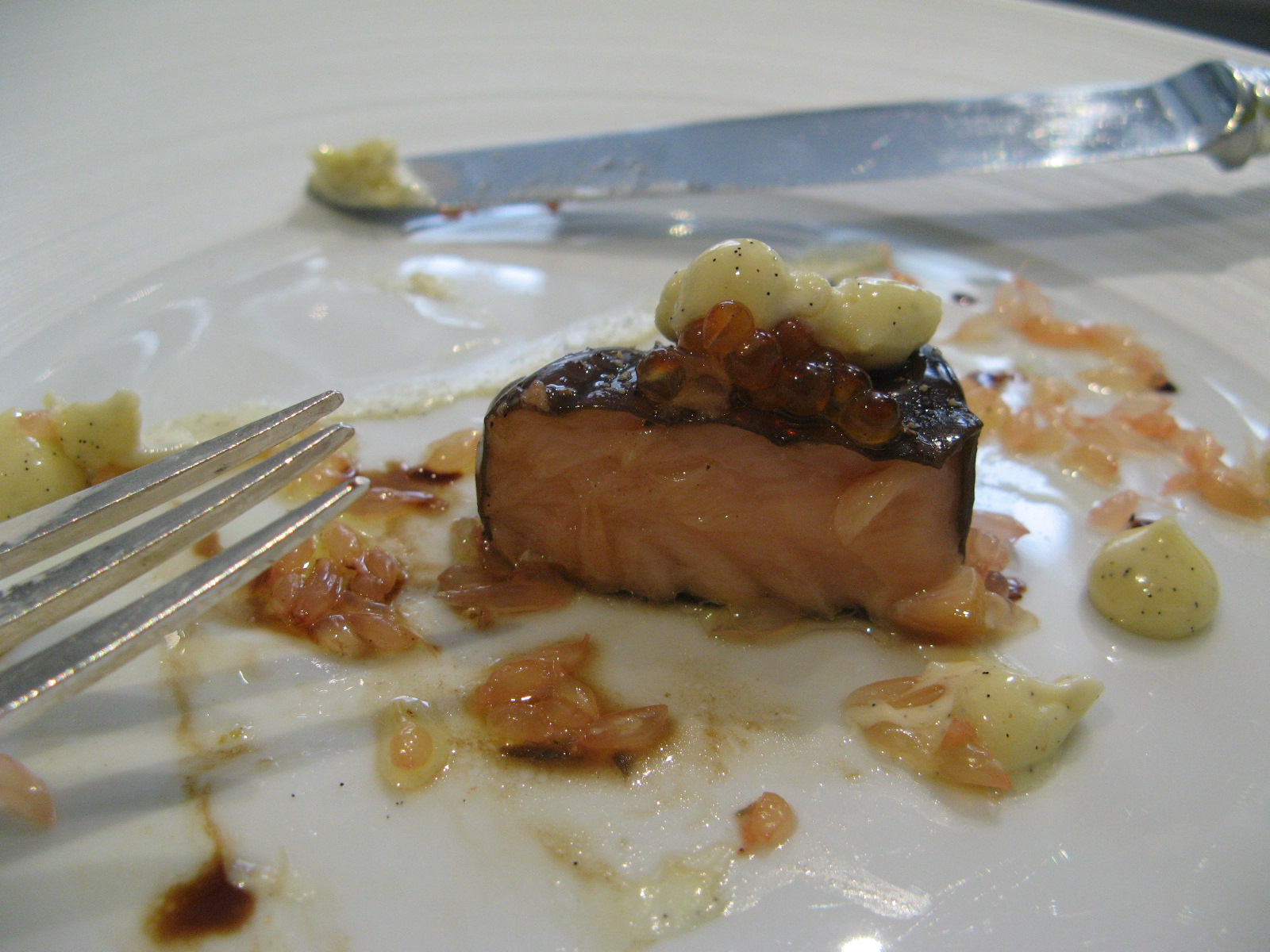
The substance to this dish is a nice square of fillet of Salmon which is strong, fatty and “rich” enough to withstand the overpowering strength of Liquorice. And it works! The slice of pink salmon is cooked in “the Lab” (poached in a sous- vide bag under exact pressure of 60mbar at precisely 42ºC for around 25 minutes (puphhhhhhh) thank god there’s a restaurant with all that equipment, no wonder they reach near perfection in depth of cooking, texture, color, and consistency, but I must confess all that is not good enough if you don’t have a good sense of taste and that they do at the Fat Duck.Add the Vanilla mayo, the Golden Trout Roe, and the pink grapefruit individual fruit cells, (for acidic touch, which is also glorious on the plate as decoration), combine them all in one bite, and the balance as much as it is hard to predict is amazing this is a real achievement in taste of “paring the impossible” (Though I’m not mad on Liquorice, it’s taste and after taste, I was impressed.)I will Iet you into a small secret (I left myself some of the Chassagne Boudriotte), enough to go with this dish and they went famously together.

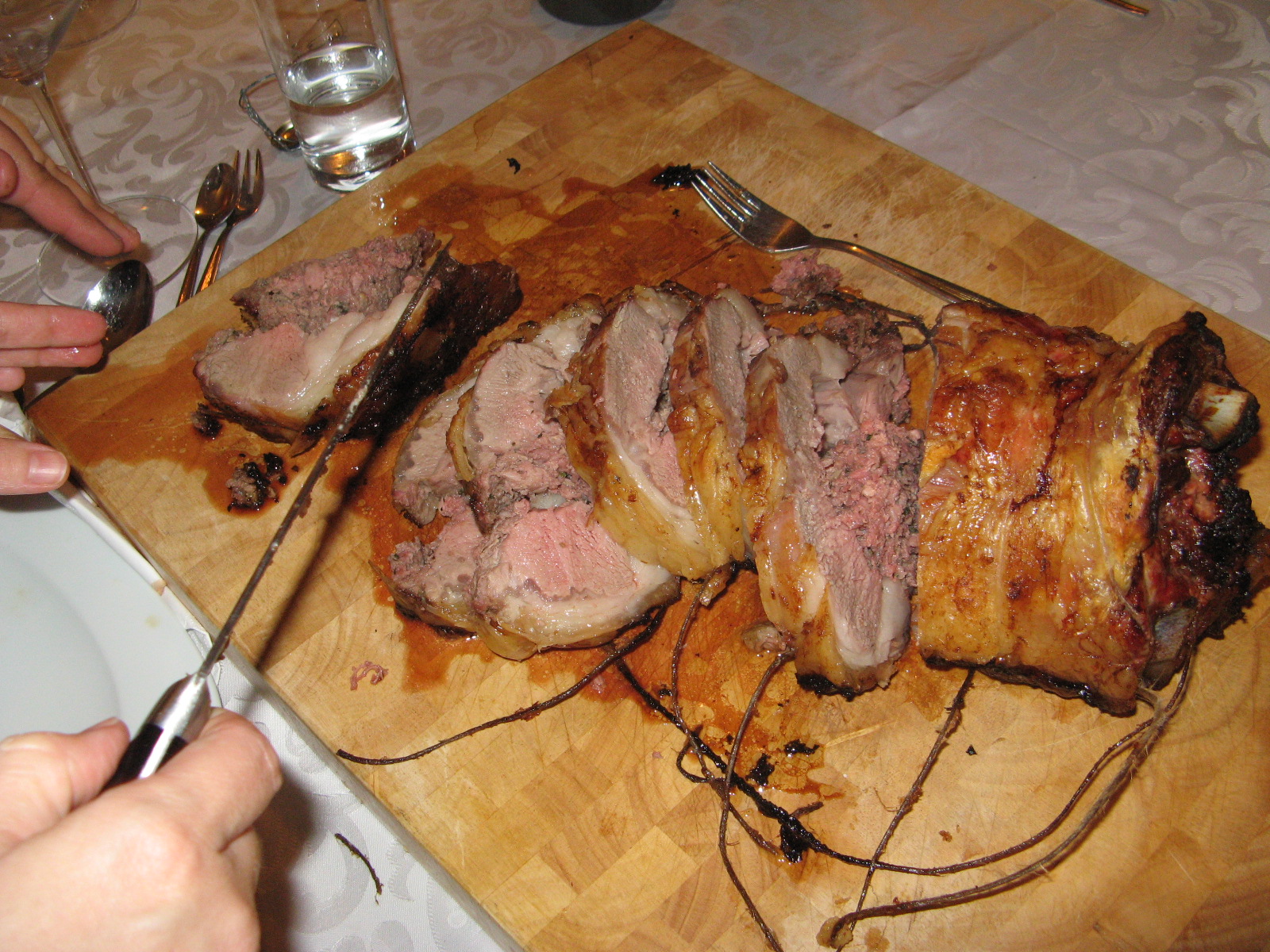
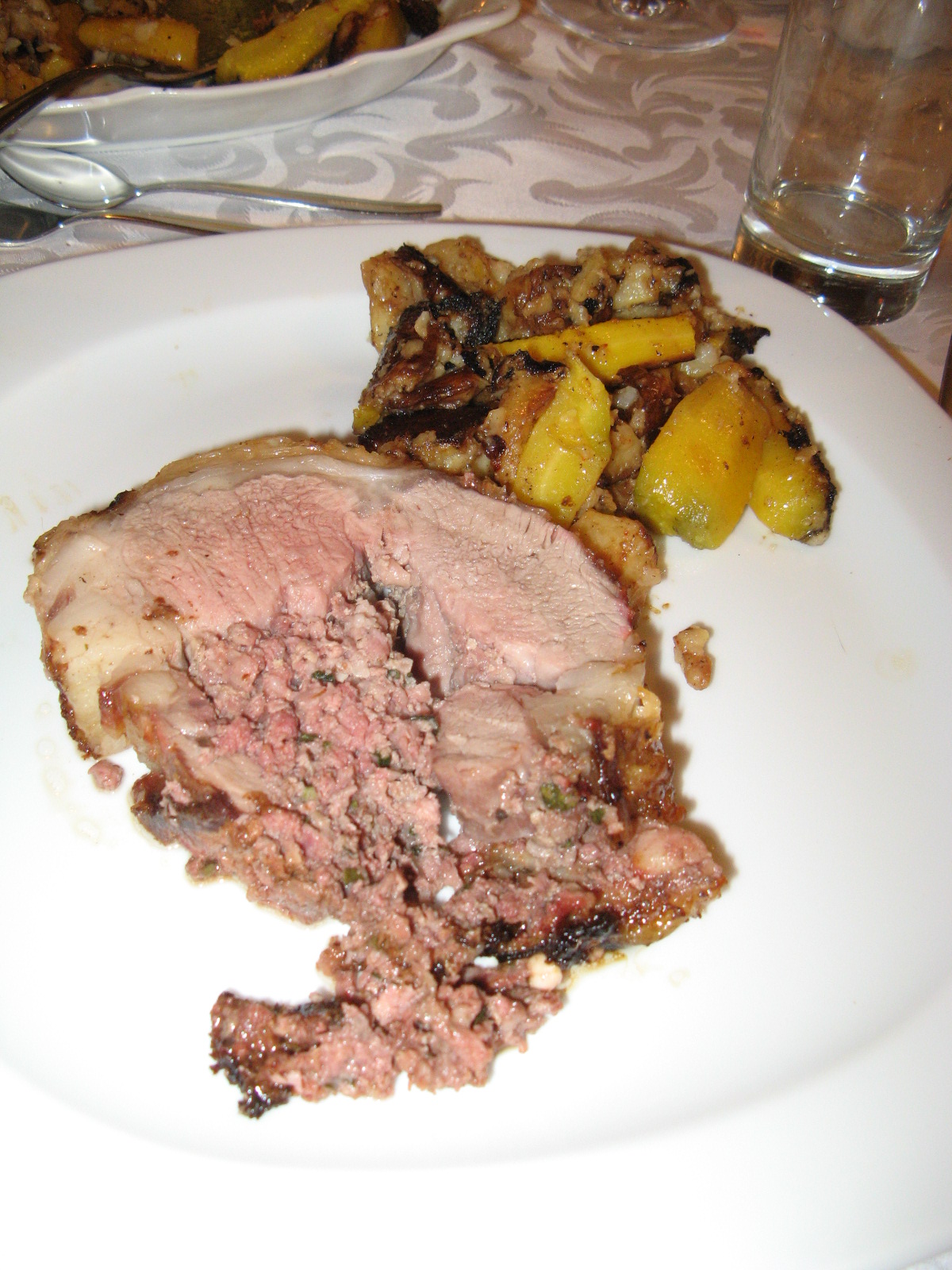
Our next serving is POWDERED ANJOU PIGEON (c.1720) Blood Pudding Potted Umbles, Spelt and Pickles According to British historian Joan Thirsk, this is a periods of excess cereals. In post-Black Death Europe, the smaller human population meant grains could be put aside for feeding birds; similarly, the low grain prices in the late seventeenth and early eighteenth centuries also translated into increases of raising pigeons. Spelt which is basically a wheat species, was an important staple in parts of Europe from the Bronze Age to medieval timesDuring the Baroque era, English cuisine consisted of various breads, meat pies, fresh fruit, sweets and desserts. for the first time the dining room became a clearly defined space within a house dedicated to one particular purpose-the service and enjoyment of food and all the pomp and circumstance that can surround it. In the French manner, at each course all the different dishes were placed on the table at the same time and in exactly prescribed locations. The diners would help themselves to whatever was near at hand without moving the dishes, and if necessary pass their plates to their neighbors to get food that was out of their reach. At large dinners this meant that it was impractical for guests to sample all the dishes, so it was important to have an interesting selection of foods near each guest. And this is precisely what we have here,
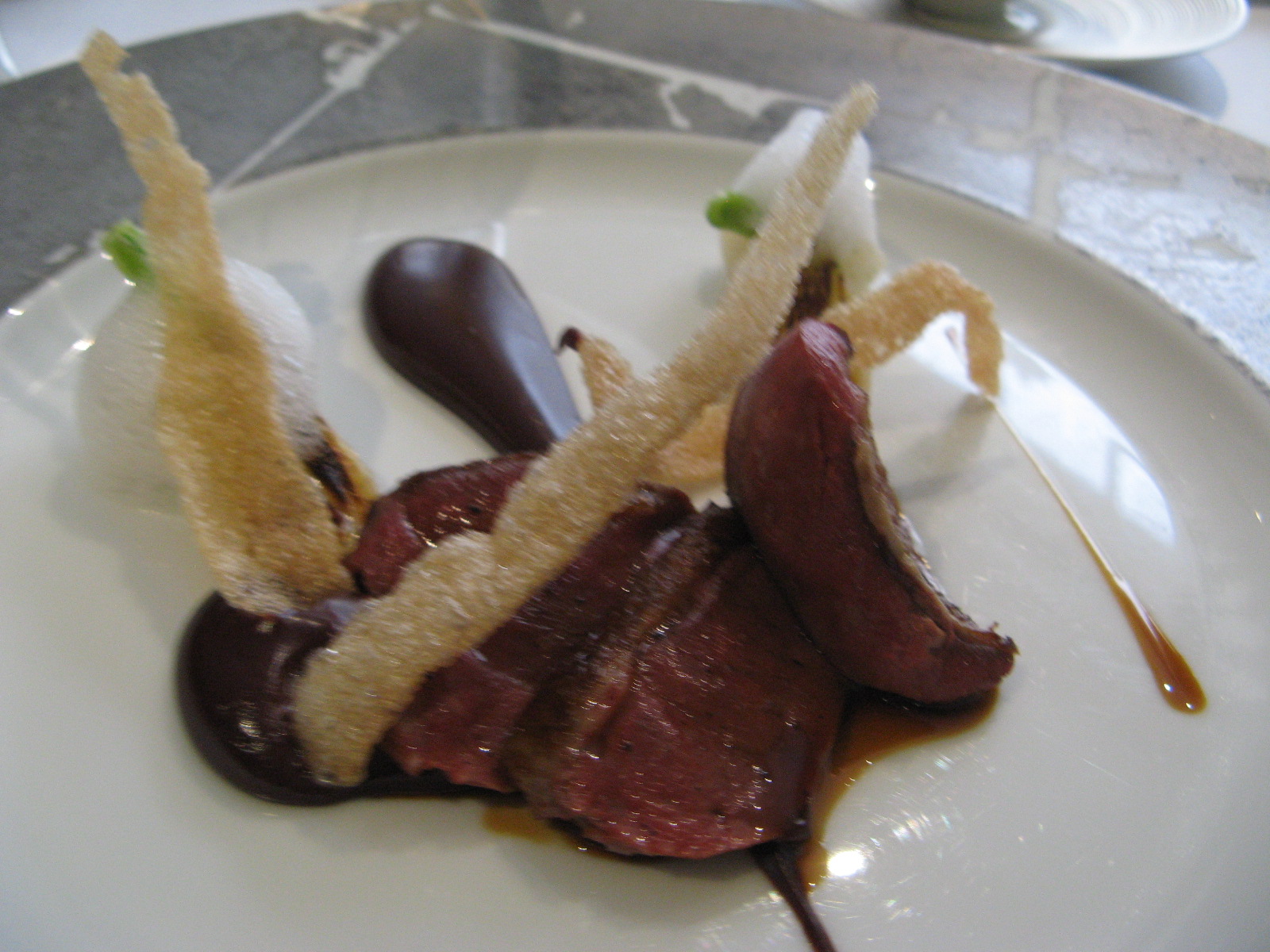
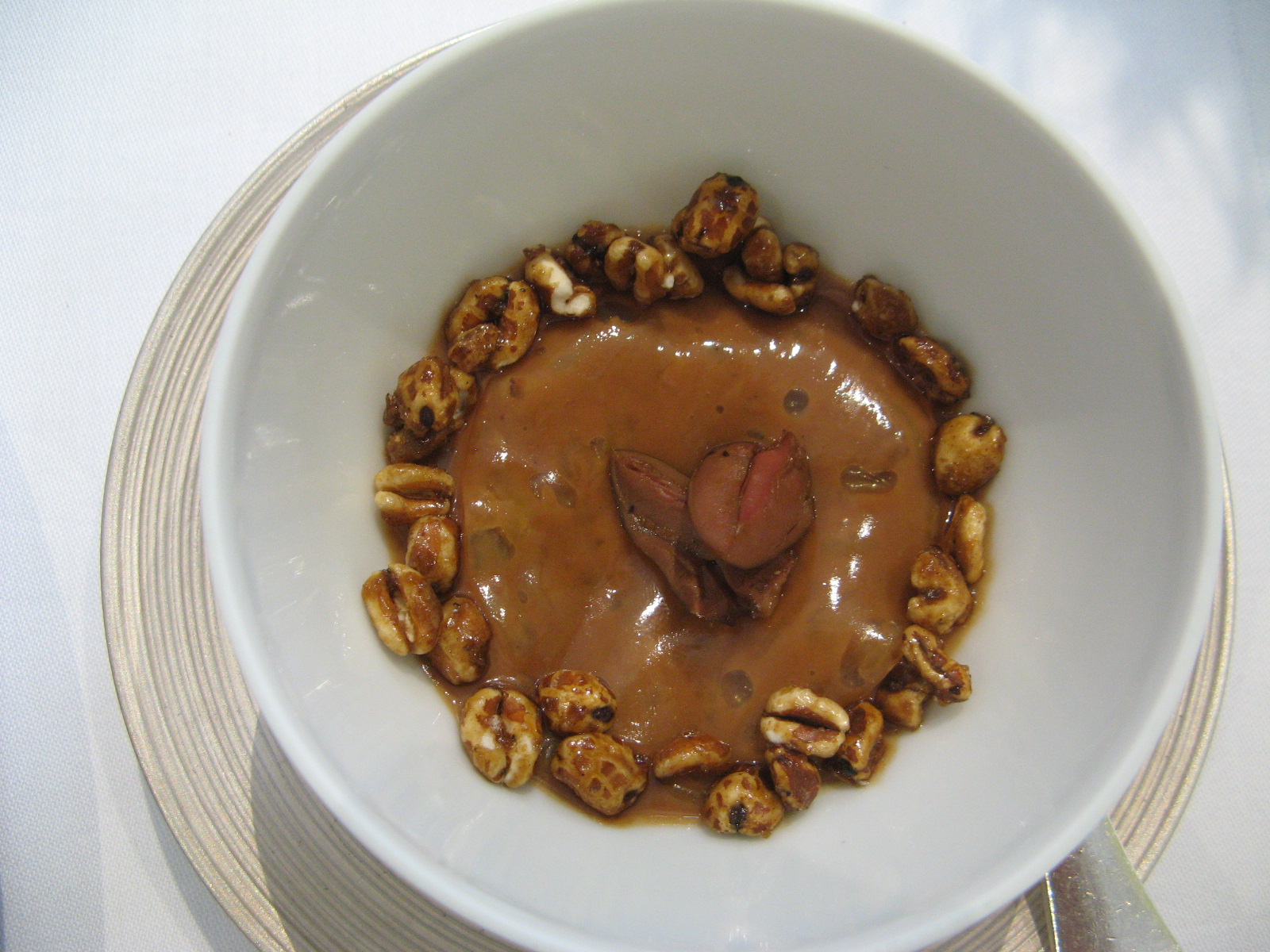
a plate adorned with Pigeon Ballotine (powdered with Transglutaminase powder), pigeon and duck crunchy crackers, Pig’s blood black pudding, baby turnips and Grelot onions pickled in a foam of junipers berries brine, and a second violin a bowl of Potted Umbles mousse and puffed Spelt with some whole sautéed pigeon livers on top. As in the concerto where the violins rush after each other meeting at times in a crescendo of sounds the dish does the same in your mouth, the tastes and flavors separate and join together with volume and intensity that gradually increases and all the time keeping the deep dark complex flavor of this wonderful game bird.Just looking at the photo reveals the fact that the meat was cooked/prepared to perfection with the aid of the transglutaminase but the surprise of the dish is without a doubt the smooth black pudding with a rich chocolate ganache color, feel, and look which is also quite deceiving at first and cleaned off the plate completely at the end. Magnifique !

Before we start our desserts we are served the Fat Duck Palate cleanser, HOT& ICED TEA, Palate cleansers, by nature, are used in the middle of a meal to remove lingering flavors from the mouth so that the next course may be enjoyed with a fresh perspective and that is certainly required after the intensity of the pigeon & Co.
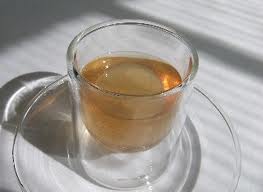

They use earl grey tea but the aroma flavor and medicinal effects of Lemon verbena infusion could be a winner here. You have to gulp it in one go and Yes it is both cold and iced at the same time and yes it is a jelly of tea using Gellan F. to form Tea flavored jellies, cold and Hot (over 70ºC) assembled vertically in a glass.

I is THE BIG FRIENDLY GIANT –THE BFG, THAT’S ME… (by Roald Dahl) Feast at the Fat Duck part 5
Our palates are cleansed and the first dessert TAFFETY TART (C1660) Caramelizd Apple, Fenne,Rose and Candied Lemon, is served.Not before we order our dessert wine. Not because I think it is necessary but because Spike usually does…so we order by the glass, Tokaji Aszú, 6 Puttonyos, Oremus, Tokaj-Hegyalja, 2000. As tokajis go this one is a youngling to the ones I would drink at home (I love good dessert wines), but I’m not chez moi (unfortunately, wine wise I mean). TAFFETY TART (C1660) I wonder what happened in 1660 or who wrote the recipe for this tart in mid 17th century England? This is really a wonderful desert to look at and of course to sample (which is not the right word to use) since we finished it to the last drop of anything. I think a photo of spike eating it will sum up our feelings.
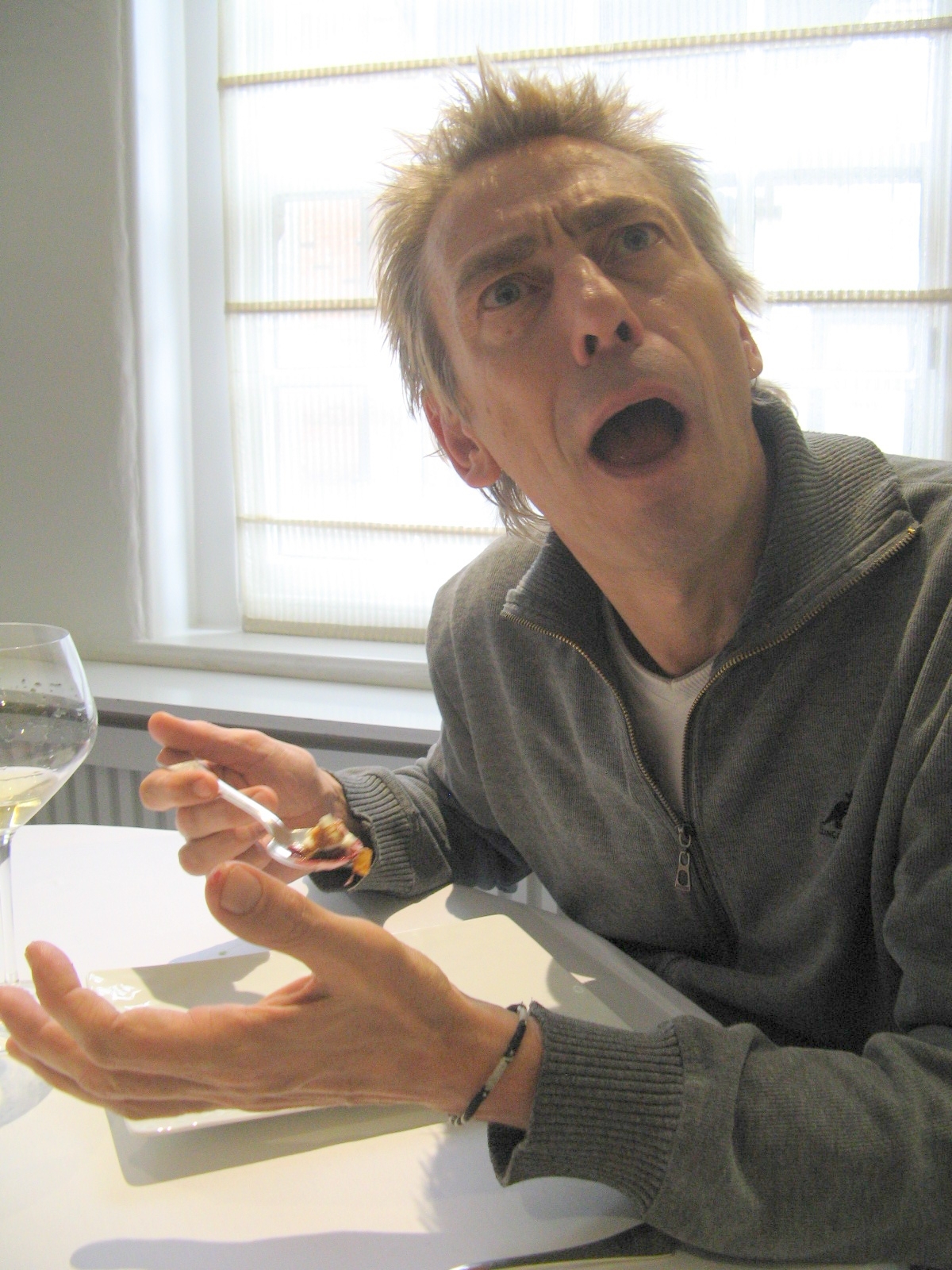
The elegance which you see in front of your eyes is really the call of the WILD, into this wonderful dessert which is just at the right amount of sweetness (meaning not too sweet still crisp crunchy and fresh and voluptuous, I think it “speaks for itself.
As a matter of fact “toffee” (or “taffy”) is a relatively new word, (early nineteenth century). It must surely be related to “taffeta”, which has referred to a glossy fabric since at least the fourteenth century, ad for taffeta we find recipes for Taffety Tarts, which usually contained apple. It is a spectacularly fragrant version – the apple pulp scented and flavoured with orange, quince, rose-water, and violets, This recipe is first published in The Cook’s and Confectioner’s Dictionary” 1724) Mix a quarter of a Pack of Fine Flour, with a quarter of a Pint of Yeast, and as much hot Liquor as will make it into a stiff Paste, with two Pound of butter, the Yolks of twelve Eggs, and half a Pound of fine Sugar; make it up into small Balls, and then roll it out into thick Plates; wash round their Brims with Milk: Boil Pippins soft, peel them and scrape the Pulp from the Cores, mingle the Pulp with fine Sugar, a little Marmalade of Quinces, the Scrapings of candied Orange-peel, and Rose-water: Make up your Tarts, dry them in a warm Place, bake them, scrape Sugar, and sprinkle Essence of Violets or Roses over them, and serve them up.
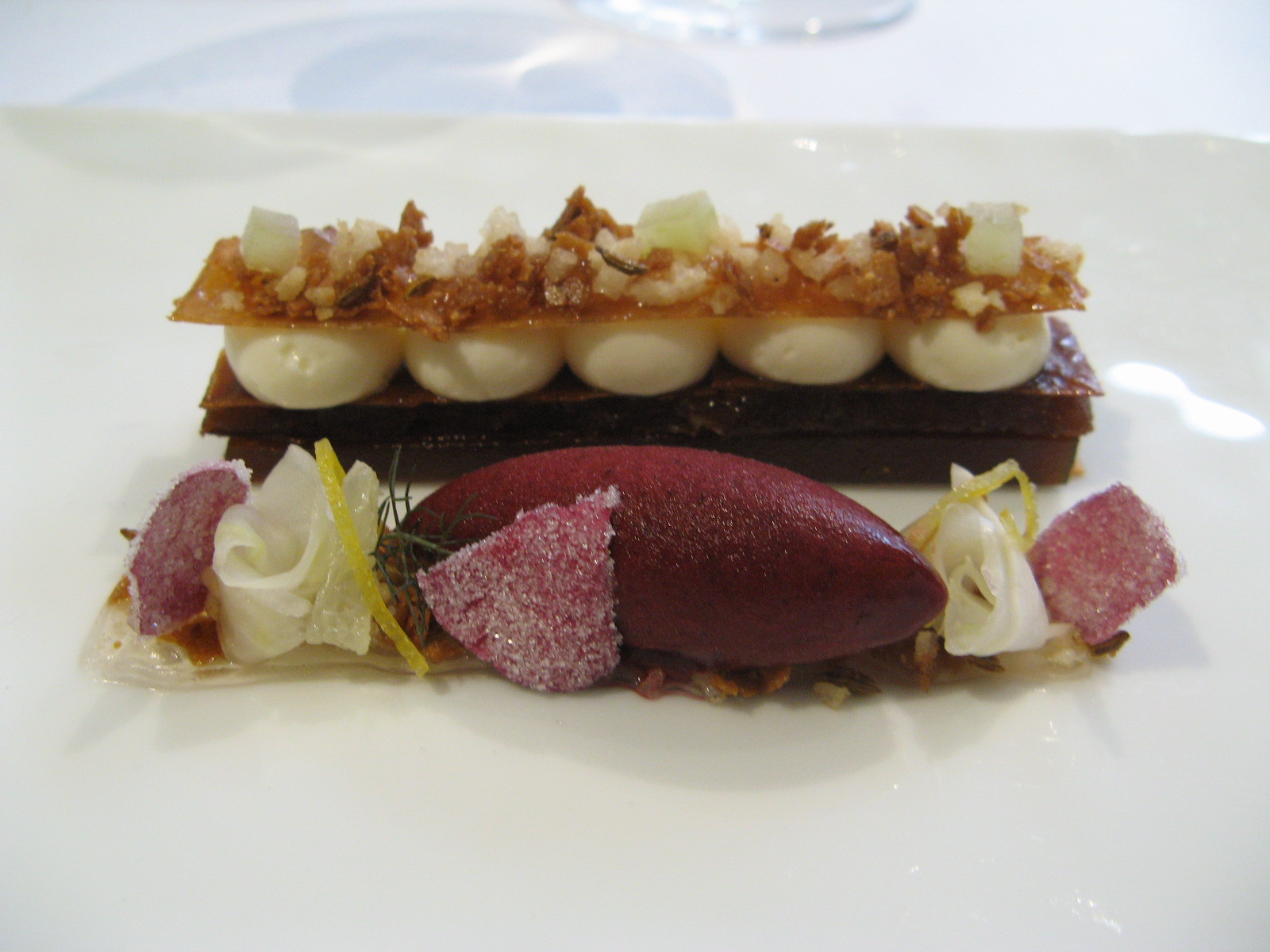
So the cake we are served is a fine and delicate assembly of all that is described in the recipe above in a manner that makes sense. (I’ve read thousands of recipes and cooked from them, but the above C.1724 instructions, will amount to nothing that looks or tastes like a tart. Thanks H.B… for your High end of “tart couture”, it is indeed made in the finest tradition of Haute couture.
Taffeta (sometimes spelled taffety) The word is Persian in origin and means “twisted woven”, It is a crisp, smooth woven fabric made from silk or nowadays synthetic fibers. It is considered to be a “high end” fabric. This “Tart” is laid down in style and colors which resemble Elizabethan fashion

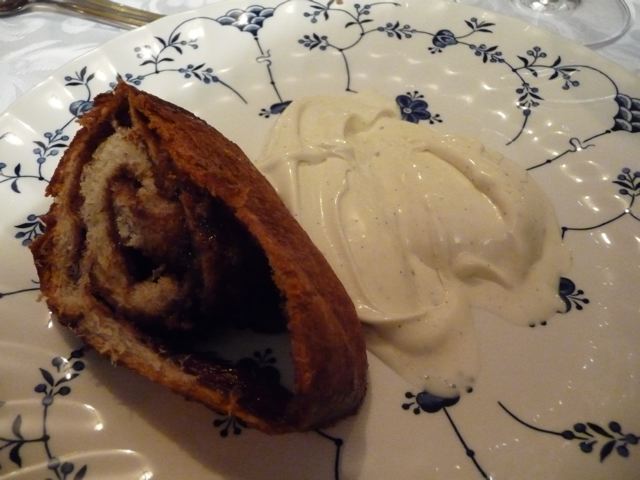
The Next desert is THE BFG Black Forest Gateau. During the 80’s you could find horrible BFG’s in every English supermarket or food chain which gave the cake a bad name and shivering memories down my spine – it consists of several layers of chocolate cake, with whipped cream and cherries between each layer. Then the cake is decorated with additional whipped cream, maraschino cherries, and chocolate shavings.But we’ve been in Victorian wonderland why can’t we be “thrown” into 20th century fantastic stories of Roald Dahl’s The BFG: One dark night, an orphan named Sophie is snatched from her bed by a giant, and whisked away to another world. Fortunately, her abductor is the Big Friendly Giant (BFG for short), a likeable guy who spends his time giving good dreams to children. He’s also the only one of his species who doesn’t eat humans, but as the smallest and weakest, he’s powerless to stop his brutal neighbors. As long as Fleshlumpeater, Bloodbottler, and all the rest are free, Sophie will never be safe, so she and the BFG concoct a plan to stop the evil giants and save humanity – once and for all!

This BFG is a Black Forest Gateau and it is not your everyday BFG, it is a fantasy of how this southern German dessert / cake: Schwarzwälder Kirschtorte, literally “Black Forest cherry cake” should have always been it restores English German relations and gives a good name to the Black forest horrific landscapes that inspired Grimm’s fairy tales. Anyway it really burrows its name from the specialty liquor of that region, known as Schwarzwälder Kirsch(wasser) a kind of eau de vie or Schnapps distilled only from the Schwarzwälde region tart cherries. HB: ” the pastry chef at the Confiserie Gmeiner had told me that the cake should contain four tastes sweet sour salt and bitter” with contrasts in taste and colors,

add the Kirsch and sour cream ice cream and you have the complete requirements in a compact dolls house of 8 layers of various chocolates mousses and cherries hidden behind the chocolate dusted outer layer with an amarena cherry on top and as before the secret remains well hidden until the first bite of cut through the cake. This BFG restores this traditional cake’s reputation.You like wine gums? I do I always did not the sticky artificial flavor version we have today … The Whiskey Wine Gums in the “spirit” of wine gums, arranged over a map of Scotland Ireland (and one from the American Colony in Old Tennessee) all 5 wine gums, taste different in strong whisky flavors as if your having a deep sniff into a glass of well distilled spirit.

My favorite was No.2 West Highlands Oban-The little Bay and so it is, look it up in the Map.
With our coffee we receive a pink stripped paper bag (like the goodies bag you get on birthday parties) Called Like Kids in a Sweet Shop bag which contains sweets and “surprises” (all edible of course including the wrappers) and all tasting deliciously rascally. Each and every one winks at you with a childish mischievous look.
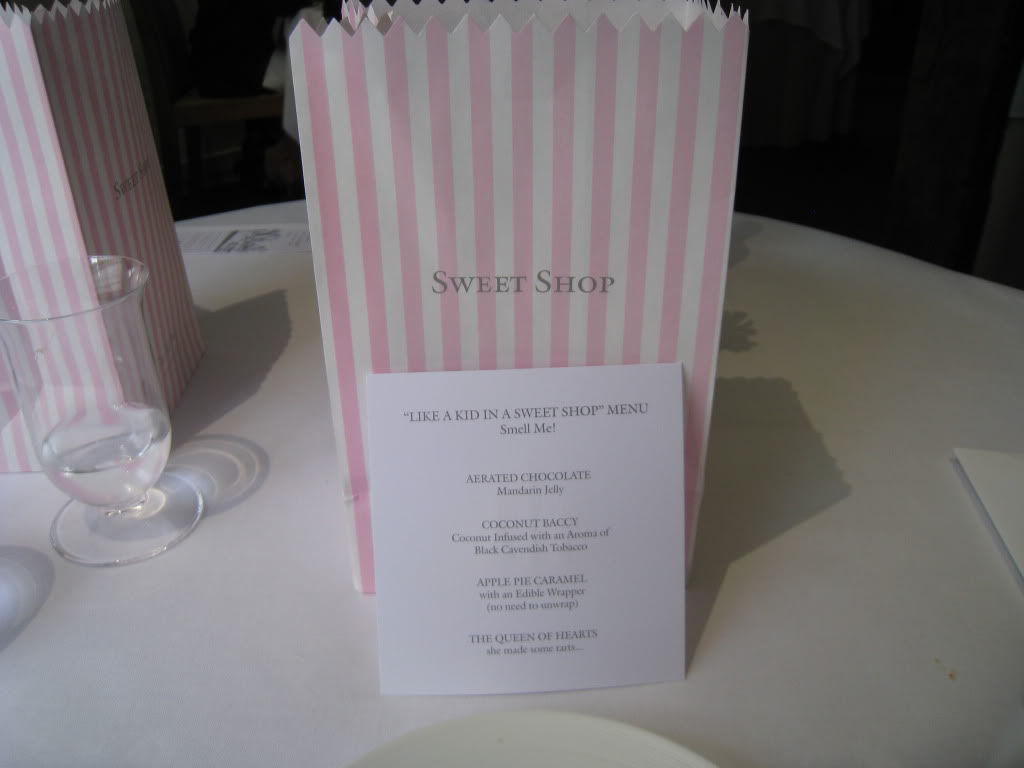
Well our dinner is over and we are happy, satisfied and amused and what more can you ask from a dinner I ask you and myself and to those who think I am new to these occasions, and that is why I am so thrilled by this joyous Lunch experience, rest assure I am experienced enough to understand how good it is to enjoy the work of an artists whose satisfaction is your joy. All the intricacies of this meal are directed with the thought that this is their mission and I say mission accomplished Spike and I and all the diners with whom we had eye or verbal contact where feeling the same. As for the restaurants requirements from themselves let’s have a look at their goals and see if they were achieved in our view:

ONE : Three basic principles guide our cooking: excellence, openness, and integrity. Check!

TWO: Our cooking values tradition, builds on it, and along with tradition is part of the ongoing evolution of our craft. Check!

THREE: We embrace innovation – new ingredients, techniques, appliances, information, and ideas – whenever it can make a real contribution to our cooking. Check!

FOUR: We believe that cooking can affect people in profound ways, and that a spirit of collaboration and sharing is essential to true progress in developing this potential. Check!

Allow me to wave off with (almost) ridicule and contempt those who have not been WOWed enough or those who suggest that the price is too high let me tell you that for this amount of thought, use of ingredients (some very expensive), amount of kitchen stuff work, number of stuff per diner, quality of glassware and silverware, and sheer 5 hours of contentious fun and enjoyment this meal is more than fairly priced!!! As a matter of fact it is rather inexpensive at around £150 plus service charge!We slid happily down the rabbit hole and came out through the looking glass, and on the day The Mock Turtle soup turned into a real, most precise and pure consommé of turtle, like the one in Babette’s Feast, the one you saw, read, heard about but would never be able to taste, and there it was caressing my taste buds and filled my heart with childish happiness, and so were all the other dishes served upon us with love and care guests deserve.

*Although not specifically mentioned I have used “The Big Fat Duck Cookbook” (a wonderful “cook book” by the way), as a reference and insight into the ingredients and ways of prep of most dishes and Mr. Blumenthal’s “notes” on the ins and outs of the Fat Duck dishes. Thanks H.B and all at the FAT DUCK, I know I have missed some of the dishes and I do intend to return this time for dinner (we had Lunch), after I visit the new venue Dinner by Heston Blumenthal at the Mandarin Oriental hotel in London.

Your WINEGUIDE

Square Meal

THE A B C: A- Amour, B- Beatles, C- Champagne DAY 1

(This is an interactive post! please press play for music as you go along reading)

A visit to Champagne with Yair – Day 1

June 7th 2011, My 58th Birthday is 4 days from today, Decided to treat myself with a visit to Paris and combine a two days trip to Champagne This is something I have been meaning to do for A LONG TIME…   for me coming from Tel-Aviv the general direction due west …or as the Beatles say  follow the sun

We set out early morning from Paris its a rainy Day. The mini cooper is quick to gulp the 137Km to the village of Vertus Where we’re suppose to visit Pierre Larmandier, of Larmandier Bernier later this afternoon.

But we took off early and the mini is swift , so we have several hours to “kill” in the area before our meeting for a tasting at Larmandier starts.

Yair is the ultimate Guide in the wine regions of France and there is a structure to his wine Journeys for Pros and Novices alike, it contains much more than just some visits for tasting wines.

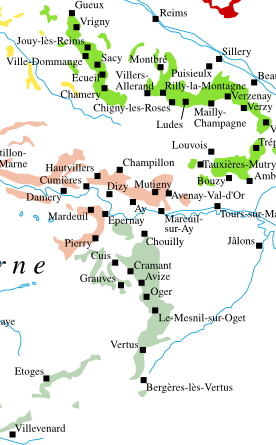
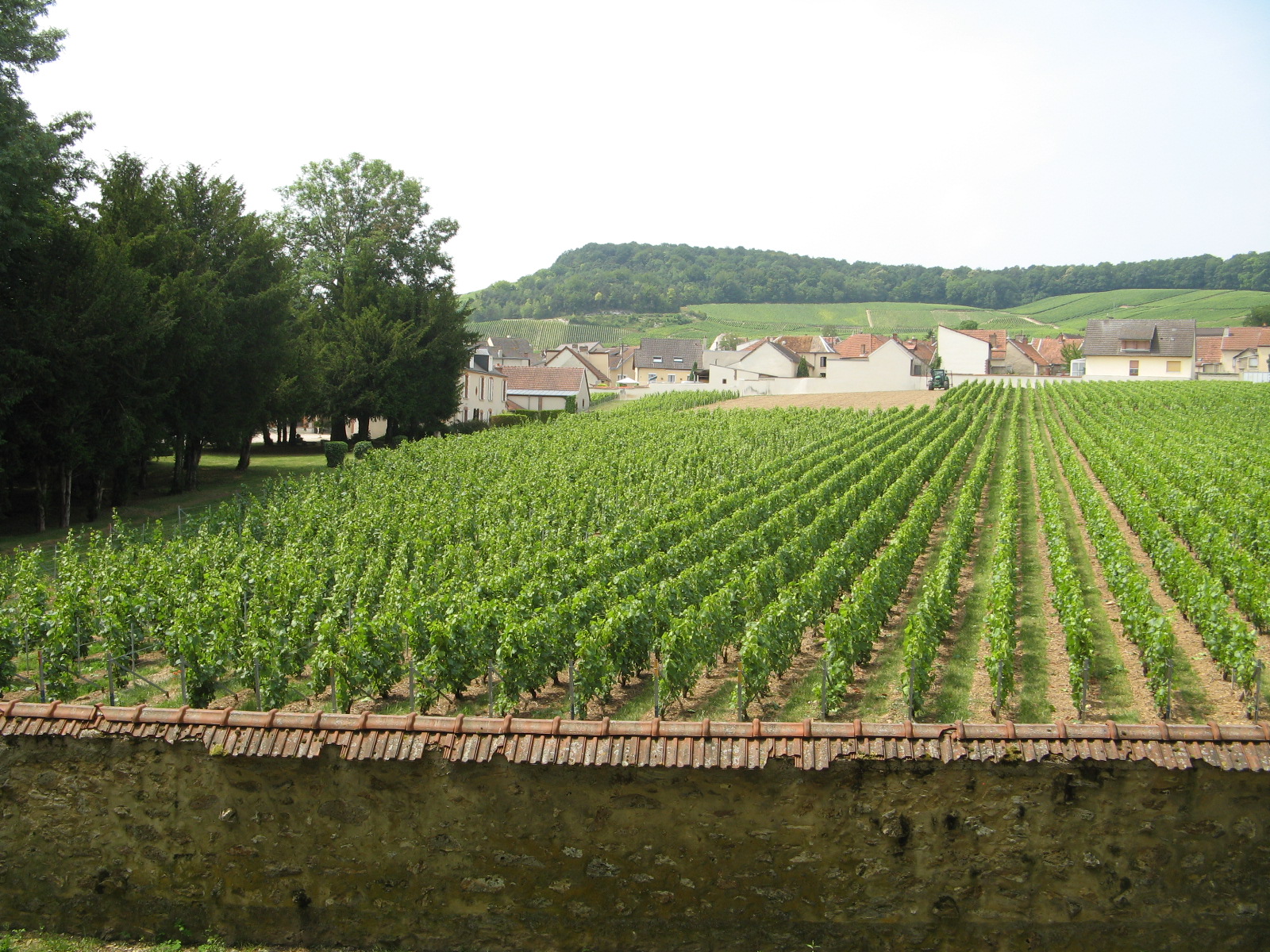
There are Visits to the vineyards,a bit of history, and other places of general or particular interest are all included. So we set out into the vineyards of the Côte de Blancs Our destination for the first day with the Men and Legends of the sub region. This is the source of the vines of the Best Chardonnay lots of champagne. We take the vineyards road all the way up to the top of the cote de blanc up to the forest,


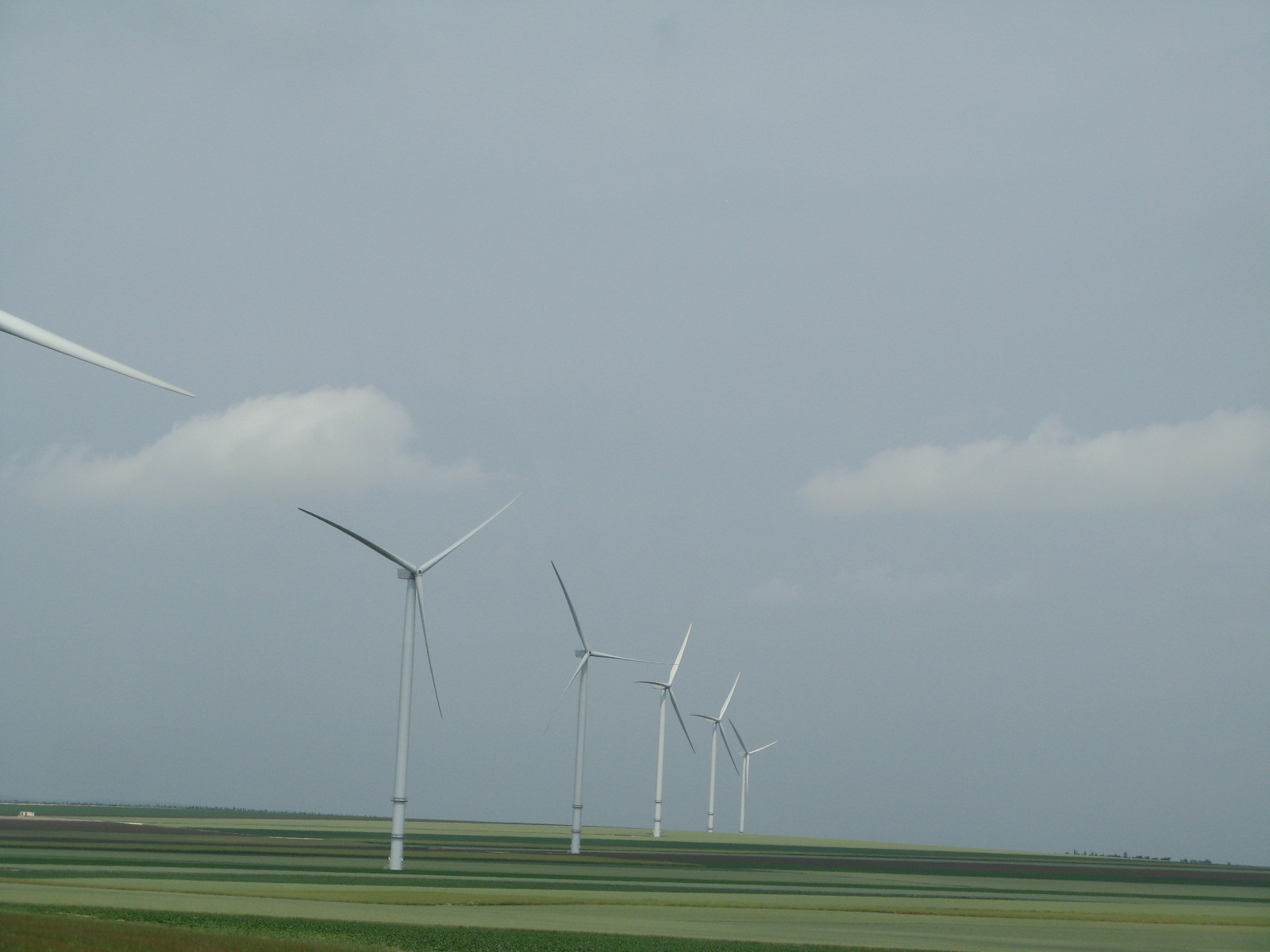
we look down the slope of the rows of chardonnay vines to the valley below and the sun comes up  The sun rays caressing the vine leaves and the air gets warmer. Now I understand (at least I think I do), why those farmers of champagne installed those giant Ventilators in the entry to the Valley, it gets pretty warm here even though we are on the 49th parallel, in fact this is the northern most wine region on the northern Hemisphere.

We stroll carefully amongst the vines, the grapes are just starting to cluster, we look down the rows, what a sight. I must show you something says Yair we drive into a little village: Mesnil-sur-Oger. Tucked in between the small houses, just off one of the streets is the the renowned Clos du Mesnil vineyard. The small ally leading to it is almost unseen called: Allee clos du Mensil (the S in silent pronounced Menil).


This historic 1.85ha vineyard has been enclosed by a stone wall since 1698  and is set on a southeast-facing slope and is sheltered from the weather by its wall and the Vilaage houses.  Purchased by the Krug family in 1971 it was restored to its previous glory by replanting the Chardonnay vines one section at a time. The 1979 vintage finally achieved expected quality by Krug standards and the first vintage of the Krug Clos du Mesnil was produced since than about 12,000 bottles of this wine are made in only the top vintages. We climbed an elevation of the ground which set us just above the wall line, The “Legend” infront of our eyes and the wall separating us humans and wine Royalty. I was not humbled but certainly excited. A sip from a 1985 Clos du Mensil would make this moment perfect, Alas Krug do not have a stall of wine by the glass on site.


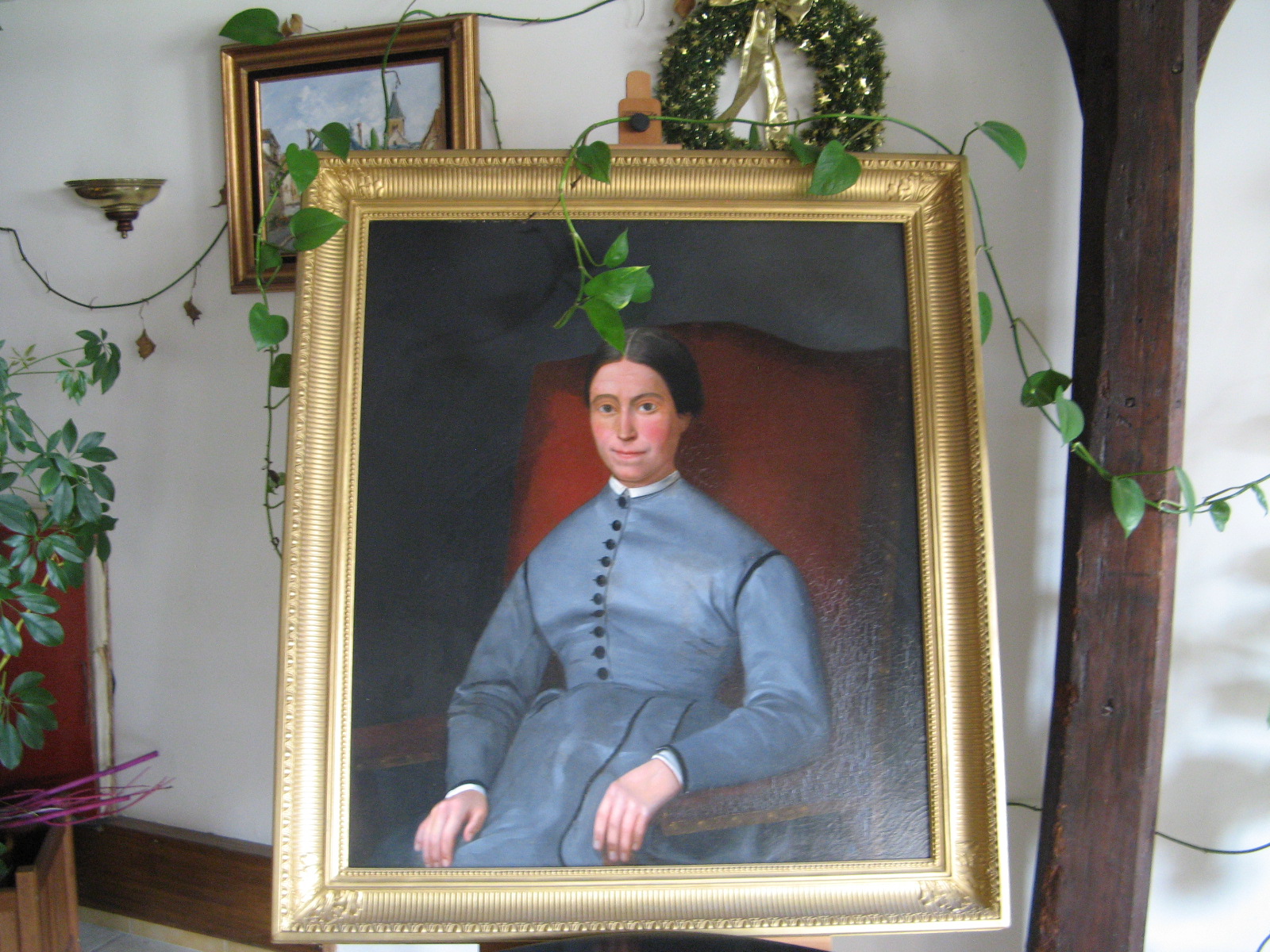
Lets pop in to see my friend Pierre Gonet and his sister Chantal says Yair since we’re in Mensil Sur Oger, Only Chantal is there but she gives us a very warm welcome and a proper tasting of ALL their wines The one with the intriguing name: Philippe Gonet EXTRA-BRUT 3210 Blanc de Blancs, means Aged 3 years, 2 terroirs, 1 variety, 0 dosage is the crisp, fresh and the most acidic of them all and they start with higher acidity than your usual blended champagnes here at the Côte de Blancs! It’s a backbone that stretches through all the other different wines, an excellent start to a sunny day in the countryside CAMPAGNE. ..Grandma Gonet (picture above, deceased over a century and a half ago), was overlooking the tasting with her stern posture

We depart and set out the short ride south to VERTUS to our first “booked” visit of the day at Larmandier Bernier. Sophie Larmandier welcomes us to the wonderful tasting room on the ground floor


Pierre ia an artisan producer, he says: “we do disgorge the bottles, we add the dosage, to give the final touch to the champagne. But while most brut Champagnes are dosed at around 12 grams per litre, we never exceed 5 grams for our brut cuvées. For the ‘Terre de Vertus’ Non Dosé’, it’s simple: we add no sugar at all. Generally speaking, there is about 1 gram of residual sugar anyway”.

“We prefer to favour the maturity of the grapes and their natural sugar rather than adding sugar when the bottles are disgorged and running the risk of making the Champagne heavier and losing sight of the terroir”.

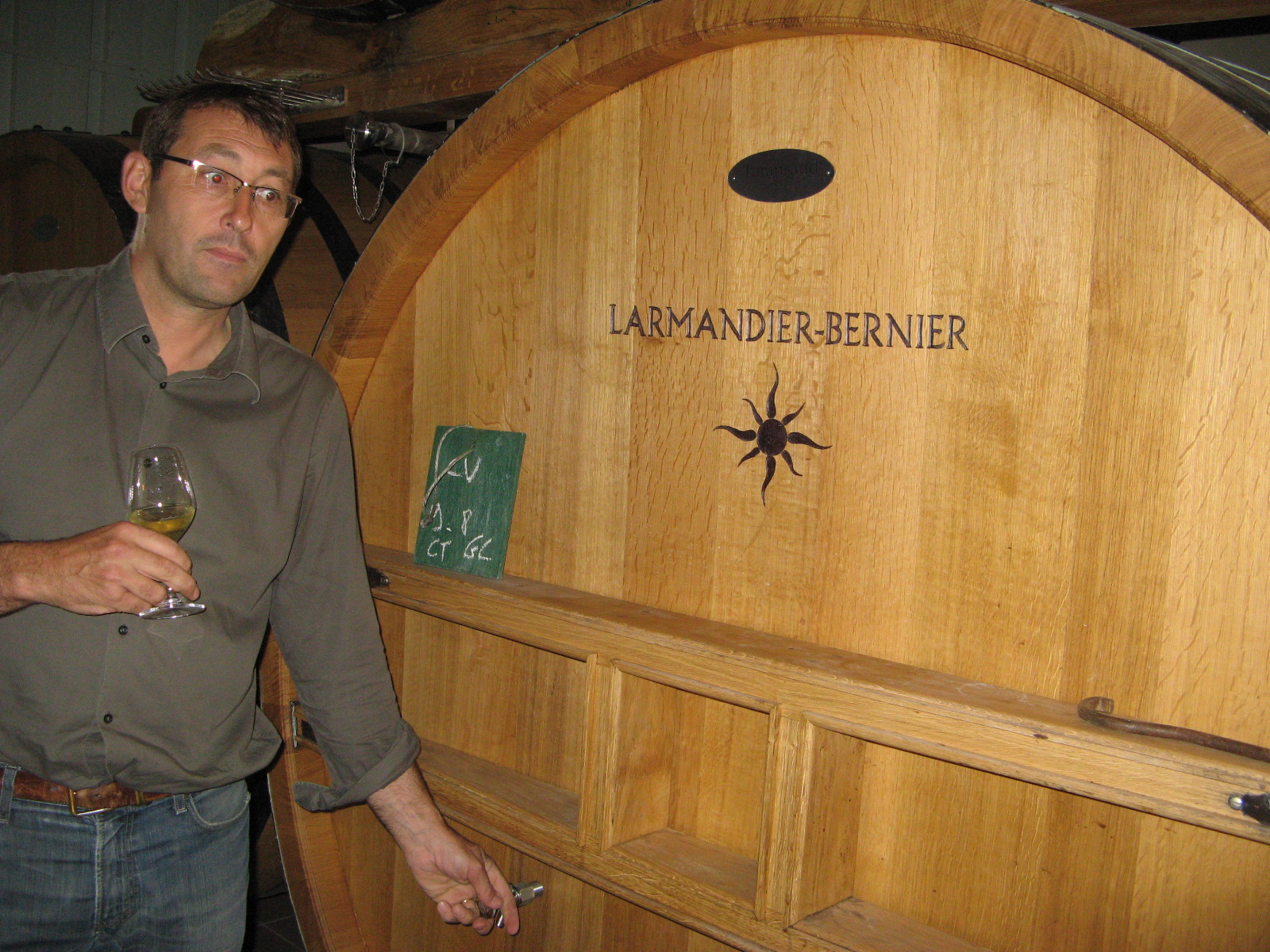
First we go down the spiral stairs to the cellars to have some of last vintage wines before bottling. The acidity at the moment is sky rocketing though it will mellow at the end of the process but keep an elegant, tight, dense and fresh, but delicate champagnes of the highest order.


Pierre is so enthusiastic and feels at home amongst the Oak barrels on one hand  and the strangely looking egg-shaped concrete tanks. These small tanks assist in oxygenation of the wine. Their shape aids fluid movement for temperature and reduces pressure on the lees. The shape also aids the deposition of the lees across a larger floor area than a barrel and avoids the need for stirring. The material is porous, allowing fermenting wine to breathe without imparting the oaky flavors. Concrete is insulative while stainless is conductive, so concrete acts as a low-tech temperature control.

This is not your everyday champagne these are “terroir-related” champagnes, with very little interference in the essence of the initial wine produced.

” Current trends among these artisan producers include decreasing yields, increasing use of oak for fermenting and ageing the still wines, lower levels of dosage with the likes of Gimmonet, Larmandier-Bernier and Jérôme Prévost offering wines with no dosage at all, and wines that are rather less aggressively fizzy than the champagne norm. Many of these producers also give far more information about make up of the blend and disgorgement dates than the average champagne producer.” Jancis Robinson

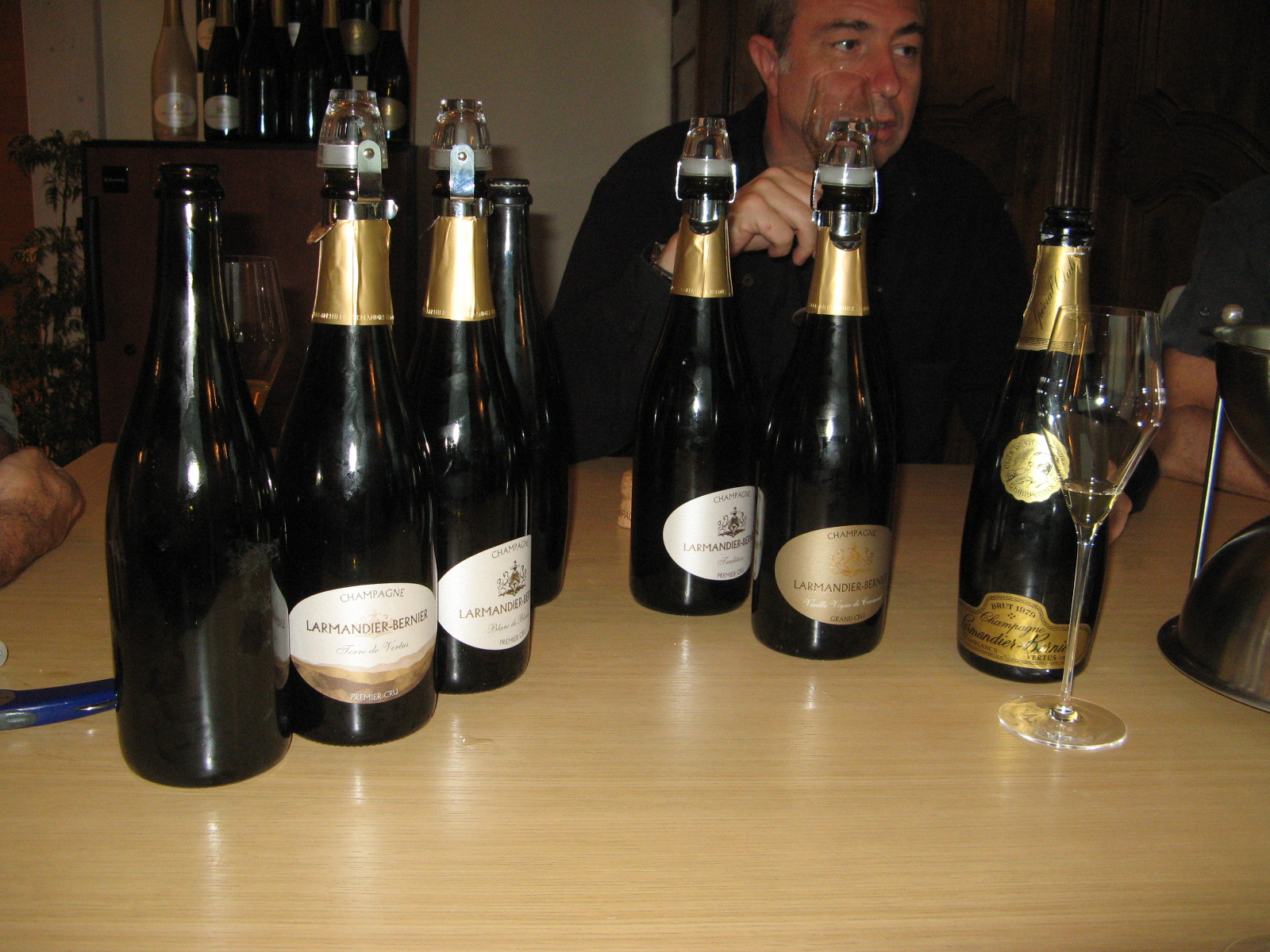
We tasted the :

Larmandier-Bernier Tradition Premier Cru NV

Larmandier-Bernier, Extra Brut Blanc de Blancs Premier Cru NV

Larmandier-Bernier, Terre de Vertus Non-Dosé Blanc de Blancs Premier Cru NV

Larmandier-Bernier, Vieille Vigne de Cramant Extra Brut Blanc de Blancs Grand Cru 2005 and 2006


    Some non disgorged cloudy 2009’s which had the scent and feel of a delicate cloudy fresh apple and grapefruit  juice.

     These were rushed up from the cellar and opened on the porch spitting their enchanting scent as they were allowed to burst out into the air when the crown cork was opened.

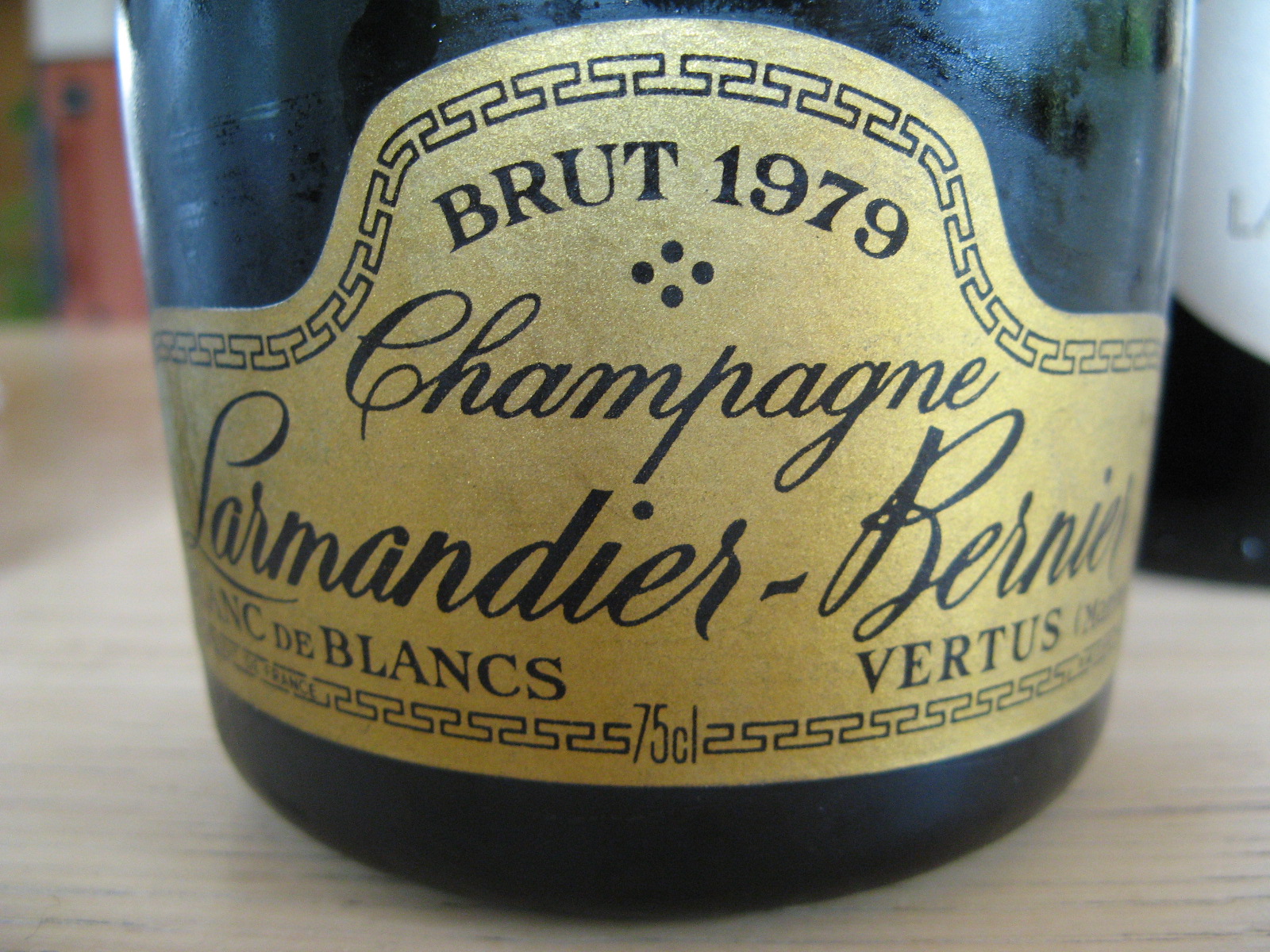
And the Brut 1979 Larmandier Bernier Blanc de Blancs

All the above are excellent champagnes each with its own character according to “pedigree” They can be described as very delicate with smooth small bubbles size, delicate to creamy mousse and excellent balance with long and lingering presence of citrus fruit and mineral touch of “Pierre à fusil” (It is the smell of heated flint or burned gun powder), aromas associated with the mineral character of the wine and that of the terroir. They are lighter champagnes when young with perfumes of flowers, slight aromas of grilled bread spread with butter, brioche and hazelnut. When getting older, they gain in smoothness, developing notes of fully ripe white pears and peaches. Wonderful precision!!!

As Pierre was preparing to fly abroad the next morning, we parted with sorrow but fully content and joyous

We are now heading to our final destination of the day to meet champagne’s “High Priest” in Aviz, Anselme Selosse, a good friend of Yair, what a lucky guy I am to have such friends.


It is hard to think of a single winemaker in Champagne today whose work is more influential on the new generation and on the philosophy of champagne production than that of Anselme Selosse. In heart he is a farmer, a wine grower, who happens to have this genius sparkle, which come to him with ease. (He answers to nobody but himself in the vineyard and the cellars…at home he answer to the wife like we all do)

I do not know him well enough but they say that his brilliance he has change the course of wine making in champagne region and that Anselme is the man most responsible for the revolution that’s taking Champagne to a new level. Since he studied oenology in Burgundy, he coined the idea that first you have to produce a great wine and only than make them into a great champagne all produced from grand cru vineyard in Avize, Oger, and Cramant.

In the winery, Selosse uses only indigenous yeasts for fermentations and by minimizing the use of SO2. He ferments his wines in wood barrels on their lees for more than 2 years, and in 1994, Gault-Millau named him France’s best winemaker in every category take that for an achievement.  Some describe him as the most original winemaker in France today, and still he goes on with his aspiration and interests and seemed to me utterly unaffected by all the Razzmatazz around him. He is friendly, humble and thank god still eager to improve the small intricacies on the path to perfection. “Chapeau”!!!!

We tasted great (young) chardonnays from the Barrels bursting with fruit and livelihood  some almost 2 years old and still expressing youth characteristic of a month old wine from a steel tank rather than a wine in an oak barrel on it’s lees.

The Champagnes: (we did not taste them all, left a few for the next visit)

Blanc de Blancs

Initial. A “classic” Brut. An assemblage of three vintages. Aged 2 years before degorgement.

Version Originale. Anselme’s great multi-vintage cuvée is aged 42 months before degorgement, and bottled with very little (1.2gr) or no dosage.

Millésime. The expression of character of a single vintage year.

Substance. The taste and character Avize’s vineyards.

Exquise. With a slightly higher dosage

Blanc de Noirs & Assemblage

Contraste. Show off with Pinot Noir from Aÿ.


There’s something very correct and precise about these wines on both the wine and the champagne stage, but it also has its “sexy” side. It is voluptuous. elegant with tons of finesse. BRAVO!

I had so many exquisite wines on the day for tasting which seldom went into the spittoon (sheer greed) with nothing to eat since last night , I was beginning to feel a bit weary and tired.

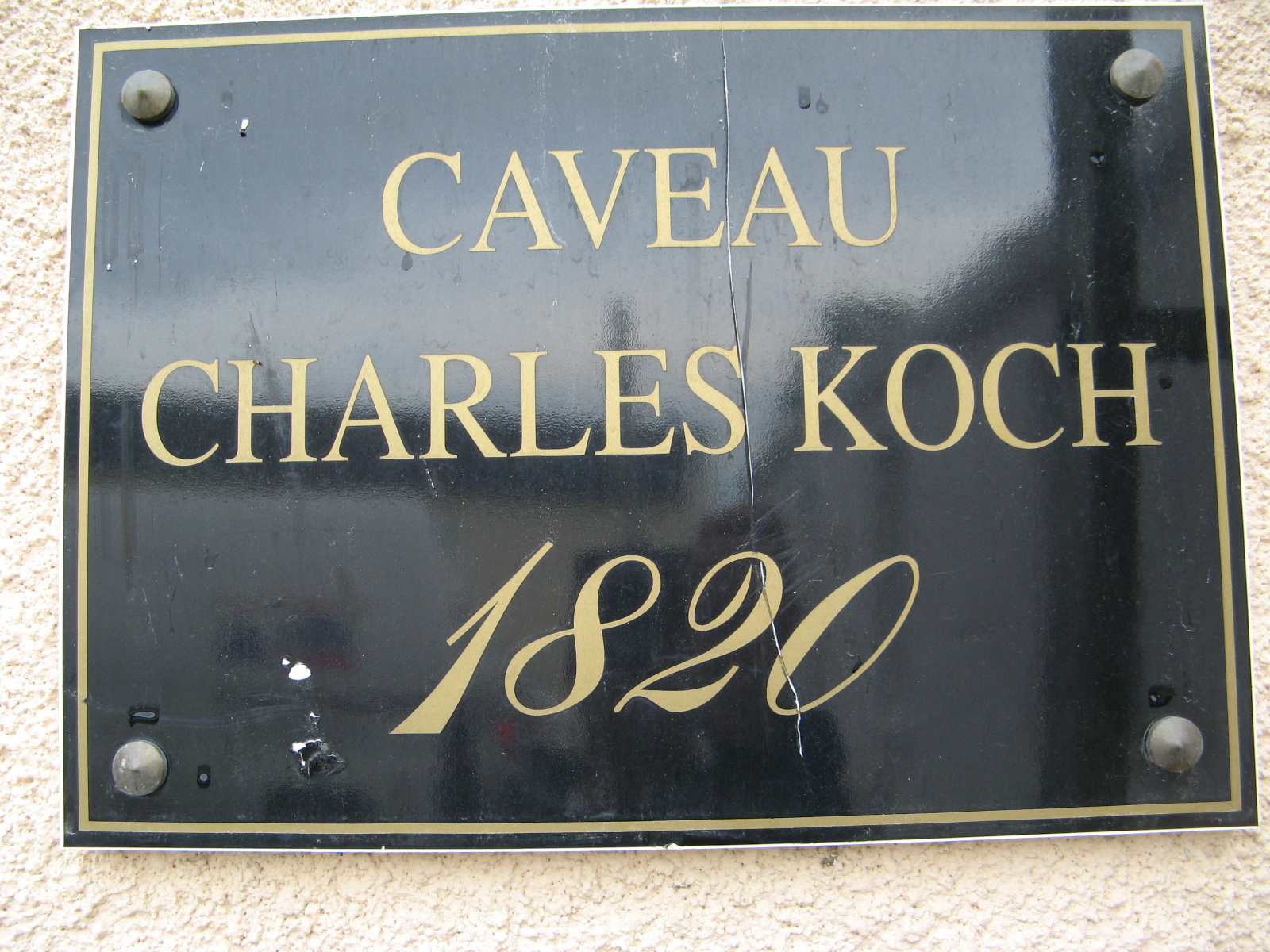
I was thankful that we were invited to spend the night, at the exquisite almost finished new hotel his wife Corinne erected.  a nice neoclassical residence linked to the production of wine CHARLES KOCH since 1820 it make you share the soul of champagne in the past with the luxuries and amenities of the present. It is a perfect place to stay rest eat with style and quality

At the moment I leave you only with the details of the Hotel (below)

Hôtel Restaurant Les Avisés – 59, rue de Cramant – 51190 Avize

Tél (33) 326 577 006 – Fax (33) 326 577 007 – Email : hotel@selosse-lesavises.com

Check the dates with reception

A separate post, about the Hotel and Restaurant will be posted in the near future.

Your wineguide

KUNLEY The Drunken saint, Ara, and the school of Non dual insight of one taste.

 Tashi Delek my dear disciples it’s your wineguide, Been to Bhutan (late April      2011)

   Tashi means auspicious and Delek means fine or well.It is quite difficult to translate properly into English, but:  “Blessings and good luck” or “May all auspicious signs come to this environment” is a good proximity to the intention of this blessing, and so… I bless you all.

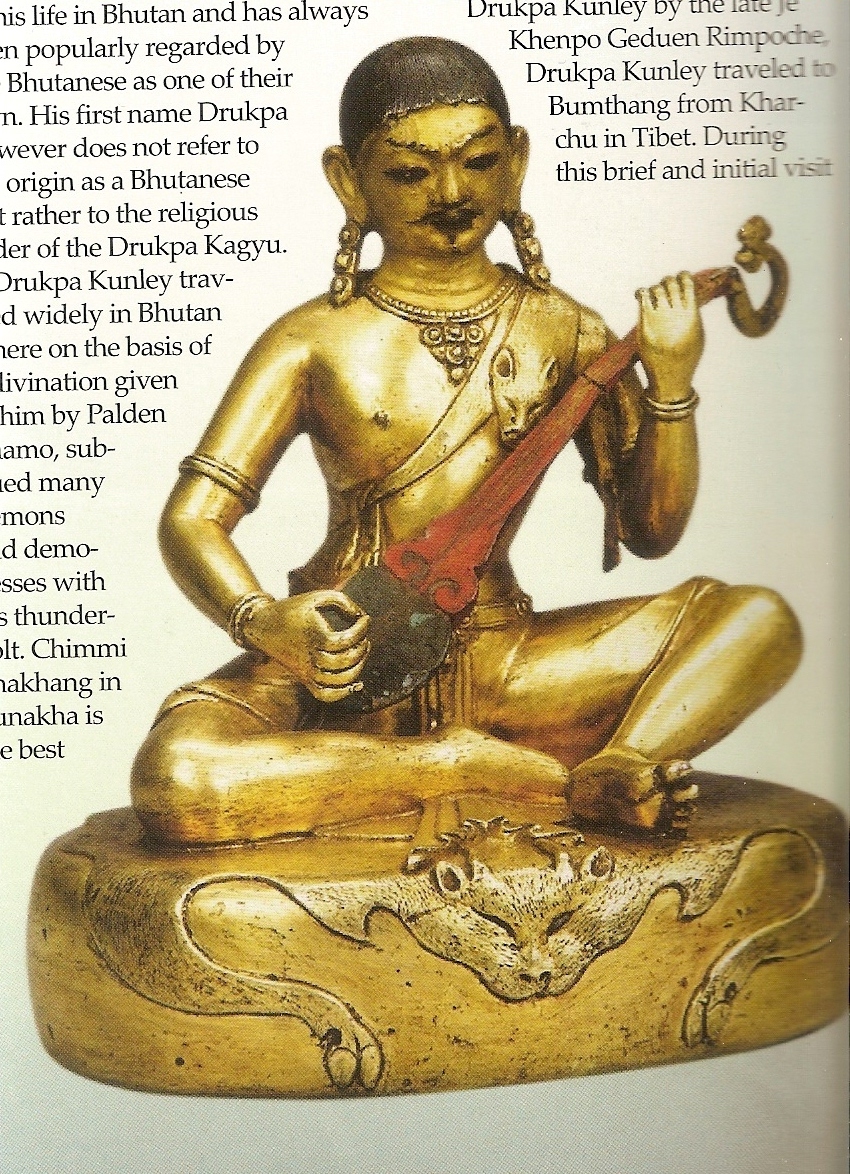
Bhutan, not a place of food or wine But… who is the most Loved and revered saint of the land? A guy who called himself “crazy dragon Kunga Legpa“, named Drukpa Kunley (1455-1529). Drukpa refers to a person from Bhutan or of Bhutanese descent. Kunley is also known as the “crazy wise” or the Divine Madman, the crazy monk the drunken monk.

   Drukpa Kunley is the patron saint of Bhutan, belongs to the Drukpa (Dragon) school of Tibetan Buddhism. He is greatly loved by all the people of Bhutan and Tibet as an enlightened master and an exponent of ‘crazy wisdom’. He taught through outrageous behavior and humor in order to awaken the people he met to a higher awareness free from conventional morality and self-obsession.

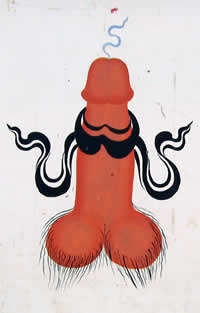
Image

He took his female friends and disciples along the path of sexual desire and relationship to free them from attachment to the illusory world and to awaken their buddha-nature. He would constantly taunt the monks with jest and insult to dissolve their hypocrisy and hidden faults.

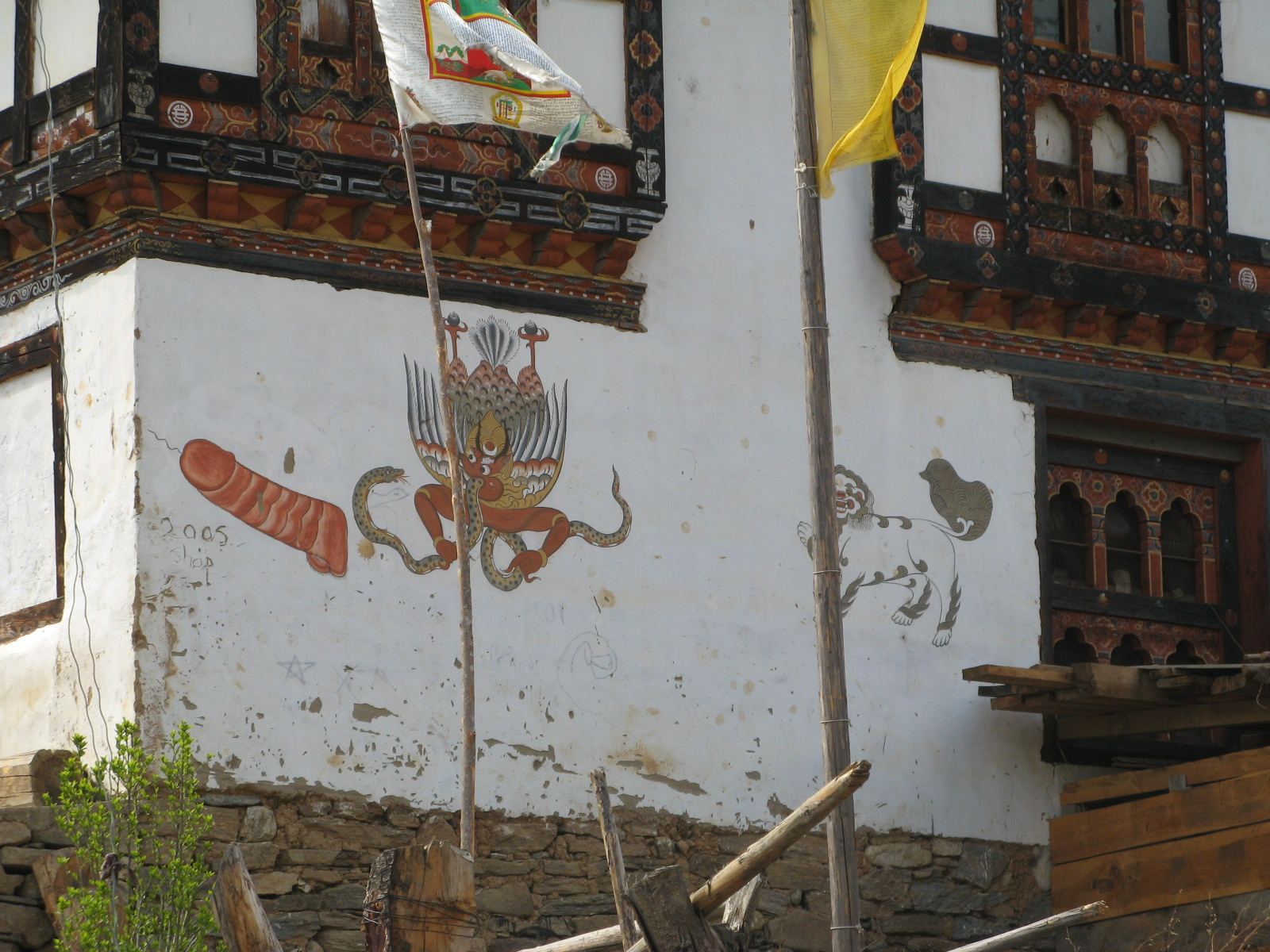
Drukpa Kunley who traveled throughout Bhutan is known to have subdued many demons of both sexes. Bhutan was full of demons who were “tamed” by Kunley with his thunder bolt (sometimes his phallus) to transfer people from the ” Dark side” of ignorance, to the side of “non dual insight of one taste” or in more simple words: The great liberation consists in being freed of the pairs of opposites (light and darkness, good and evil etc). Freed of duality-and finding instead the Non-dual One Taste that gives rise to both. This is liberation because we cease the impossible, painful dream of spending our entire lives trying to find an up without a down, an inside without an outside, a good without an evil, a pleasure without its inevitable pain, or which allows no duality between creator and created – all are reflections or manifestations of the one, which is not and cannot be an object of sense (one taste), which is the underlying reality or consciousness.

           Drukpa Kunley’s anecdotes are ribald beyond belief. Wherever he went he carried his ‘divine thunderbolt of wisdom’ (his penis) before him. It penetrated the mysteries of life as it did willing virgins. The bawdy tales of fornication and copious intake of chung wine are interspersed with words of wisdom, and attain nirvana. The god-fearing but high-living Lama Drukpa Kunley sums up his philosophy:

“The best chung wine lies at the bottom of the pail / And Happiness lies below the navel.”

As in one of Drukpa Kunley’s Teaching Songs:

‘In the rosary of my many lives
I have taken the form of every creature;
I remember it only darkly,
Yet I feel it was something like this:
Since now I thrive on chung,
Once I must have been bee;
Since now I am so lustful
Once I must have been a cock;
Since now I am so angry,
Once I must have been a snake;
Since now I am so slothful,
Once I must have been a pig;
Since now I am so mean,
Once I must have been a rich man;
Since now I am so shameless,
Once I must have been a madman;
Since now I am such a liar,
Once I must have been an actor;
Since now my manners are so rude,
and so on…

More of his tales and songs could be found in : http://www.keithdowman.net/books/dm.htm#BOOKS

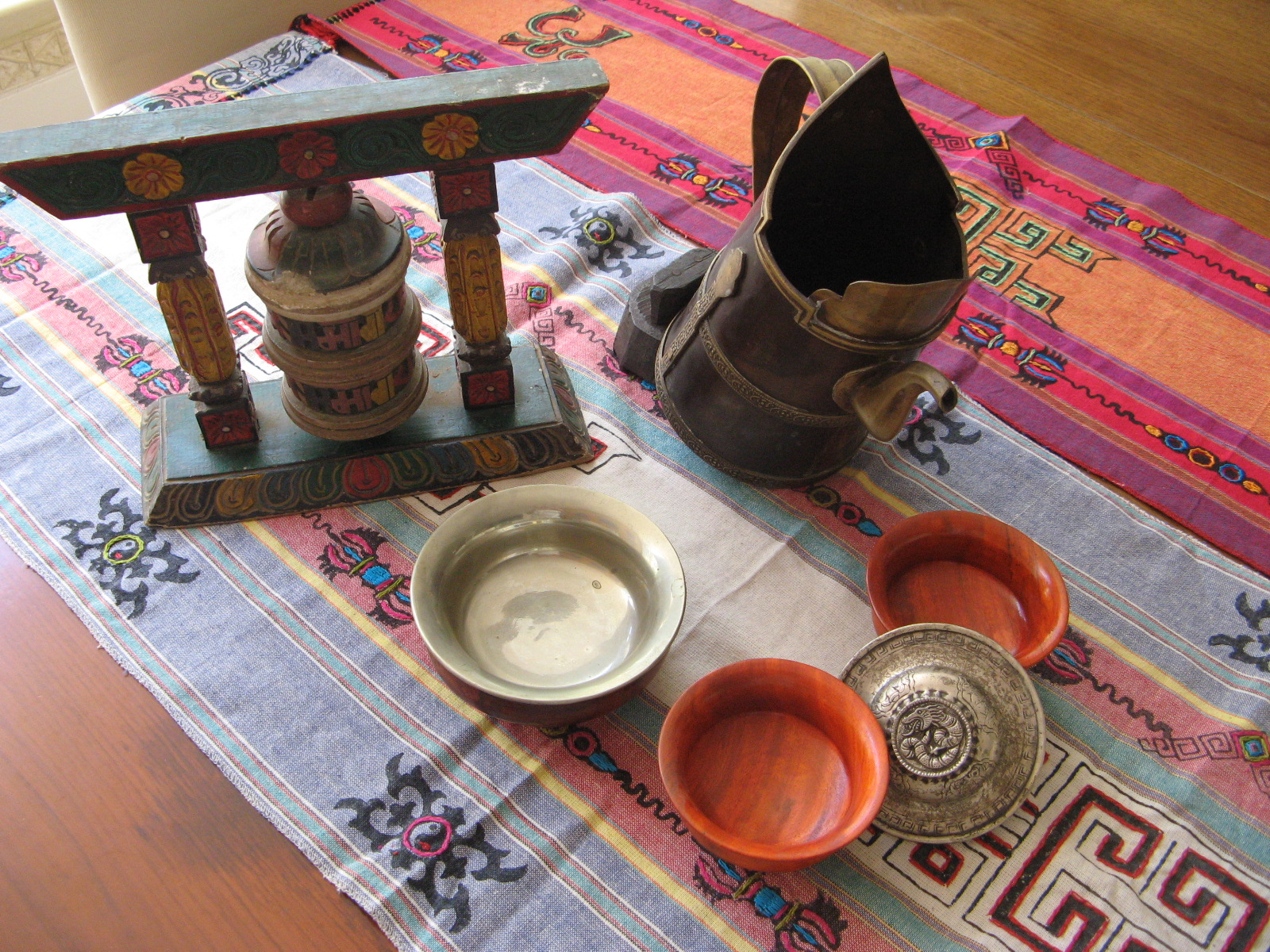
Playing the Dramyen (a traditional lute)- MUSIC, reciting stories and songs Story Telling and POETRY were two important ways to convey his teachings to all aspects of society rich and poor, uneducated and scholars.

Drinking wine was a means loosening up open to the seven stages of life: the seven original jokes, these make a “mockery” of the universe as a laughing matter, so that man will transcend it. When you have fulfilled the teaching of truth than you get the “joke” of human existence, your path must include the seven stages which are stages of laughter, each one must in turn become a great laugh to you. You must be able to feel total pleasure in the face of each stage of experience before you can go on to complete the next stage, it’s just like opening several great bottles of wine and if tasted in the right order and you are patient enough to get into the pleasure of the wine you can get on to the next great bottle that awaits you at the next stage. Too often have I participated in such events that missed their purpose because the “total pleasure” has not been reached by some pricks (who manage to ruin it also for the others), and this is not derogatory …it is served with compassion.

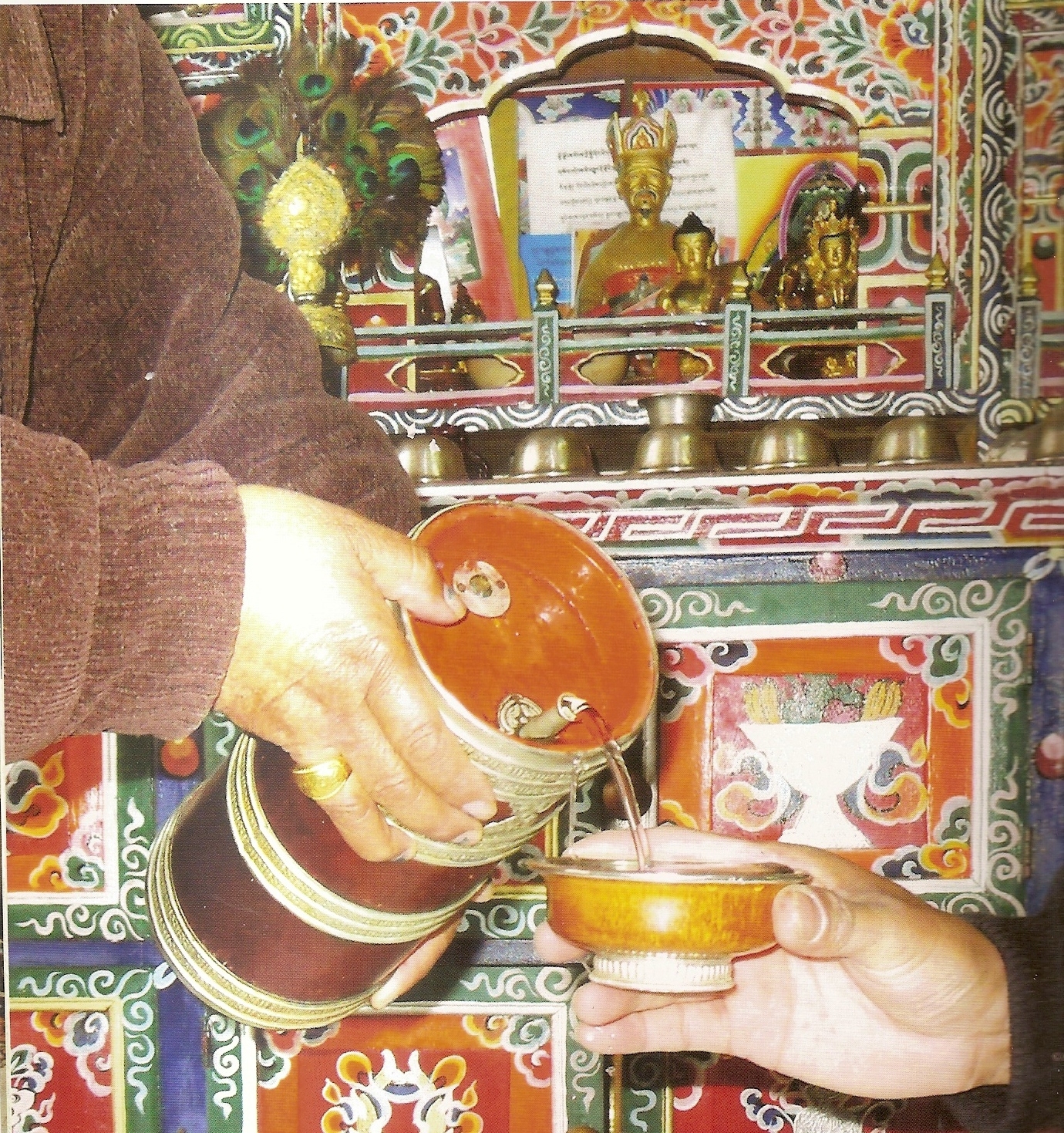
If you ask yourselves, what did Drukpa Kunley drink mostly is seems to be Ara a local brew, an alcoholic potion brewed from grains like wheat, barley, millet, maize, jowar, barja, buckwheat and rice, than undergoes a steam distillery process. Ara business (not production) is illegal to­day in Bhutan,


because Ara is mostly home-brewed so its qual­ity is not regulated, almost every family has its own Ara distillery for personal use and it is drunk everyday throughout the day from dawn to midnight from the palace to the last broken down rural hut, Every time it has a different taste, quality and special distinctive name for the occasion Dhong-chang as a reception drink, To-chang as appetizer, Shell-chang (a wash of the throat), Droe-chang during discussion and gossip, Zim-chang (when drunk as a night cap), Lam-change (is the one for the road), and khal-chang as a farewell drink, you don’t have to sweat to find a fitting occasion to drink Ara in Bhutan (if you like the drink, it has what I would call an acquired taste, it comes in various strengths from 5%-40% alcohol it is distinctly different in flavor and aroma from one place to another, from one family to the other, from the different grain it is prepared (no rules any grain or their  combination will do. It comes plain or with added flavors of local flowers and herbs poured to the glass/cup (Zapchi)


made from white or red maple trees. It is served on its own, or heated in milk butter or Yak cheese, with eggs or bone marrow, Yak dry meat and bone, fish and hornet with ginger and garlic (it stings!!!!!!).

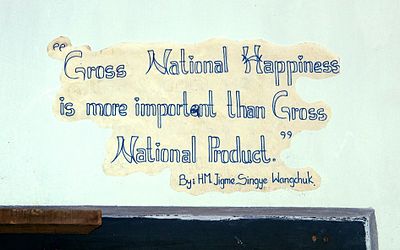
No local festival (and there are many) is celebrated without Ara , Bhutanese new year and other celebrations of private, family’ religious or secular nature all have one thing in common – ARA. Is that what keeps everybody in Bhutan happy?, they are all content, relaxed patient and polite. Probably because instead of measuring the wealth of the land in gross domestic or national product (GDP).a concept of gross national happiness or “GNH” (this is for real and it is a great idea coming to think of it).

It was developed by the former King, in an attempt to define an indicator that measures quality of life or social progress in more holistic and psychological terms and live by it, really and I wonder if Ara contibuts to this nation’s fine, happy and dignified nature. I guess Ara alone cannot do the trick.

I toast a cup of Ara and say to you khal-chang !

your wineguide

The magnificence of the Douro A Visit to Niepoort

This is our first visit to Portugal, though my love of Port (the wine), always allured me to this lovely country it is only now the opportunity of a short visit came about…

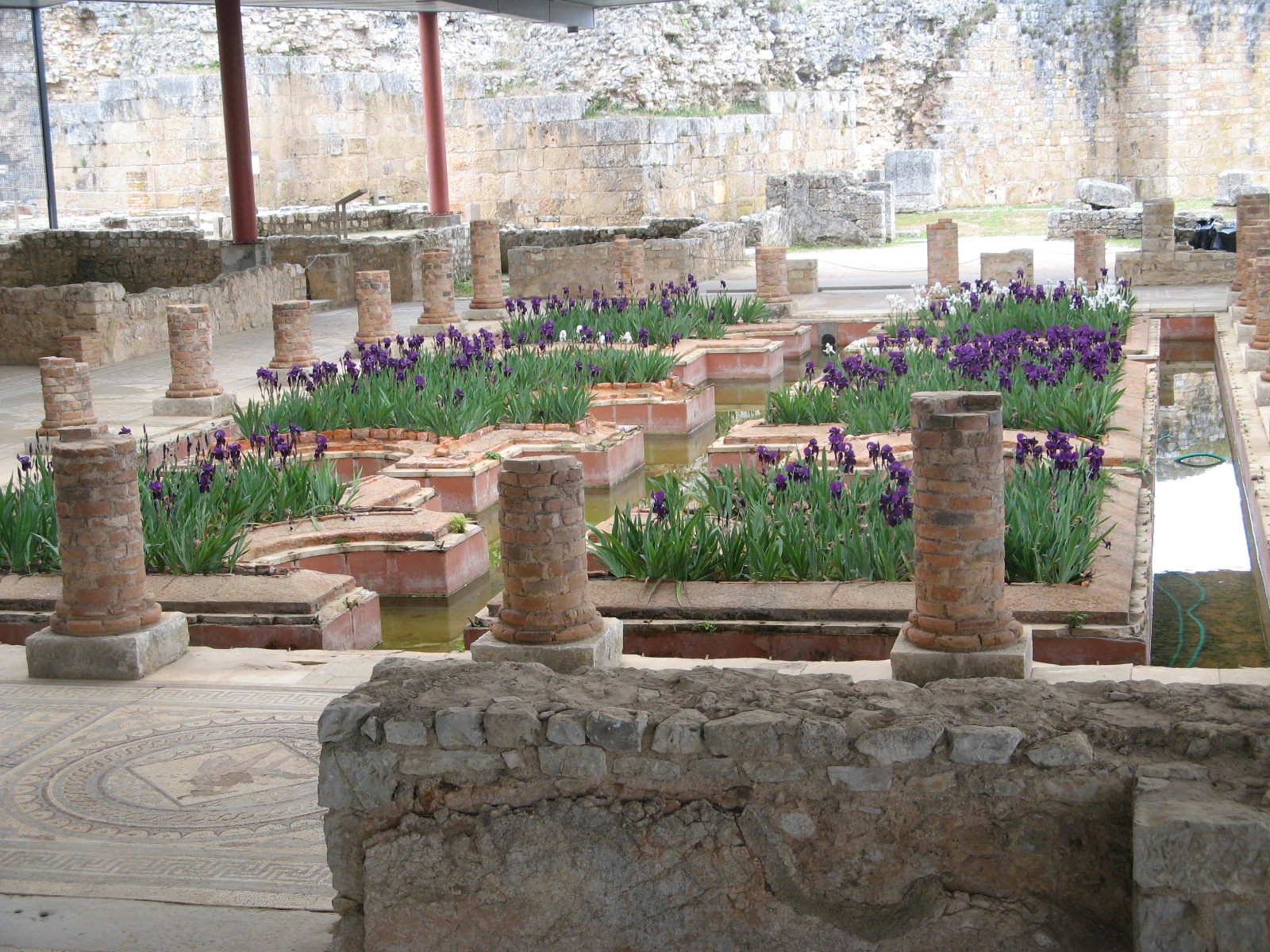
The Romans arrived here a long time before me, around the 2nd Century A.D., conquering the Celtic inhabitants and establishing cities like Conimbrigia  Setúbal, Aveiro, Obidos and Lamego to name but a few. The Romans brought wine and vines with them, and are responsible for introducing some eastern Mediterranean grape Varieties such as Muscatel Graudo, to the Iberian Peninsula. Its distinctive aroma is quite easy to recognize being one of the few grapes whose wine smells like the fresh grapes, plus scents of young raisins, lemons, tropical fruits, lime and citrus bloom. It has good, fresh acidity. Elsewhere in the world, it is known as Muscat of Alexandria, mainly used for sweet, fortified wines, most famous of which is Moscatel de Setúbal with its firm aromas of acacia blossom.


It is mid April and the fields are flowering with some wild flowers (it hardly rained this year in the Cima Corgo region, but this is an arid piece of land in European standards, still the vines are used to water shortage and hardship, and the vintners, as always complain about the weather…

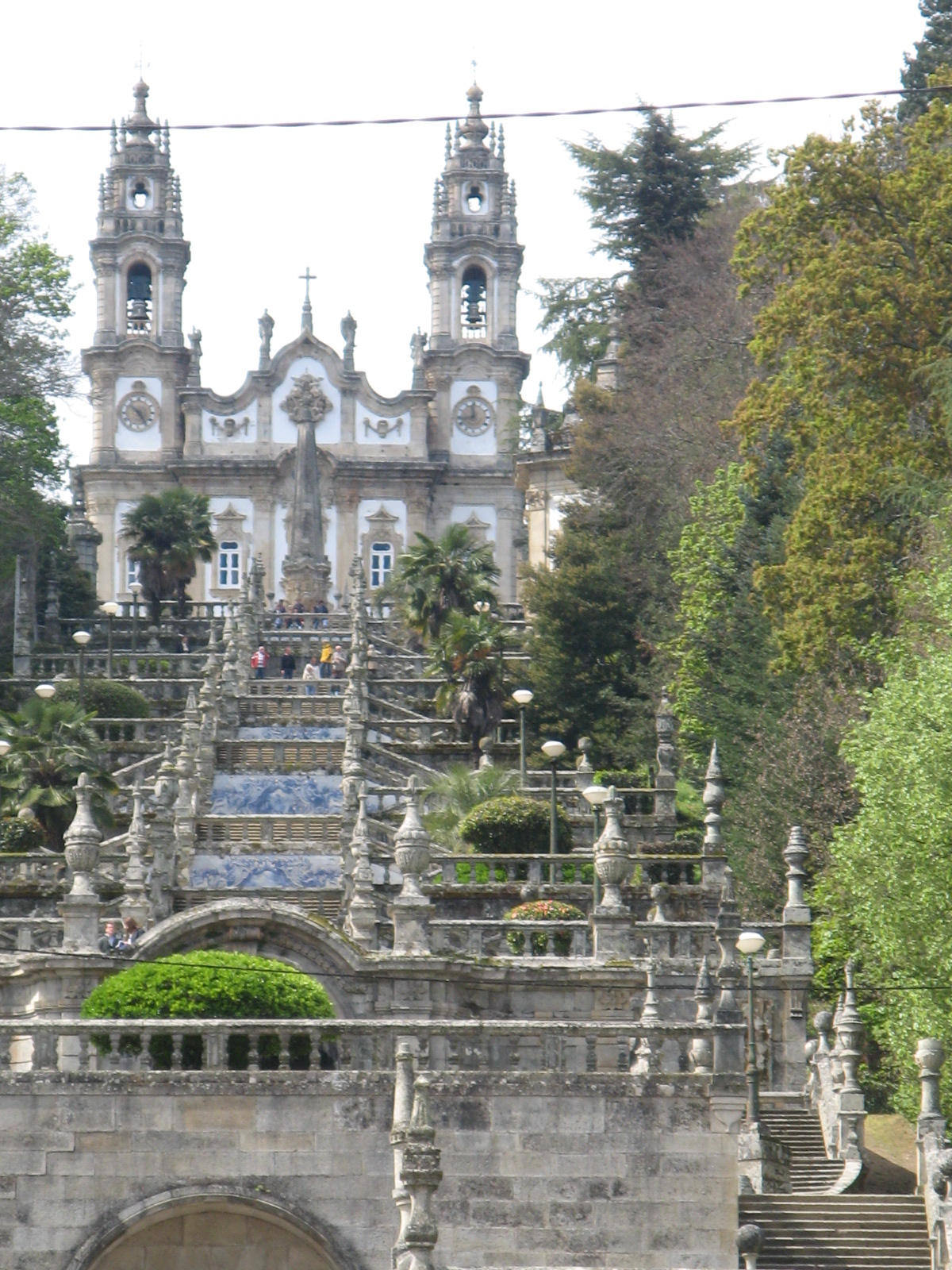
We are leaving ancient Conimrigia, the largest Roman settlement in Portugal. Driving due north and entered through the “gate” to the Northern wine regions of Portugal, via Lamego the small town with the monumental baroque Sanctuary of Nossa Senhora dos Remédios.

                                                 A marvelous granite staircase decorated with tiles, allegorical fountains, small chapels, and statues which lead to a baroque church up the hill. What a wonderful sight, with views all over the town.

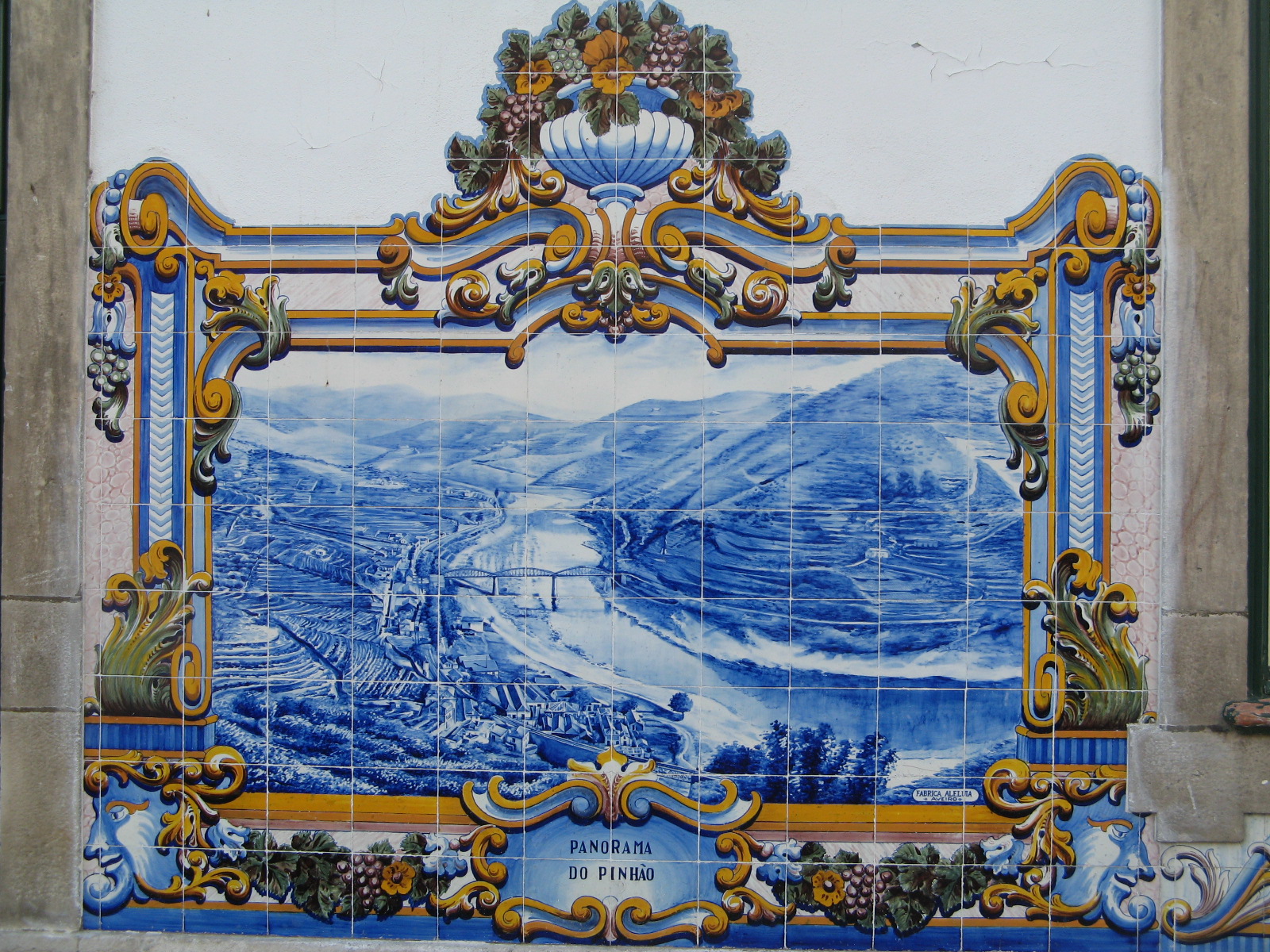
Next stop Pinhão in the Cima Corgo, one of the three sub regions that form the Duoro wine region. Cima Corgo – Located further upstream from the Baixo Corgo in the west, centered on the town of Pinhão (municipality of Alijó). The rainfall is about 600 mm a year. We’re heading towards the centre of the meticulously terraced Duoro Valley, enjoying the magnificent view of this spectacle: The oldest legally defined (AOC), wine-producing region of the world!


As a local saying goes, “God created the Earth and man created the Douro”, with its dramatic landscapes on the steep banks of the river created over centuries of human cultivation, made up of carefully terraced vineyards of the home of port wine.  the Douro Valley is breathtaking with its hills covered with terraces of vines falling down steeply all the way to the river banks. The Douro River originates in Spain and flows west in the north of Portugal until it reaches the ocean in the town of Porto.

Today we enjoy the view and some wine and Port from various producers, and a good rest in The splendid C S VINTAGE HOUSE HOTEL, on the river bank in Pinhão, tomorrow we are invited to a visit at Quinta de Nápoles Just outside the town of Pinhão. It is one of Niepoort’s acquisitions of own vineyards, with wineries adjacent to them.


We cross the river to the north bank. The winery building designed by Austrian architect Andreas Burghardt, is camouflaged in the terraced hillside. Grapes travel a short ride from the vineyards to the reception area, which is the “roof” of the winery, and from there brought down the four floors of the building. Everything is there from the clusters stage start to the finished wine stage in the basement. It seems to fulfill Dirk Niepoort’s wine making philosophy. It enables a close watch on quality control of the wine, on the wine drop level, rather than the bulk Juice that starts in the “lagares”. (A lagare is the traditional container made of granite or cement where grapes are foot pressed for juice extraction).


As our hosts Gabriela Santos and Carlos Raposo emphasized, that owning Quintas and vineyards in the Douro was an important step in the continuation of the port wine tradition and the first step for the creation of Niepoort table/dry wines. Niepoort is now at the top of Douro winemaking, I guess this is because he originates from the love of excellent wine in general, placing him amongst the leaders of the new generation of quality winemakers who combine the best of both the world, that of 350 years old local tradition with a desire to produce world class wines. Some of which we will taste shortly from the barrels and from the bottled past vintages.

Till today Niepoort, was in my mind, the winery that produces the best Colheita Ports and as it turned out it produces serious and sophisticated dry red and white table wines.

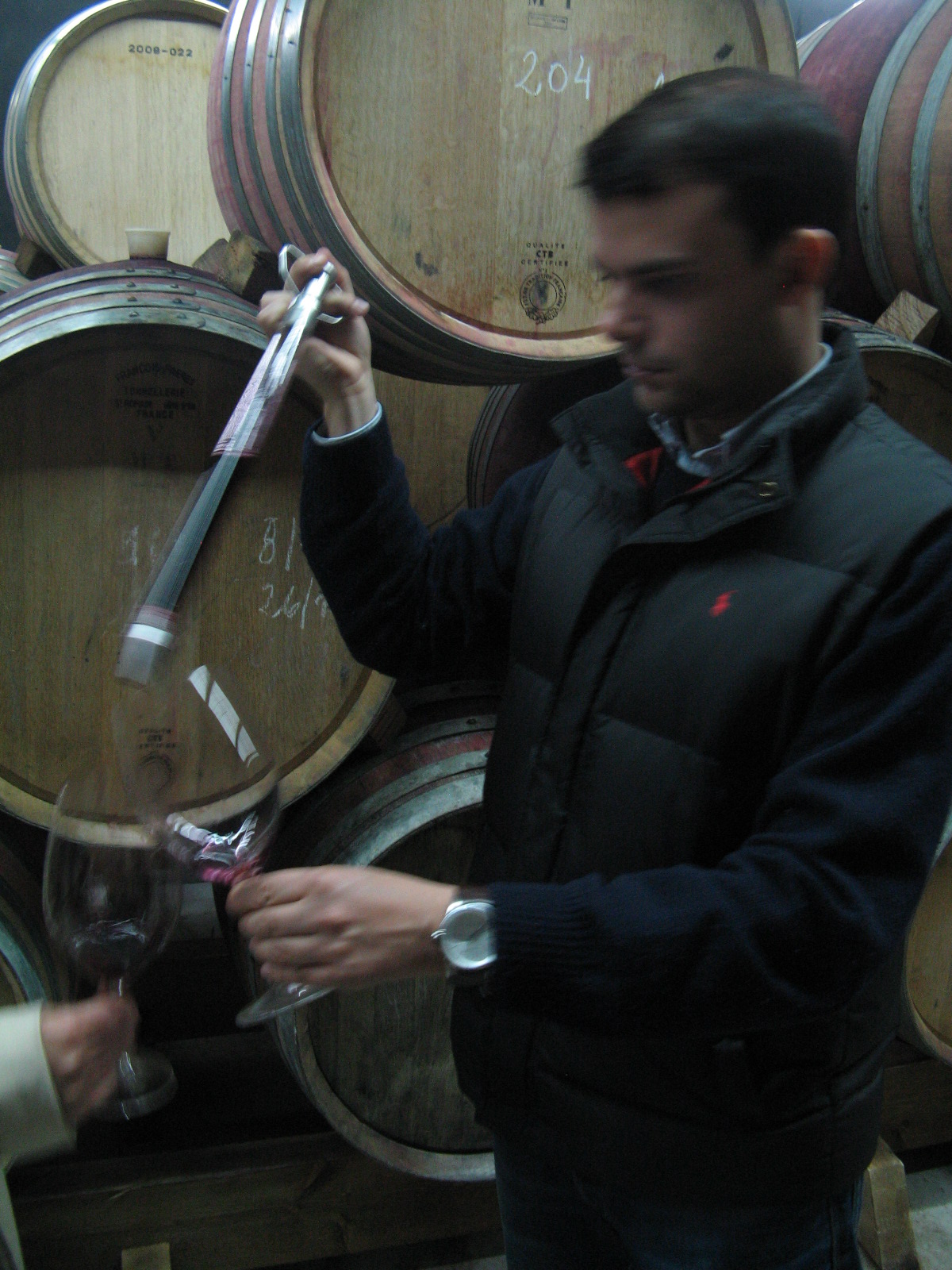
I will not bore you with the laborious job of barrel tasting we did in the barrel cellars, some of which were absolutely surprising to me as a novice to those Portuguese grape Varieties for whites: Rabigato, Codega do Larinho, Arinto, Gouveio and Viosinho, for reds: Tinta Amarela, Touriga Franca and Nacional, Tinta Roriz, Tinto Cão, and several others. The region’s geology of mica slate and schist’s soils of the region, the usually harsh climate and the fact that most wines are made from old age vines 60-100 years old and that all wines are blends.

Here is where the secret lies, and the Art shows. Lead by the winemaker at Quinta do Nápoles Luis Seabra. The aim is for blended wines which sum up to much more than their separate parts, and it works!

Food is prepared with love and attention by the Quinta’s cook Maria José da Fonseca Mansilha. Who cooks and serves and over sees the lunch country style fare meticulously presented as you can see. With us set to the table Paulo Dinis Barreto the owner of EnoMania wine Distributor from the Isle of Madeira and his friend .

We start with Redoma Branco 2010 here you find an intense mineral flinty character, combined with the a touch of grapefruit bitter flavor with a sweet finish and added aroma of citrus blossom. A bit of smoky oak aroma, that does not mask the aromatic elements of the wine. A good crisp start

We move on to the more complex Coche 2010 a great wine with substantial character, Coche shows intense red grapefruit aroma with a touch of fresia floral notes with multiple layers of flinty mineral touch. A very long multilayered  finish on the palate. A wonderful wine!

Than the reds come pouring in

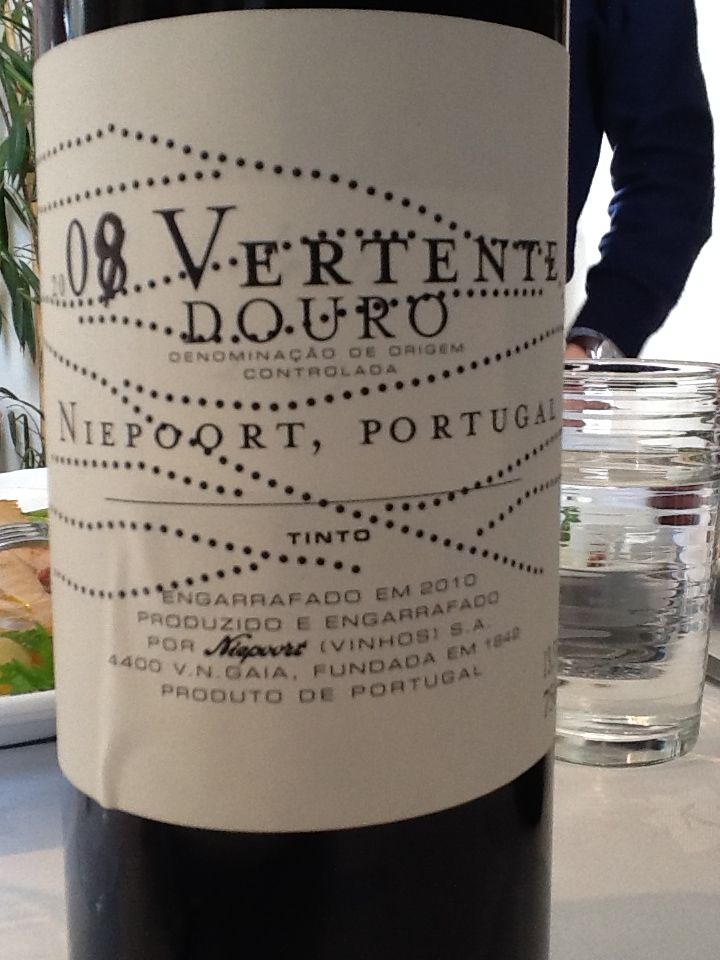
First, the Vertente 2009. It has deep and cloudy purple color. Red and black fruit aromas, a touch of green pepper with mineral finish. Good balance, and  elegant but powerful fruit with great freshness. The tannins are firm but not obtrusive. Will keep for another 5-6 years and even improve as the tannins round up.


Than came the Charme 2009 although quite Dark in color, the first thing that comes to mind when you sniff in the earthy mushroomy aroma is Bourgogne and it may well be what was on the blenders mind as the wine evolved. Even after 14 months in the barrels not every barrel is chosen to be bottled as Charme. There is an aim here and if not reached the wine will be used in other blends. The Charme 2009 is rich and elegant, with dark cherry, plums compote aromas, deep wet earth, mushrooms and a touch of truffles aroma engulfs the palate, the wine is totally hedonistic aimed at the pursuit of pleasure in the same manner a good Époisses de Bourgogne is. The finish is long with extremely good balance; tannins are well integrated and appear soft but will keep the wine for at least another 10 years. This was my favorite wine of our lunch/tasting.

But the most characteristic of the region in my mind is the Redoma Tinto 2009 Dark in color Mainly ripe black fruit aromas, with plenty of dark plums, a strong aroma of mint and thyme and of wet forest leaves. Flint stone touch and good tannic touch turning velvety well balanced with good acidity and fruitiness. The wine is very expressive almost extrovert, and rich, with very long and persistent finish. A wine true to its origin and Paulo’s favorite of the reds.

And to sum it all up, we had 2 Wonderful Ports

The Neipoort Vintage Port 2009 (Paulo’s preference for dessert).

The color is deep ruby blood red, and the aroma is all about sensuality, with freshly ground mixed sweet spices of cinnamon stick with cloves and English pepper with green cardamom. On the palate, amazing presence of huge tannins and high concentration of ripe re and black forest berries, very powerful but elegant, which is so well balanced that it seems it may keep forever (almost). I would buy a case to keep for my grandchildren and the generation to follow.

And the Neipoort 2001 Colheita (my choice for dessert).

Colheita’s are tawny Ports matured in wood for at least 7 years but most are taken even further before bottling. In Neipoort the grapes were trodden (by feet) in cast cement lagares and later the port is matured in small old oak casks. Colheita Ports are Tawny Ports from a single vintage year.

Wonderful brick reddish brown colour. It remindes the mysterious aromas of the spices street in an oriental souk. Scents of dried fruits, black shriveled grapes with burnet tea leaves, coffee and tobacco all with flavour of dried prunes and Figs in sweet liquor it has a long finish of soft and oily honeyed alcohol. A sip of that and with your eyes closed you can almost see shehrazad dancing in the palace of the Sultan. (Imagine what you see when you drink the 1900 or the 1970 Colheita! Alas we did not have that chance on the day. Maybe on our next visit)

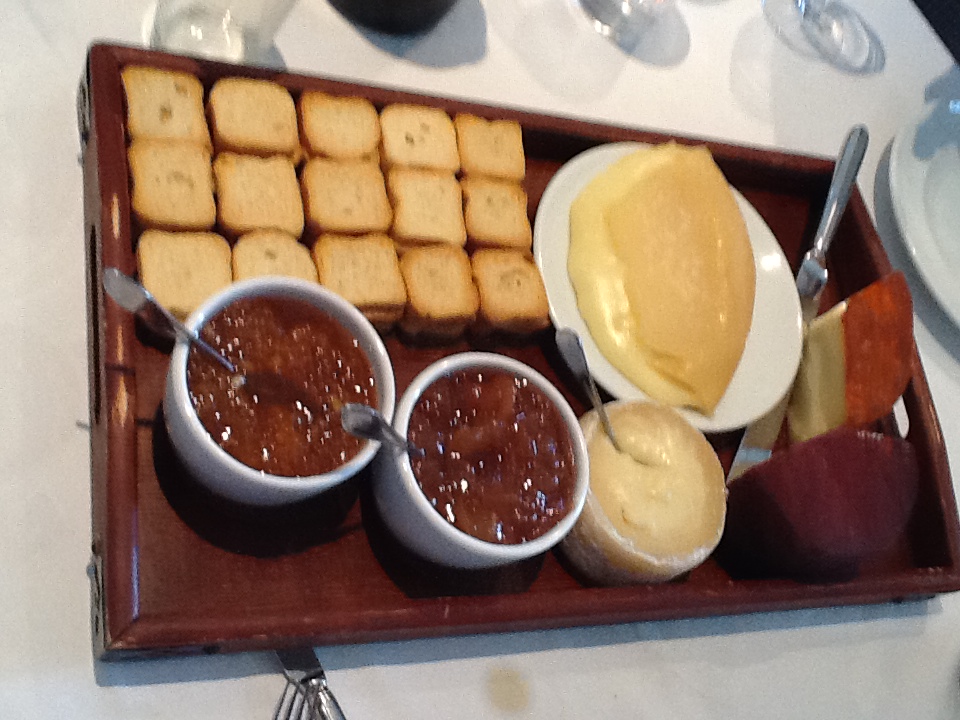
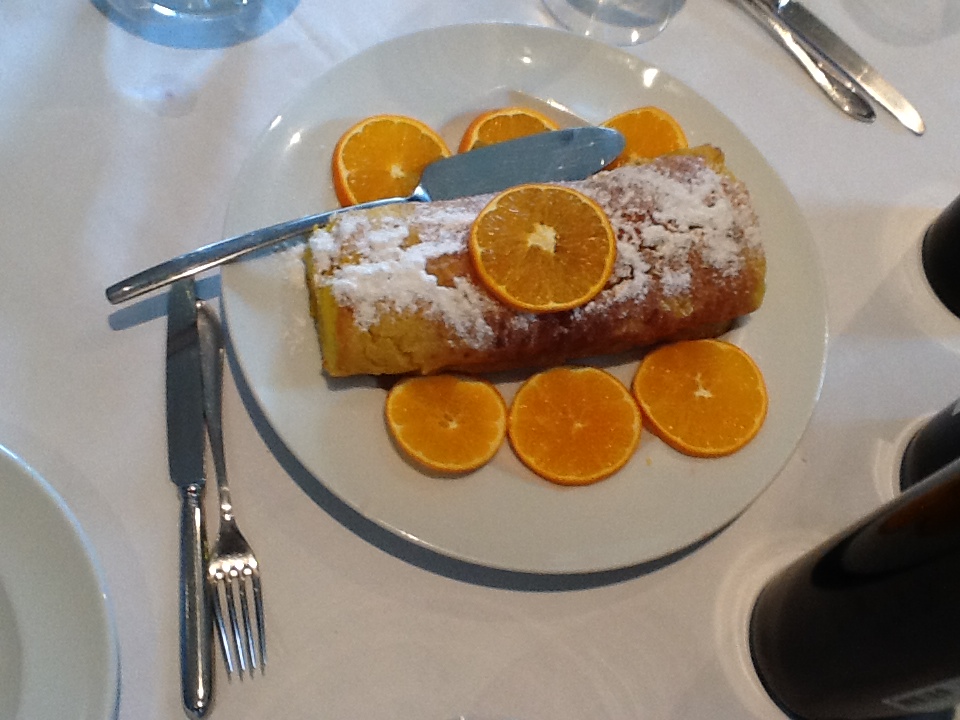
We had the Ports with the amazing cheeses and Marias Orange cake.


And had to excuse ourselves we still had 2 hours drive to Porto and a fair amount of alcohol in our blood. Vilanova de Gaia looked a far reach But tomorrow we have a plane to catch to London where for ages these wines headed across the ocean and the English channel to it’s destination on the London Docks.

We parted our wonderful hosts sorry we were not staying in the region for at least another day with the magic taste of the Ports still lingering on our palates.

Adeus Porto hasta pronto.

P.S.

The Neipoort Iphone Ipad App is on : http://itunes.apple.com/en/app/niepoort/id517958040#

The wineguide

SYMPHONY OF SENSES The Anatomy and Physiology of wine tasting

 The Cranial Nerves

The Scent of wine A Neuro-physiological study of wine perception

Part 1 The Brain

Wine making production, creation, becomes an art when all elements in the finished product are totally balanced. This of course, requires a set of strict and precise actions in all minute details from the vineyard to the winery, through the barrel to the bottle stages, which result in a refined and balanced drink with unique taste, smell and color qualities which cause the consumer, even at the glass stage a profound experience beyond a mere quench thirst.

Drinking wine can be an act meant to quench thirst: just tilt your glass and gulp. On the other hand the art of wine tasting is a challenge, an enigmatic quiz with all the clues stored inside the bottle behind the cork. To solve the quiz one needs specialized tools, all of which are “stored” in our cranium (the part of the skull that contains the brain) our 5 senses: Smell, Sight, Hearing, Taste and Touch for wine tasting you also need good memory and a colorful imagination.  Between us this quiz is a game of associations.

I know that tasting wine adds an extra dimension to the basic daily function associated with eating and drinking. It turns the act of consuming food and drink for sustenance, as a source of strength and nourishment into an act of pleasure a celebration of our senses combined in an intellectual act.


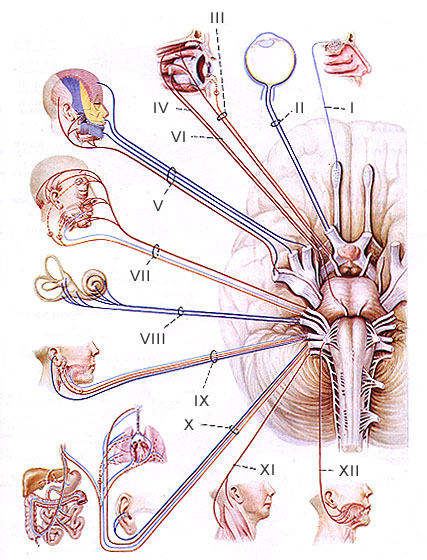
Cranial nerves are nerves that emerge directly from the brain and not from the spinal cord. In humans, there are 12 pairs of cranial nerves. Only the first and the second pair emerge from the upper part of the brain, the remaining 10 pairs emerge from the brainstem the lower connection of the brain to the spinal cord.

The Cranial nerves all have specific task to execute and are highly specialized (unlike other motor or sensory nerves that emerge from the spinal cord). Although their function is diverse and spans on many different tasks along our body,

Image

All of the 12 pairs of cranial nerves take part in the process of wine drinking and wine tasting


List of the 12 Cranial Nerves and their function

  1. 1.                      Olfactory- sense of smell
  2. 2.                      Optic- Sense of sight
  3. 3.                      Oculomotor – eyeball and eyelid movement
  4. 4.                      Trochlear  –  downwards and sideways movement of eyeball
  5. 5.                      Trigeminalchewing touch & pain of the face and palate
  6. 6.                      Abducens – eyes side movement
  7. 7.                      Facial – mimic muscles, tear glands, salivary glands sense of taste
  8. 8.                      auditory– Hearing and body balance
  9. 9.                      Glossopharyngeal– sense of taste and carotid arteries blood pressure
  10. 10.                   Vagus– Aortic pressure, initiator of digestive system,sense of taste 
  11. 11.                   Accessory swallowing action and neck muscles
  12. 12.                    HypoglossalTongue movements


The Cranial Nerves and wine tasting


Nerve No. 1  Olfactory Nerve – sense of smell well this one is too obvious. Without it you’re a goner where wine in concerned. This is one of the easier senses to “train” and improve. The smell center although small (around 2cm2), contains ten million neurons (sense cells), and can detect around ten thousand different smells. You think this is a lot? A German Sheppard dog has one billion neurons within the same size smell center.  Still as far as wine is concerned it does the Job!

Nerve No. 2  Optic Nerve The first encounter with wine is through sight. Colors, hues, clarity and depth are all perceived through the eyes, as well as your company and the surrounding of your wine experience

Nerve No. 3  Oculomotor Nerve  – Very important during wine drinking. Who knows who’s after the last sip in your glass of Richebourg 1929 DRC or Chateau Mouton Rothschild 1982 or 1945, it’s always handy to have the capacity to look around discreetly.

Nerve No. 4  Trochlear Nerve – downwards and sideways movement of eyeball, helps you see where your wine glass is before you pick it up or alas spill the above wines (and many others) on the white table cloth!!

Nerve No. 5  Trigeminal Nerve – chewing muscles touch and pain of face and palate. Very important nerve to on all aspects of food and wine, apart from chewing it controls our ability to sense Touch which is important to our taste sensation. This is where we try to feel the wine on the palate the texture, body, temperature, astringency, aftertaste, finish, and length of a wine are all things we feel on our palate cheeks and lips.  Wine’s weight (light, medium, full) or texture (silky, austere coarse, chewy velvety). Palate sensation or perception is the scales with which we judge the BALANCE of Wine.

Nerve No. 6  Abducens NerveControls the eyes side movement, carefulwho’s sitting next to you, who sneaks a hand towards you glass during conversation with the person next to you!!!

Nerve No. 7  Facial Nervemimic muscles, tear glands, salivary glands and parts of the sense of taste. It’s not always useful that everyone knows (by the expression on your face) what you really think of a wine especially if the tasting is in the winery. But what would we do without the sense of taste where would flavor be if smell and taste would not combine?

Nerve No. 8  Auditory Nervesense of Hearing and body balance. The chatter of people the clutter of cutlery and dishes the clinging of glasses the heavenly echoing sound of the perfect handmade glass of wine, cobined with the ability to keep your balance inspite of having a glass or two too many…

Nerve No. 9  Glossopharyngeal Nervesense of taste and carotid arteries blood pressure. Controles most of the sense of taste all 4-5 basic tastes. Also controls the proper pressure of freshly oxygenated blood to the brain keeping the brains analytical capacity intact.

Nerve No. 10  Vagus NerveAortic pressure, initiator of digestive system,sense of taste . This one basically keeps us alive (very important to wine tasting) not to speak of its importance in digestion of food and parts of the sense of taste.

Nerve No. 11 Accessory Nerveswallowing action and neck muscles. Without swallowing we would have to spit wine all the time and it is nice to swallow wine from time to time for some wines spitting is a obligatory some wines swallowing is a MUST. As for the neck action it’s nice to be able to nod yes to an extra top up or to nod nay if you had one too many.

Nerve No. 12 Hypoglossal NerveTongue movements, There’s no swirling of wine around the mouth without the tongue moving folding and caressing the wine. We sense we taste we smell better with the tongue moving. Needless to say we will not be able to let the “world” know what we think of the wine we have all just tasted or drunk. Speech is nonexistent without tongue movements.

Combination of bits of information provided to us through observing, looking, smelling, tasting wine Touch by tongue palate will be used as a means of helping to solve a riddle: What wine is before us?

That’s it for now , anatomy and physiology of all the different senses: vision smell, taste and touch in future Posts

YOUR WINEGUIDE
A New Years Eve Dinner

I like winter celebrations, a cause to PARTY.. A champagne festival. GREAT!

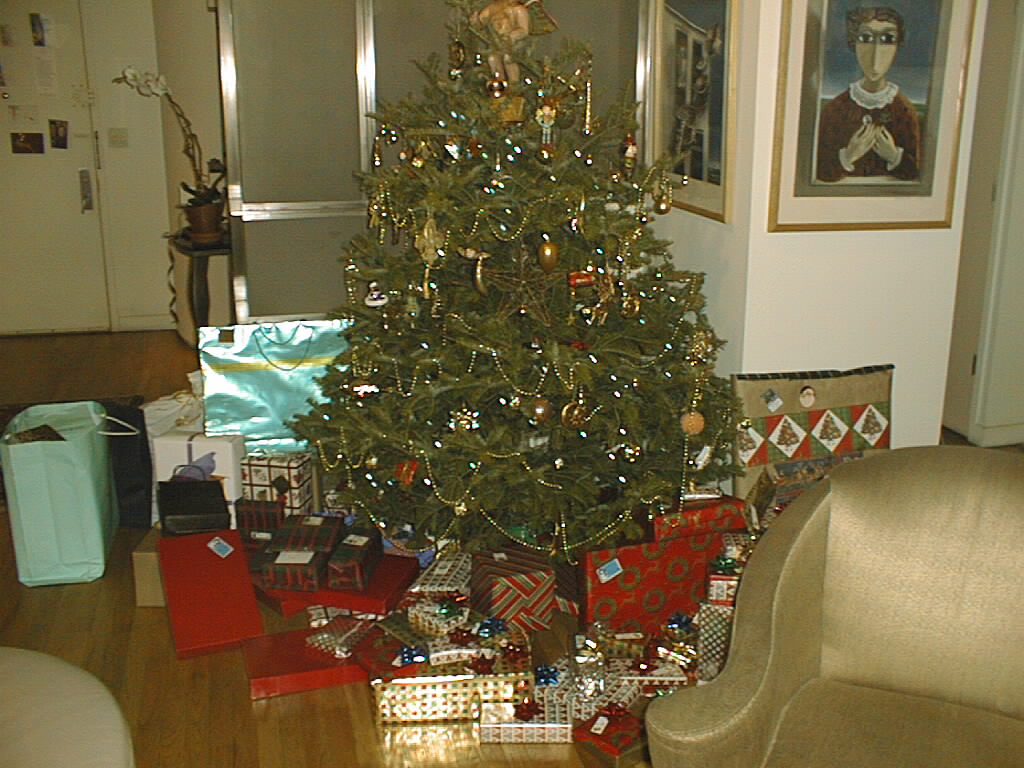
They are “A decoration of our lives”, some with trees and glittering adornments

and others with lots of presents around. There are those who would like a trip to a warm exotic place, whatever fills your life with joy and gets you through the next quarter.

I wonder if you celebrate Christmas and New Year’s time around the end of December, and Easter around end of March beginning of April (it goes by the Lunar months) what do you celebrate in mid August Napoleon’s birthday or India’s Independence (both on August 15th), or maybe Just the Kids summer Holiday or just your own Summer. Then you get to stick again to the Gregorian calendar, introduced by Pope Gregory XIII, by a decree signed on 24 February 1582 (the previous calendar was 11 minutes too short per year which means that every million years the Christian faith would lose around 21 and a half days (Oi Vei…) If you asked me pope Gregory wanted to down history with something in his hands and HE DID!!!!!!!!!!

Lets move on Just to let you know (for the next trivia Quiz you will play round the old fireplace with a glass of eggnog in your hand :

The 3 oldest calendars are :

The Byzantine 7520–7521 calendar which calculated the first day of creation to September 1st, 5509 BC to August 31st  5508 BC  ANNUS MUNDI  + 2012 = 7520/21

The Assyrian 6762

The Hebrew 5772–5773

All the above count from the “day of creation” according to their belief and calculations Nice!

Back to our own humble celebration which celebrates US.

If wine (mostly Champagne is not the issue tonight than the food will balance the occasion.

The menu:

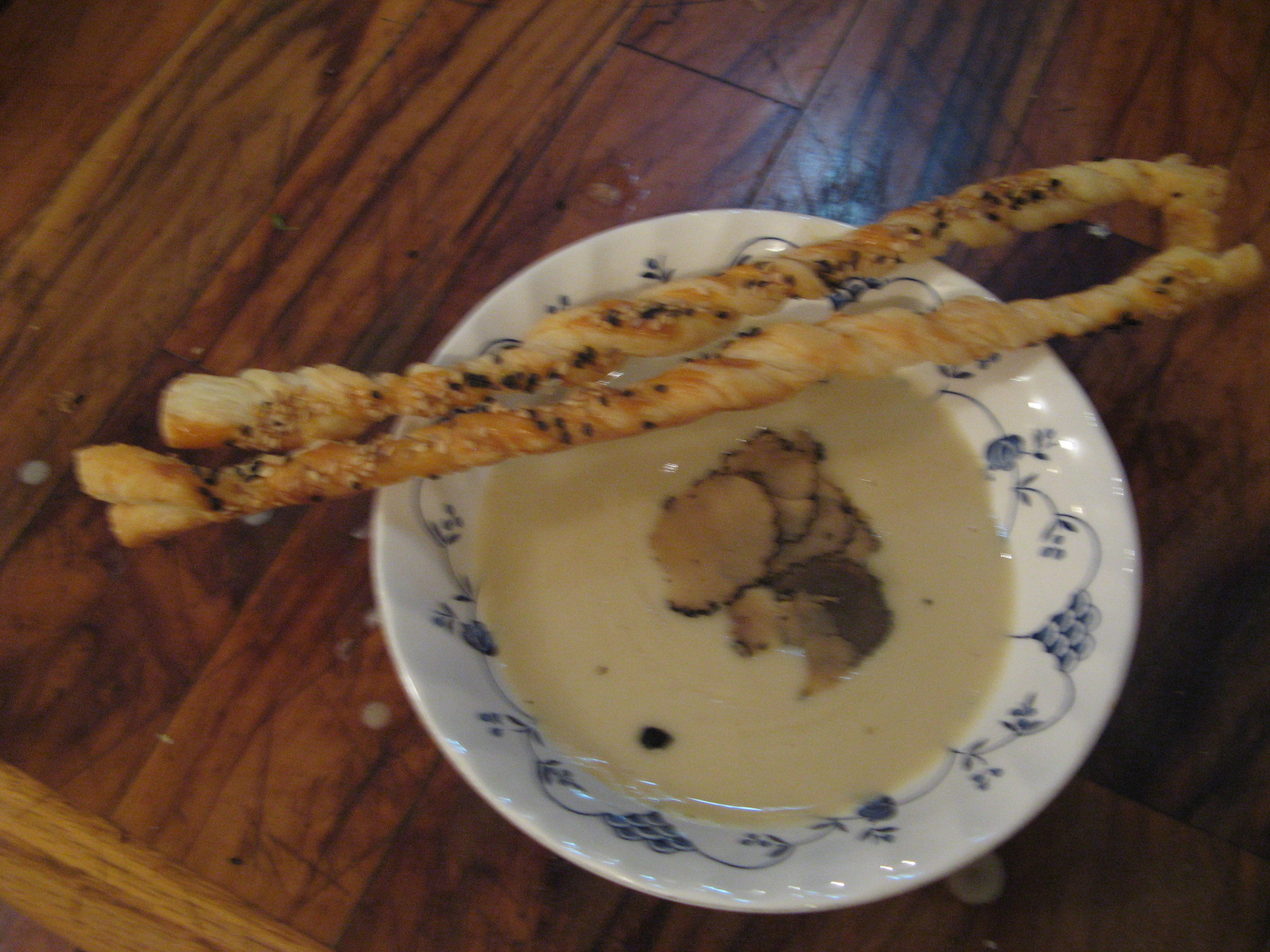
* Cappuccino of white beans with white and black truffles Home made seasame and Parmigiano grissini

  • 2 salads: Roasted endive with fresh figs, Rockfort, and Pomegranate dressing.
  • Oven Roasted Tomato sald with Tulum cheese

Tulum cheese (Turkish: tulum peyniri) is a traditional Turkish goat’s milk cheese ripened in a goatskin casing. Due to its unique flavor

* Souflee of French goat cheeses and fresh porcini mushrooms

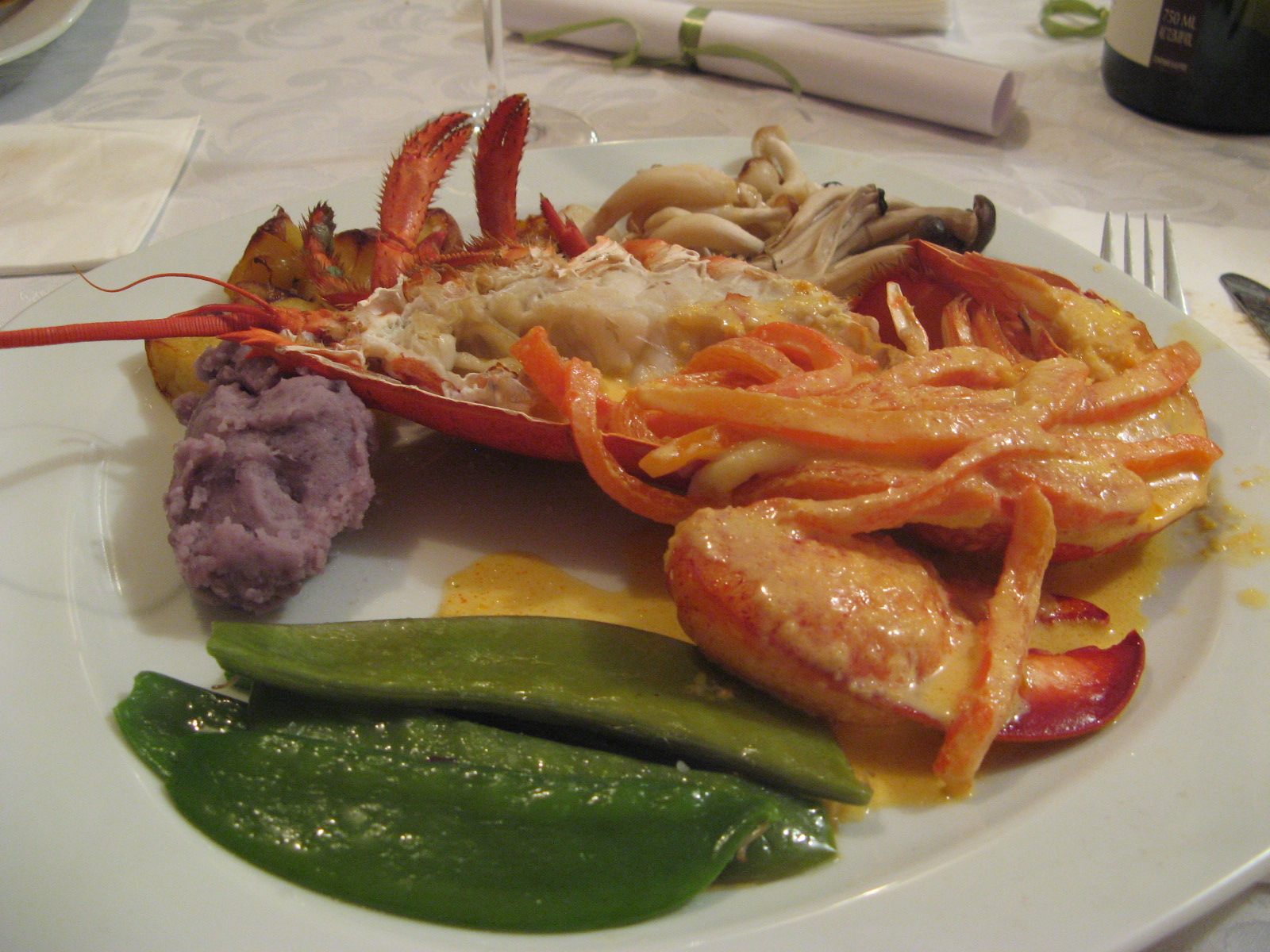
* Lobster whith cream of sweet pepers (Girardet style, I wish…..) servrd with a puree of violet potatoes, fried cubes of yellow potatoes mange tout and baked Shimeji mushrooms

Festive Macaroonsn  with Port and Coffee

Drinks:

for starters Duval Leroy Blanc de chardonnay 1999, I must admit it was not the best of choice but since all our drinks were different champagnes leading to our midnight champagne to receive the New Year it was subtle enough. The pronounced sweetness which I personally dislike was appetizing to my family members. It acted as an appetizer with salty munchies and led us

We quickly moved to Bollinger Rose NV to ease my pain of shattered expectations between us it did not but raised the level from our first champagne and took us through the salad break which gave me a chance to grt the soufflé to the table at the best possible timing

With this perfect soufflé (I must add) we had to move to a sure bet one of my favorites The Bollinger grand annee 1990 . The 1990 Bollinger has a rich, light golden hue in the glass, and nice sized bubbles. Upon pouring it reveals the full array of mature aromas, roasted almonds, toffee, even creamed coffee with burnt caramel or honey, than wet mushrooms and even earthy truffles. Full bodied, but vibrant and sparkling. It has fully evolved flavours, still nicely supported by the acidity. What a delightful wine a real mood maker and it is going very well with the mid course. The Champagne and our mid course delighted us and got us closer to the “…stroke of midnight …clock hands join palms in respectful greeting …” of the New Year (may I use and add to the wonderful opening lines of Slman Rushdie’s Midnight’s Children). So Just before the midnight hour we filled our glasses with the last bottle of one of my favorite champagnes:  1989 Heisieck Monopole Diamant Bleu , A rich lemon-brilliant gold color opened in the glass with a perfect mousse of tiny bubbles, complex elegant nose of butter fruit tart in Crème pâtissière, with a whiff of grilled almonds and buttered toasted brioche, all tender but expressive long and persistent aromas of “more” . one of the perfect examples of a perfect champagne of equal amounts of Pinot and chardonnay. The perfect opener to a new year and a wonderful accompanying drink to our desert (eaten after the 10th stroke of midnight)

With the Lobster I wanted a winner We worked our asses off to get the claws out of the shells intact (actually V. did most of th work on that she somehow got the hang of itwhich allowed me more time to look after the tails and the Lobster and sweet peppers sauce so…

So Just before the midnight hour we filled our glasses with the last bottle of one of my favorite champagnes:

1989 Heisieck Monopole Diamant Bleu , A rich lemon-brilliant gold color opened in the glass with a perfect mousse of tiny bubbles, complex elegant nose of butter fruit tart in Crème pâtissière, with a whiff of grilled almonds and buttered toasted brioche, all tender but expressive long and persistent aromas of “more” . one of the perfect examples of a perfect champagne of equal amounts of Pinot and chardonnay. The perfect opener to a new year and a wonderful accompanying drink to our desert (eaten after the 10th stroke of midnight)

Happy celebrations for whatever reason to Ya all.

Your Wineguide

Cooking at home with Yair Yossefi (October 2010)

Image

The Idea: simple enough: to cook a meal together with an accomplished Chef at my home / kitchen and have some great company and wine to complement it with…

So while shopping with Yossefi at Tomer the Butcher (of Tzook Farm) we planned the meal, first second and main courses were wrapped up in situ from the fresh ingredients on offer at Tomer’s, Still I felt like some sea food for balance and offered to prepare crystal giant shrimps rolled in Zucchini, fried in Goose fat, with froth of champagne shrimp sauce a great recipe I picked years ago from a Robuchon book, but Yossefi offered langoustine risotto and after all he is the Chef!!! so I went gladly along with the idea, I love fresh Langoust  and they’re not easy to get here… that sorted out third course, for desert we’ll have my cousin’s Dalit amazing Austrian style chocolate Gugelhopf with home mage Ice cream (the kitchen is well equipped)

The Venue: my “tastefully furnished”, kitchen and dining room at home near Tel-Aviv.

Chef: Yair Yossefi (Y.Y), my friend, with an impressive resume: worked with “greats” like, Pierre Gagnaire au 6 rue Balzac – Paris 8, and Guy Martin au Grand Véfour, Restaurant Lasserre in avenue Franklin Roosevelt  Paris  amongst others. His fingertips are burning to cook for others his palate yearning for good old Bordeaux’s (from my cellar) he’s a bourgundian buff. Since than Yossefi has opened the already acclaimed Bistro Elba t in 36 Ibn Gabirol Street Tel-Aviv                             Tel: 03-5467905

Sous Chefs:

1. Lionell Pinot (L.P), Chef de Partie de legume (vegetable peeler) and Sommelier du maison for the day. He is now the Sommelier at Elba!!

2. Me (A.S) the Wineguide, as Gaffer (ga for this ga for that) Kitchen coordinator and keeper of wine!

The food / menu :

* Roast Bone marrow (on the bone), Shimeji mushrooms, champignons, butter fried Challa (brioche style Friday bread) and radishes.

* Pot au feu Soup (consommé) with oxtail raviolis.

* Langoustine risotto foie gras cubes and grilled crayfish on a stick

* Saddle of lamb stuffed with lamb offal and herbs with butter sautéed yellow carrots


* Warm Chocolate Kugelhopf with Crème pâtissière ice cream


Selection of French cheese


The Wines: (don’t be jealous)

Welcome drink: Bollinger Grande Annee 1995, this is a highly regarded vintage by the Bollinger house. It already, shows good secondary Aromas of mushroom and a slightly burned butter toast, latter showing more cream caramel style in aroma and touch. It is so open, expressive, and forceful in character that these qualities carry through onto the palate where there are notes of honey, brazil nuts and dried mushrooms, even hints of truffles and caramelized dried orange peel. This has a great style and lots of impact, and although very evolved it has good acidity I wish we had 3 more bottles of this wine which turned to be a box of delights, HEAVEN!!!!!!!!!!!

We were hungry and thirsty so we went on to open the wine brought by Lionel the 2007 Puligny-Montrachet Louis CARILLON et Fils what a delightfull wine to start the meal with fresh and modest wine after all this is not a premier or grand cru wine but the aromas of minty peach and the finesse of the lightly toasted almonds really appealed to me but we were 5 at the table and one bottle does not go a long way in our district so we proceeded to the surprise wine of the meal, is it drinkable at all? Is it a gonner?

 After all it is a Magnum of 1962 Maison Noemie Verneaux Mersault Charmes, at best a 48 years old White wine from an extraordinary Bourgogne vintage !!! and at worst an unusable vinegar. It’s not easy to open a 48 year old Magnum with the cork “stuck” firmly by what turned to be some sort of deposits that sealed the bottle (luckily) with a hard resin like material. The wine was reborn into the glasses of all of us anticipating bunch, it started as deep gold in color with nice aromas of slightly oxidized very old bourgogne, with an excellent dry fino sherry touch, more like a good old Vin Jaune with its nuttyness but this wine for at least the first 20 minutes of his rebirth kept a fair amount of fruity acidity, as if to remind us of its origin. It was impressive and highly rewarding with depth in tertiary aromas of its nutty bouquet with austerity full bodied touch. As the time passed by the color deepened into old gold yellow-brown color almost maderized but drinkable all the time and that kept us happy throughout the Pot au feu and for some the Languste & Foie Gras, personally I would have prefered a more fresh and acidic wine for this dish. The Langustine stock was creamy and rich (without any cream added!!! (YY) the risotto was made in the traditional manner with us sous chefs having to stir constantly under the chef’s lashes. The foie gras cubes added an extra creaminess to the dish and the firm langustine inside their shells were made properly. So some opted for the acidic touch of the Hubert De Montille Volnay Les Champans 1999 with its austerity of fruit and earthy flavours it  was a good intro into the red wine part of the meal. This is a wild bunch of wine guzzlers and no drop was left to spare…

This is a meal at home so we had to rest between dishes which is fun when you have good wine to keep you happy in between and that was not a problem since the cellar is not 39 but only 8 steps away… We started with the wine and had the meat dish well into our second pouring. Lionel was yet again summoned to honor us with the opening of our first heavy duty red wine of the evening The Saint Estephe Chateau Cos d’Estournel  1986 which was prepared well in advance. This is a glorious wine from an ace Cos vintage year and a wine I had many times over the years The 1986 is a highly extracted wine, with dark ruby color and plenty of toasty, smoky  in its bouquet that suggest ripe plums and licorice. It should exhibit massive ripe fruit, with extremely concentrated flavors and has impressive depth and richness. But in hindsight maybe because it preceded our next wine, it was not to be the wine to cause all to fall off their chairs today. So we opened what turned to be the crown of the evening: Château Latour 1983. It was robed in rich, dark ruby red color slightly fading to amber. Nose with earthy, mineral scents and a seam of rich blackcurrant fruit, with a slight vegetal undertones. Medium bodied and supple. Mature, meaty flavours of plum and dried fruits, but delightful nuances of fresher violet and floral character, So many superlatives to a wonderfully balanced wine andstill fresh with a deceiving young touch even on its 27th year. The fresh fruit with mineral edge added to complexity. Very good length with a depth of fruit, properly balanced with the rounded integrated tannins. The scents of rotting mushrooms and leather soap adding to the complexity which evolved slowly in the glass into a more creamy touch of sweet dried figs compote with cinnamon and cloves. Another sigh of content was heard around the table and before long whilst we were still having our second helping of the perfectly prepared juicy Saddle  And what a wine The Chateau Latour 1983t was! a perfect complement to the dish and more…

 I had to take the 8 steps down the pirate ship plank to the cellar to get a wine to match or at least complement the wonderful LATOUR, my selection of Bordeaux’s is not bad for a wine cellar in a remote place, still this is a choice that has to be made quickly my guests are not a forgiving crowd…,, so I decided we would move from Paulliac to what in my mind the best Saint Emilion grand Cru Chateau. The Chateau Cheval Blanc 1988 which on its own would have been what I have on my previous tasting notes from the past: Deep shiny Bordeaux colour, looks younger than its age, with powerful, concentrated bouquet of Blackberry and blackcurrant and very spicy black pepper and cloves.Subtle oak and a slightly toasted. Very elegant and refined wine with good concentration and a classy Cheval-Blanc character. Very well balanced on the palate with freshness (reminiscent of minty green peppers), and firm tannin, but today it was shadowed by the Latour.

Press play to watch Video:

The meal was glorious but as you can see it was a meal to complement a night of wine sampling rather than wines that suited a meal, that in fact does not take anything from our enjoyment of the food or our gratitude to the chef and his efforts.

Thank you Yossefi for agreeing to cook in an unfamiliar surroundings Luckily you brought you own posh chef’s knife. Thanks to Lionel, Meirav, Shaul, for the company and the insights into their impressions of the wines and Vive La France and King John for making Bordeaux (when at best) what it is. Thanks for Riedel glasses that kept the wonderful scent of the Latour well after the glasses where empty and into the desert.

Perfect wine and the Paradox of perfection

Image

We had a perfect meal; we drank the perfect wine … What is perfection? When is perfection? Is there perfection or near perfection in food or wine?
Let us try to define perfection: is it conforming absolutely to the description or definition of an ideal type: a perfect sphere;? Or is it: excellent or complete beyond practical or even theoretical improvement: a perfect meal, or is it: entirely without any flaws, defects, or shortcomings: a perfect dish; the perfect wine. . What is perfect?

Image

The oldest definition of “perfection”, goes back to Aristotle. In the Metaphysics, he distinguishes three meanings of

the term perfect, or variations to one meaning, but in any case three different concepts
1. Which is complete — which contains all the requisite parts;
2. Which is so good that nothing of the kind could be better;
3. Which has attained its purpose
The parallel existence of two concepts of perfection, one strict (“perfection,” as such) and the other loose (“excellence”), has given rise — perhaps since antiquity but certainly since the Renaissance — to a singular paradox: that the greatest perfection is imperfection. This was formulated by Lucilio Vanini (1585–1619). The paradox of perfection is that imperfection is perfect, applies to cooking and oenology in the same manner it applies to technology. Thus, the irregularity in semiconductor crystals (an imperfection, in the form of contaminants) is requisite for the production of “perfect” semiconductors. (loosely aided by WIKI) The solution to the apparent paradox lies in a distinction between two concepts of “perfection”: that of regularity, and that of utility. Imperfection is perfect only when that irregularity is useful. In short, very often the accumulation of small imperfections lead to perfection
But before the Renaissance paradox there was the fact.

ImageThat of Dualism and “Daoist” or “Taoist” belief that the “whole” is a combination of its contrasts: there’s no good without evil, light without darkness Yin and Yang…Hence the perfection of the whole is relying on the imperfection of its parts. Eastern philosophy does not look at the imperfections within the “perfect” as a paradox, but rather as a ,, where two opposites co-exist in harmony and are able to transmute into each other. So balance is what it is all about!!

Think of “…the wine is perfectly balanced” or “…the dish is well balanced” or even “…an amazingly balanced meal ” these all contain numerous balancing factors which are often opposing to one another in character shape taste flavor aroma and color, are not necessarily in even quantities and their assembly creates the “Perfect” balance which is a combination of a variety of imperfect irregularities that contributes to the perfection of the end product be it wine dish or a whole meal (with or without the wine).. The solution to the apparent paradox lies in a distinction between two concepts of “perfection”: that of regularity, and that of utility. Imperfection is perfect in technology, in the sense that irregularity/imperfection is useful. This applies always to cooking and wine making. The term “perfection” is actually used to designate a range of diverse concepts. If perfection is, broadly a state of completeness and flawlessness and in food and wine balance is the “gate” to perfection let us look (in this post), at the components in the balance of wine: A balanced wine is considered to be in proper harmony of acidity, fruit, sugar and tannins. A wine may show many good characteristics, but it will not be complete in other words perfect!!! unless it is balanced.
Balance is a wine characteristic quite unrelated to flavor of wine, it means that the alcoholic strength, acidity, residual sugar, and tannins complement each other so that no single one of them is obtrusive on the palate.(from The Concise wine companion, by Jancis Robinson). All the imperfect components “meet” to create perfection i.e. the perfect wine! A paradox? Not at all. Why? Because anyone of us had a perfect wine on a day or a perfect meal and not just once but we tend to “describe” it always as a “near perfect” I guess we are afraid to “reach” perfection, after which none would look or taste or smell the same?
Should any great wine be the Nadia Comanechi of wine? A perfect 10 on all counts?

Or is a perfect wine, the wine you felt was perfect for that moment? Personally as a complete hedonist I prefer to sense a special wine I am having as a source of pleasure and self-gratification. Therefore I had and will have many perfect wines. I am not sure that all the “perfect” wines some of which listed were always perfect on the occasion (some of which I “heard” of and some I did have), like Chateau Cheval Blanc 1928, 1947 0r 1961? Fonseca Vintage Port 1927 1948 1977? A bottle of Krug 1982 or Mouton Rothchild 1945? Latour 1982 or many other that are considered top scorers, perfect wines 100 points from all directions, many of which I had over the years were perfect on the occaison for various reasons, but rather a wine you had which at the time and till this very day is unforgettable hey? Like the Roumier. Chambolle Musigny. “Les Amoureuses” 1982 I used to have as a special treat and every time whichever the occasion was had this magic touch of a perfect wine,

Image

or a 1995 Bollinger that knocked me down with its completeness and is not up there with the so called or considered “greats”, or La mission Haut Brion 1976 some of which were waiting in a dark corner down my cellar and was a celebration and had the grandeur of a mythical genie in a bottle, or the 50 bottles of NV Krug and 6 magmums of Cos d’Estournel 1986 I served at my 50th birthday, even the oxidized 1962 Maison Noemie Verneaux Mersault Charmes I had not long ago with friends had all the components that make a great wine certainly after 48 years in the womb/bottle. So many others come into mind of good (that’s all) wine bottles that were perfect on the day.

Image
I feel lucky to have had the chance to have them with the company of people I like or with just the right food and never on my own! A perfect wine bottle is something to share and admire in company not alone!

The Wineguide is urging you to write in your very own perfect wine or wines. It is a great pleasure to relive those moments, Try it and see.
I await for your “perfect wines” with anticipation and curiosity.

The Wineguide